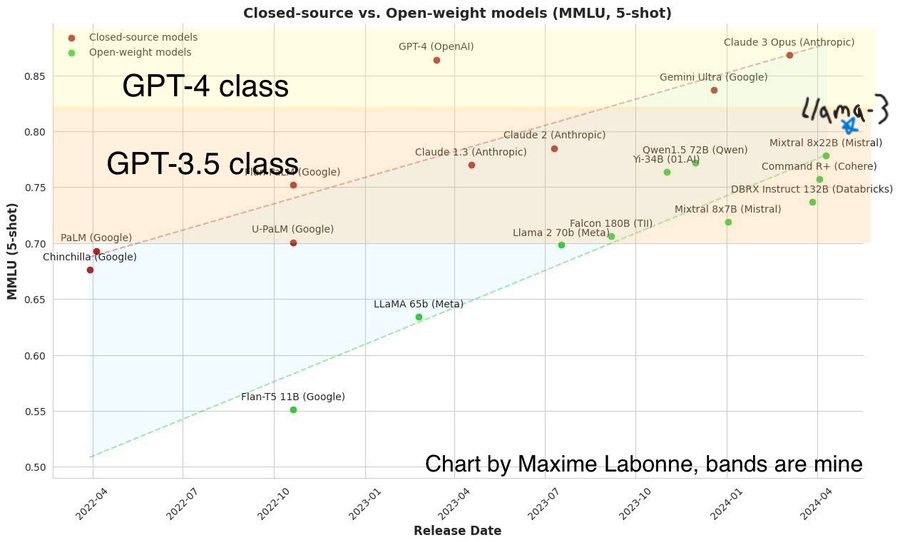
Meta (formerly Facebook) has recently released LLaMA-3, a series of foundational large language models (LLMs) that aim to advance AI research while remaining more accessible in terms of computational requirements.
Performance
LLaMA-3 models demonstrate competitive performance on various language modeling tasks, showcasing significant improvements over previous open weights models.
Integrated free across their social media platforms
Fast image generation, can be fine tunes for creatives.
LLaMA-3 models are notably smaller than comparable LLMs. They were more efficient to train.
Sizes are currently:
7B parameters, outperforming the previous 70B models on some metrics
70B parameters, approaching or exceeding some closed source online models
400B parameters (still in training), expected to outperform SOTA models
This efficiency allows them to run on less powerful hardware, broadening accessibility for researchers.
They can be fine tuned more easily.
Bias and Safety
Meta has taken active steps to assess and mitigate potential biases and harmful outputs. This is usually “undone” by the community at some stage for performance gains, raising important questions.
Open-Source Focus
Meta’s release of the LLaMA-3 weights and code under a non-commercial license fosters transparency and encourages research collaboration.
Acceptable Use Policy
Open Source Controversy
Llama 3 is claimed to be open source but faces criticisms.
Licence restrictions may not meet the Open Source Initiative’s definition.
Restrictions on free use, modification, and redistribution.
Acceptable Use Policy (AUP)
Applicable to Llama 2, but also underpins Llama 3 license.
Prohibits:
Law violations.
Infringement of third-party rights.
Misuse of sensitive information.
Emphasizes compliance across jurisdictions.
Lacks specifics on consequences for policy violations.