Nwosu, cofounder of Coinfloor exchange in the UK, and cofounder of the aforementioned Fedimint and says that a digital money needs the following four characteristics:
that it be technically mature.
it should have strong community support and network effect. We have seen that this is more simply a feature of money itself.
that there should be regulatory clarity around the asset, a feature which even Bitcoin currently struggles with.
it should demonstrate a core use case of ‘store of value’ which sounds simple enough, but again is contestable because of the volatility of Bitcoin.
Spending it
Since this book seeks to examine transfer of value within a purely digital environment it is necessary to ask the question of whether Bitcoin is money. This short ‘story’,purportedly written by Nakamoto, is a fabulous look at the money values of the technology, irrespective if it’s provenance. In it is the following text:
“Here, for once, was this idea that you could generate your own form of money. That’s the primary and sole reason, is because it was related to this thing called money. It wasn’t about the proficiency of the code or the novelty, it was because it had to do with money. It centred around money. That is something people cared about. After all, plenty of projects on Sourceforge at the time were just as well coded, well maintained, if not better, by teams, and even if someone else had created the blockchain before me, had it been used for something else beyond currency, it probably would not have had much of an outcome.
Again, irrespective of the author here, this point seems to ring true.The memetic power of Bitcoin is in it’s proximity to ‘money’, and the potential of the separation of money from the state.
It is beyond argument that the Bitcoin network is a rugged message passing protocol which achieves a high degree of consensus about the entries on it’s distributed database.
Ascribing monetary value to those database entries is a social consensus problem, and this itself is a contested topic. The most useful ‘hot take’ here is that Bitcoin behaves most like a‘property’,while it’s network behaves far more like a monetary network which is created and supported by the value of the Bitcointokens.
Jack Mallers, of Strike presentation to theIMF identified thefollowing challenges which he claims are solved by the bitcoin monetarynetwork.
Speed
Limited transparency and dependability
High cost
Lack of interoperability
Limited Coverage
Limited accessibility
He further identifies the attributes of the ideal global money.
Uncensorable
Unfreezable
Permissionless
Borderless
Liquid
Digital
Mallers has recently announced USA focused partnerships which leverage his Strike product to enable spending Bitcoin, through Lightning, as Dollars in much of the point ofsale infrastructure in the USA. This is a huge advance as it immediately enables the vendors both online and at physical locations to either save 3% costs for card processors, or else pass this on as a discount. Crucially for ‘Bitcoin as a money’ it also allows the vendors to receive the payment asBitcoin, not Dollars. A possible further and highly significant feature is that it might now be possible to divest of Bitcoin in the USA, buying goods, without a capital gains tax implication. Mallers claims to have legislative backing for this product, but the devil will likely be in the detail. The likely mechanism for this product is that the EPOS partner sends a Lighting request to Strike, which liquidates some of their Bitcoin holding to a dollar denominated stable coin, but in a tax free jurisdiction such as El Salvador. This stablecoin will then be sent to the EPOS handing partner such as NCR. Stablecoin to Dollar transactions in the USA are much murkier and likely don’t cost anything for these companies. This agent will then authorise the Dollar denominated sale to the American digital till. Crucially nobody has a US capital gains tax exposure in this chain, and all of the settlements were near free, and instantaneous, with ‘cash finality’ for everyone except the EPOS company. They are likely actually exposed to a small risk here because uptake will be very low level. The novelty opportunity will likely cover any potential exposure to stablecoin collapse. This isa radical upgrade on the normal flow of divesting Bitcoin for American users.
Using this open product to spend Bitcoin as Bitcoin to vendors might be available through Shopify globally. Again, it’s too new to be sure. Promisingly a Deloittestudy has found that 93% of businesses accepting Bitcoin have seen revenue and brand perception improve, and 75% of USA sales execs plan to accept digital assets at some point in the next 2 years. This ambition in the US markets is likely to benefit from the proposed $200 tax exempt law for purchasing goods and services with Bitcoin.
Of these recent developments in Lightning Lyn Aldensays:itSome people naturally dismiss [strike] because they don’t want to spend their BTC; they want to save it. However, the more places that accepted BTC at point of sale (on-chain or Lightning or otherwise), the more permissionless the whole network is. This is because, if all you can do with BTC is convert it back into fiat on a major exchange, then it’s easy to isolate it, effectively blacklist addresses, etc. But if you can directly spend it on goods and services across companies and jurisdictions, it’s harder to isolate. There are now plenty of vendors that make this easy for merchants to implement, and the merchant can still receive dollars if they want (rather than BTC), or can decide their % split. Since it’s an open network, anyone can build on it, globally. And then when you add fiat-to-BTC-to-fiat payments over Lightning, it gets even more interesting because it doesn’t necessarily need to be a taxable event. Lightning wallets with a BTC balance and a USD/stable coin balance. Lower fees than Visa and others.
African adoption
Africa has one of the most fragmented banking, payment, and currency systems in the world, which makes simple financial tasks like paying a bill, sending money, or accepting money extremely difficult. Over half of Africa does not have access to a bank account, so people hold and save everything in cash, which is often stolen and loses value due to inflation. It is also difficult to get money in and out of many African countries because only about 40% of people have active internet access, and must rely on financial institutions. Bitcoin is being used in Africa as an alternative form of money that resolves these issues. It is being taught in education centers in underdeveloped areas, giving children the opportunity to learn about and use Bitcoin as a way to access financial services that have been unavailable to them for generations. However, the rest of the country may have difficulty implementing the use of Bitcoin due to issues such as a lack of electricity and internet access, as well as government policies that centralize power.
Bitcoin based FIAT
More interestingly for metaverse applications Mallers has opened this section of the company to interact with the public Lightning network, allowing people with a self hosted wallet or node to pay directly for goods across America, settling immediately in Dollars, using their Bitcoin, at zero cost. This opens the possibility to buy from US based(Dollar denominated) metaverse stores, using the capabilities of the stack assembled at the end of the book. The implications globally are unclear at this time.
Stablesats is another approach which uses exclusively lightning bitcoin but makes the value stable against the US dollar using an algorithm. This is a very interesting option and will be explored in detail at some point.
The following paraphrases Eric Yakes, author of ‘The 7thProperty’. Again, this is an Austrian economics perspective, and like much economic theory the underlying premise iscontestedmaurel2012keynesian:it“Paper became money because it was superior to gold in terms of divisibility and portability BUT it lacked scarcity. People reasoned that we could benefit from the greater divisibility/portability of paper money as long as it was redeemable in a form of money that was scarce. This is when money needed to be “backed” by something. Since we changed money to paper money that wasn’t scarce, it needed to be backed by something that was. Since the repeal of the gold standard, politicians have retarded the meaning of the word because our money is no longer backed by something scarce. So, what is bitcoin backed by? Nothing. Sound money, like gold, isn’t “backed”. Only money that lacks inherent monetary properties must be backed by another money that maintains those properties. The idea that our base layer money needs to be backed by something is thinking from the era of paper money. Bitcoin does not require backing, it has inherent monetary properties superior to any other form of money that has ever existed.”
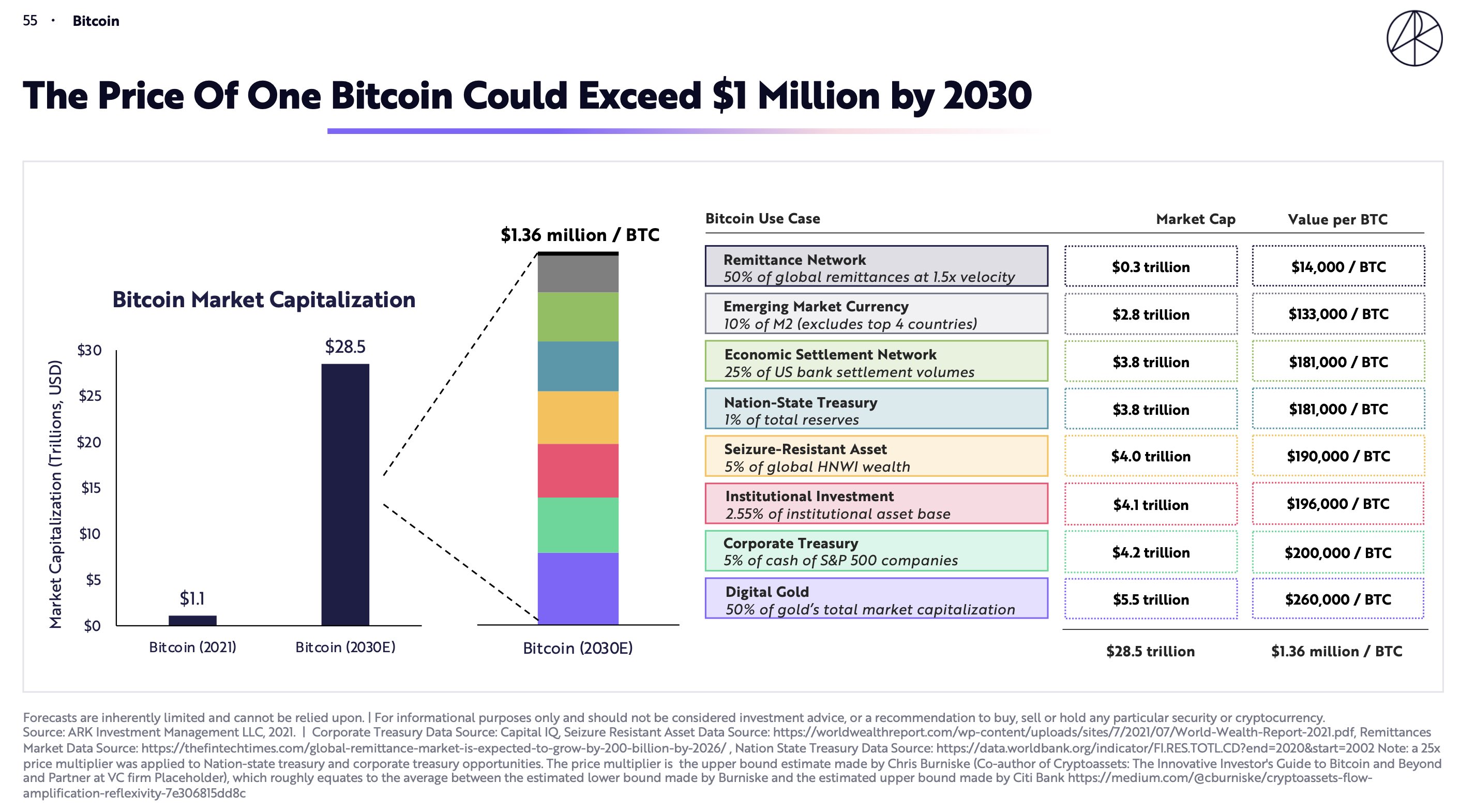
The 2022 ARK Big Ideas report again provides some useful market insight. They posit that demand for the money features of Bitcoin could drive the price of the capped supply tokens to around 1M pounds per Bitcoin as inFigure4.5.Take this with the usual pinch of salt, as Ark have been performing notably badly lately with their predictions.
Potential market exposure to Bitcoin as a money
Perhaps more than any of these takes, it is worth considering the current public perception of the technology as a money and store of value. This twitterthread from professional sportsman Saquon Barkley, to his half million followers on the platform, captures the mood. He is one of a handful of athletes now being paid directly in Bitcoin.
it“I want my career earnings to last generations. The average NFL career is 3 years and inflation is real. Saving and preserving money over time is hard, no matter who you are. In today’s world: How do we save? This is why I believe in bitcoin. Almost all professional athletes make the majority of their career earnings in their 20s. With a lack of education, inaccessible tools, and inflation, a sad yet common reality is many enter bankruptcy later on. We can do better. We need to improve financial literacy. Bitcoin is a proven, safe, global, and open system that allows anyone to save money. It is the most accessible asset we’ve ever seen.”
This ubiquity of access is what probably most distinguishes Bitcoin. Previously it could be argued that only the most wealthy could access the ‘means’ to store their labour without loss of value over time(through inflation). To be clear, inflation is an important part of the money system, somewhat within the control of the central banks, and approximate to taxation. It applies equally to all holders of the moneys upply. Asserting that money should be replaced by a ‘hard asset’ such as Bitcoin, in the place of the more controllable utility of money, is likely both a fantasy, and wrong minded. This conflation of money and property is a confusion caused by Bitcoin’s proximity to money, and it’s‘ money like’ network, and is extremely commonplace.
These narrative takes are all rooted in the popular idea that Bitcoin isa ‘hedge against inflation’; an increasingly fragile take, as the price plummets with global markets. The Bitcoin community seems somewhat confused about the nature of money, which is predictable because we can see in these sections that money is pretty confusing. Money is the fluid, elastic,cagan1958demand and thin ‘working credit’ layer on top of historical human production, which provides transaction convenience, and tools for credit. Value is effectively swapped in and out of this layer through the actions of central banks, controlling inflation into acceptable margins. Simplistically this is done through manipulation of interest rates (the easiness of credit), quantitative easing (buying of assets) and quantitative tightening (selling of assets). To give a quick high level view of central bank activity we can use the PESTLE framework:
Political:
Government policies and regulations can impact central banks by influencing monetary policies.
Political stability and government credibility can impact the confidence in central banks and currency.
Economic:
Economic growth and inflation rates influence central bank decisions on monetary policy.
The level of debt and balance of payments can impact a central bank’s ability to control monetary policy.
Sociocultural:
Consumer behaviour and demographics can influence demand for money and credit.
Attitudes towards saving and borrowing can impact the economy and central bank decisions.
Technological:
Technological advancements can change the way money is distributed and managed, such as the increasing use of digital currencies.
Technology can also influence the accuracy of economic data, affecting the decisions of central banks.
Legal:
Central banks are subject to laws and regulations, such as those related to banking and finance.
Changes in laws and regulations can impact central bank policies and operations.
Environmental:
Environmental factors, such as natural disasters, can affect the economy and central bank decisions.
The focus on sustainability and reducing carbon emissions can impact the decisions of central banks.
Fiat money is primarily it not a long term store of value, as Austrian economists perhaps believe it should be. This function is left to assets. The Austrian thesis of ‘hard money’ (which cannot be ‘debased’ by government action) seems somewhat naïve when one considers that credit exists anywhere in the world (ie, the creation of paper money through loans) then this would be used to buy up a hard money asset in the long run, causing a scarcity crisis. This is what happened to gold in the middle of the last century.
Fundamentally, Bitcoin isn’t money (in the traditional sense) because it’s not an IOU, which money certainly is. It’s a bearer instrument, novel asset class, with money like properties, as identified above. As said again and again it functions most like a ‘property’ which can be invested in by anyone, with all the attendant risks of that property class to the holder. Lyn Alden says it sits somewhere between a saving tool, and an investment, acting as “programmable commodity money”.
Andrew M. Bailey says it“in an ideal worldwhere governments honour the rights of citizens, they don’t spy, they don’t prohibit transactions, they manage a sound money supply, and they make sound decisions, the value of bitcoin is very low; we’re just notin an ideal world”
Another potentially important differentiating affordance is censorship resistance. There’s really nothing else like it for that one feature. With that said Bitcoin is only a viable ‘money like thing’ when viewed in the layers described in this book, and elsewhereBhatia2021.The base chain layer is an apex secure store of value. Whatever layer 2ultimately emerges is the transactional layer which could replace day today cash money, while the hypothetical layer 3 might be useful for complex financial mechanisms and contracts operating automatically, and also provides the opportunity for using the security model of the chain to support other digital assets, including government currencies through stable coins. All these things have a natural home in borderless social spaces.