A neural network trained to predict scalar rewards for model outputs based on human feedback, used to provide learning signals in reinforcement learning from human feedback (RLHF). The reward model serves as a proxy for human preferences, enabling efficient optimisation without constant human evaluation.
Semantic Classification
Content
- A neural network trained to predict scalar rewards for model outputs based on human feedback, used to provide learning signals in reinforcement learning from human feedback (RLHF). The reward model serves as a proxy for human preferences, enabling efficient optimization without constant human evaluation.
4️⃣ Direct Preference Optimisation Direct Preference Optimisation
- Description: *DPO dramatically simplifies the whole thing.
- Explain: Removes the reward function, and so the human in the loop.
- Paper: Direct Preference Optimization: Your Language Model is Secretly a Reward Model (arxiv.org)
- In operation: Proprietary Large Language Models:
4️⃣ Direct Preference Optimisation Direct Preference Optimisation
- Description: *DPO dramatically simplifies the whole thing.
- Explain: Removes the reward function, and so the human in the loop.
- Paper: Direct Preference Optimization: Your Language Model is Secretly a Reward Model (arxiv.org)
- In operation: Proprietary Large Language Models:
Core Models
- Available on GitHub, this model is optimized for speed and efficiency,
- Suitable for generating images quickly, especially on less powerful hardware.
- Higher resolution, better prompt control
- Will often mess up human bodies due to constrained training
- More resource intensive
Reinforcement Learning from Human Feedback (RLHF)
- Human-rated outputs train a reward model, and reinforcement learning techniques fine-tune the LLM to maximize these rewards, enhancing output quality [RLHF: https://arxiv.org/abs/1706.03762].
- Decision models, trained on human preference data, guide the LLM towards preferred outputs, incorporating logic that reflects learned preferences [Decision Transformers: https://arxiv.org/abs/2106.01345].
Supervised Fine-Tuning
- Human-rated outputs train a reward model, and reinforcement learning techniques fine-tune the LLM to maximize these rewards, enhancing output quality [RLHF: https://arxiv.org/abs/1706.03762].
- Decision models, trained on human preference data, guide the LLM towards preferred outputs, incorporating logic that reflects learned preferences [Decision Transformers: https://arxiv.org/abs/2106.01345].
- Moreover, the potential for further refinement techniques like safety and alignment measures, knowledge distillation for model efficiency, and the use of benchmarks for evaluation is highlighted, suggesting areas for future expansion and research [Knowledge Distillation: https://arxiv.org/abs/1503.02531; SuperGLUE Benchmark: https://super.gluebenchmark.com/].
More Results
Once the IP-Adapter is trained, it can be directly reusable on custom models fine-tuned from the same base model.
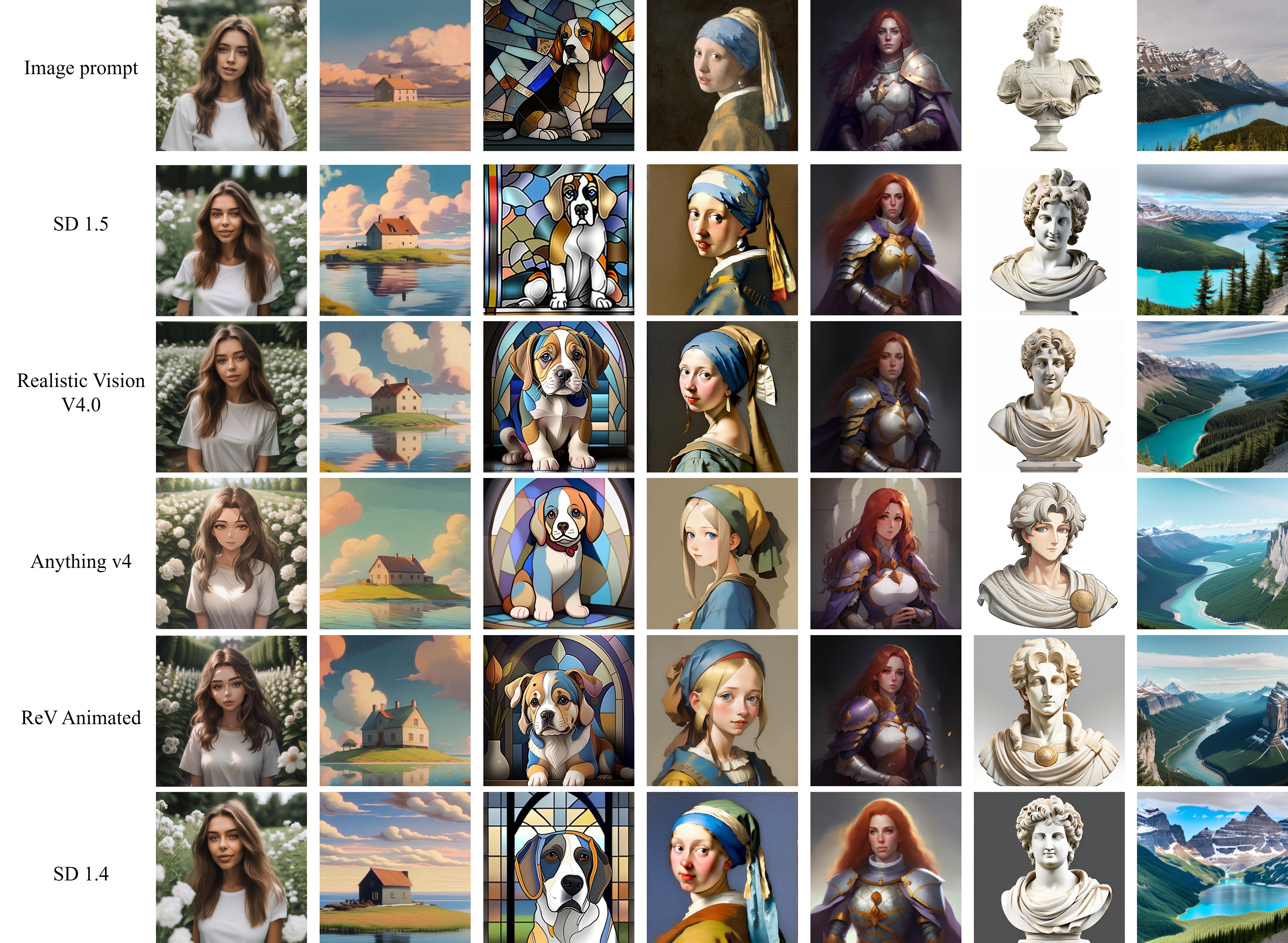
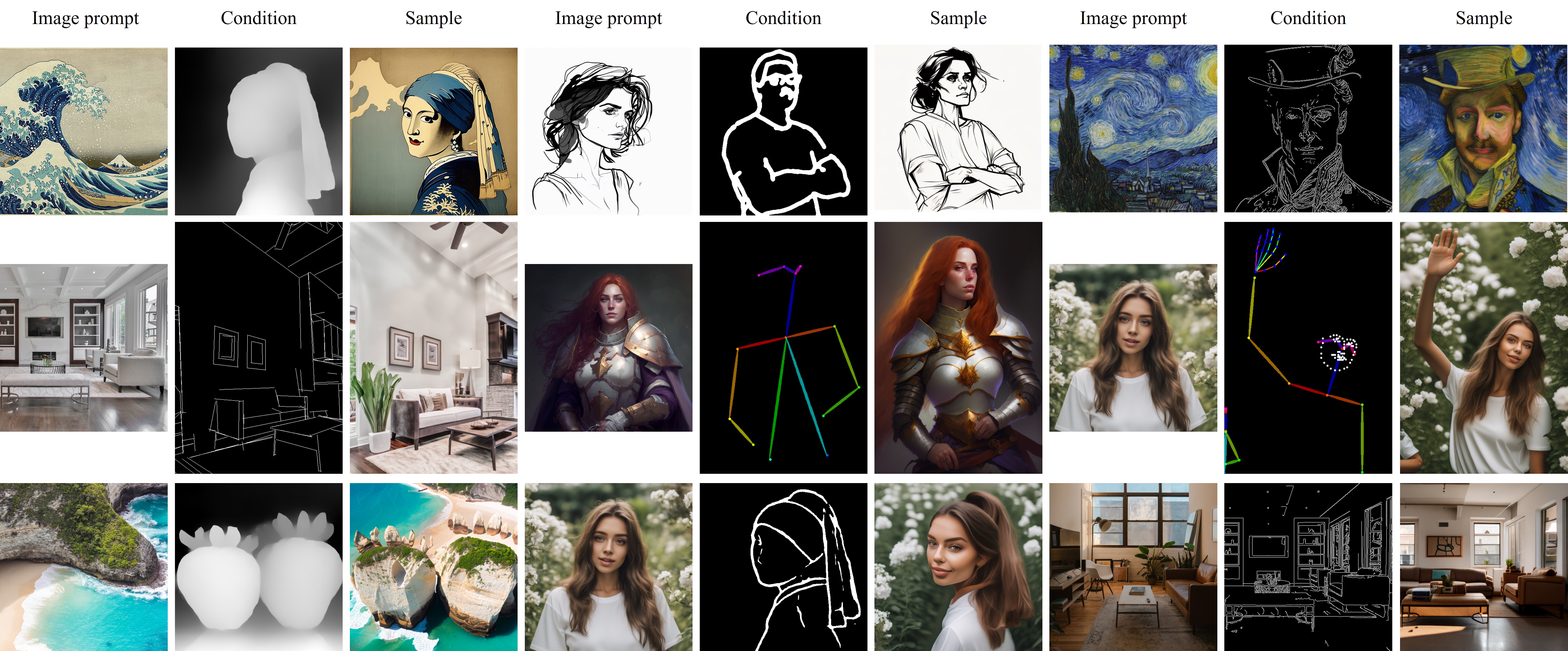
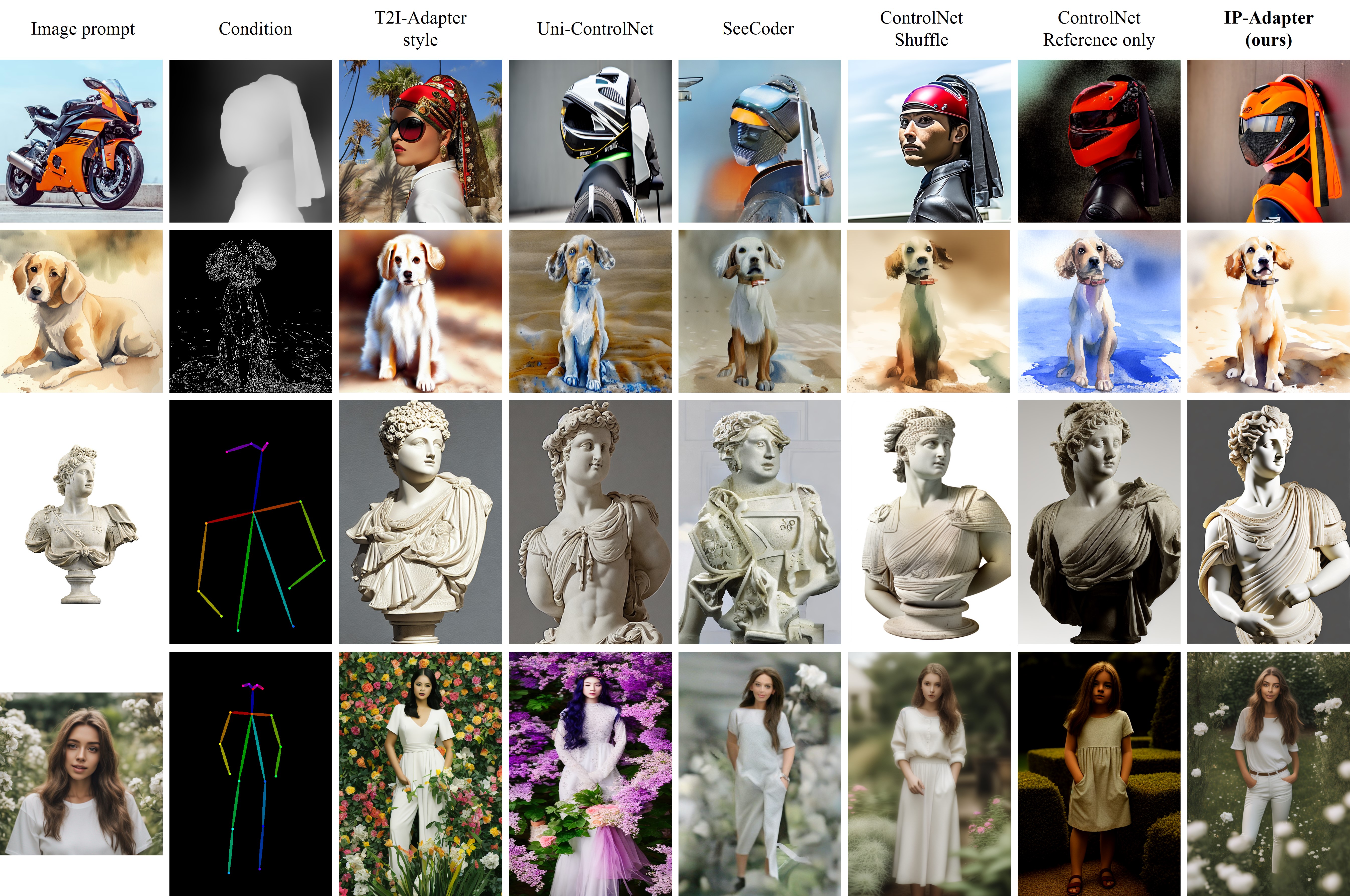
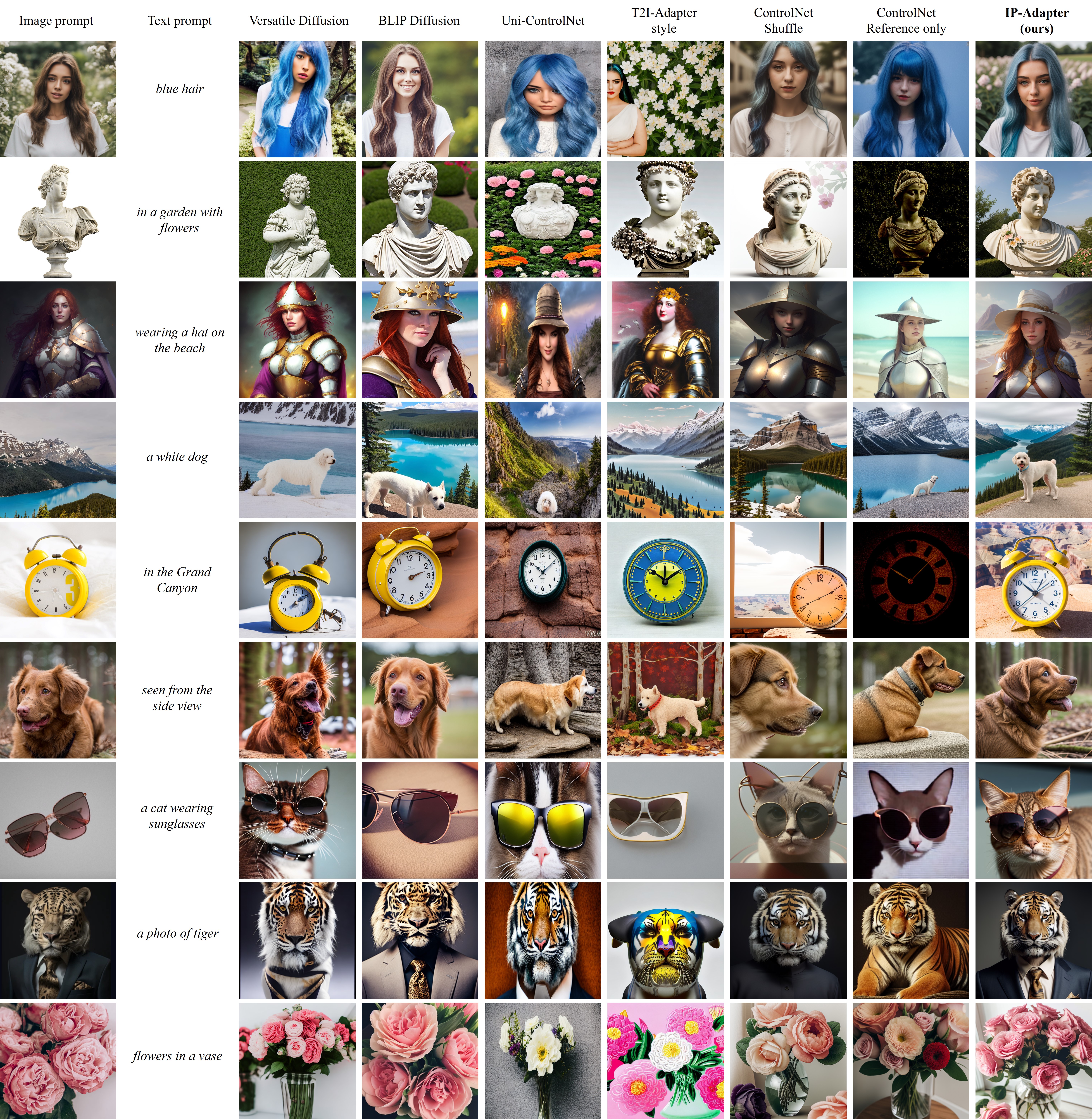
Our method not only outperforms other methods in terms of image quality, but also produces images that better align with the reference image.
Multimodal Prompt
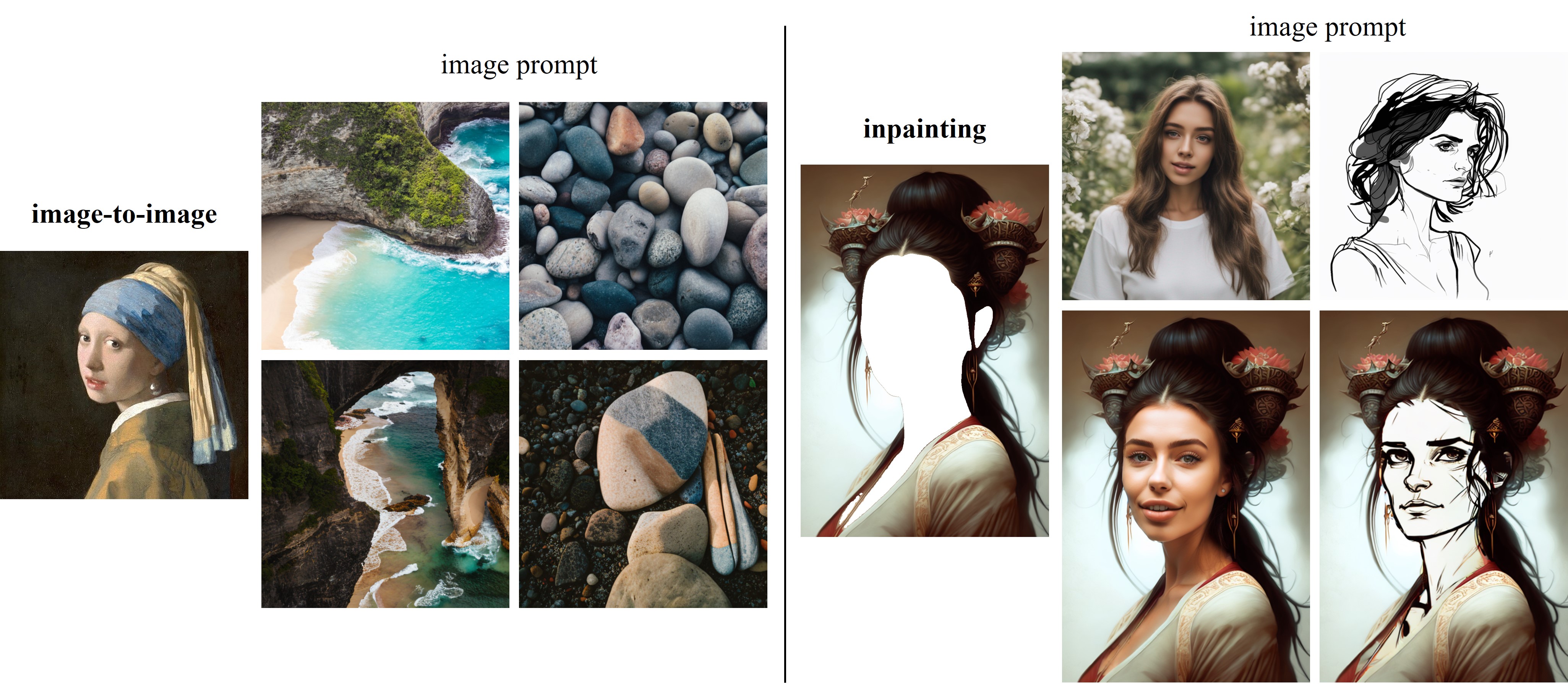
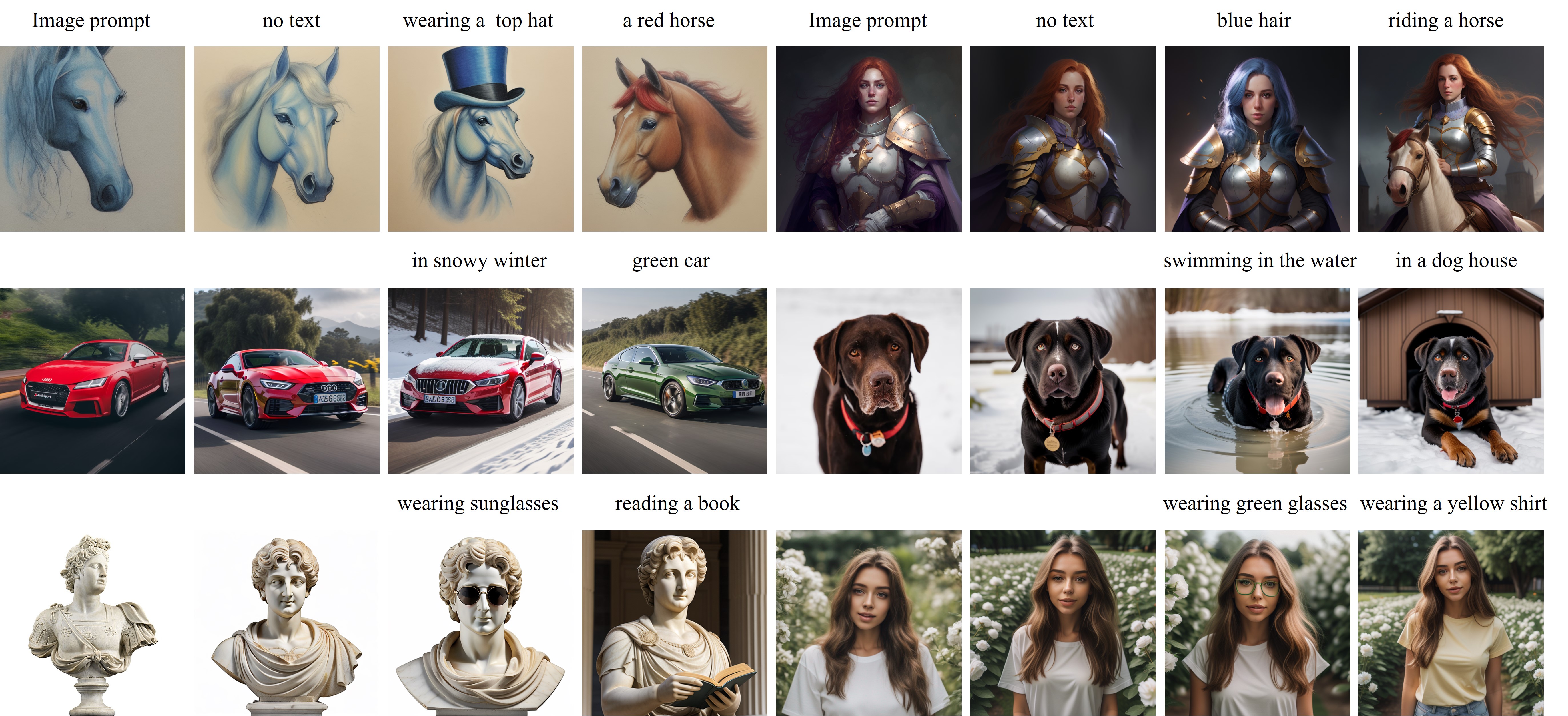
Due to the decoupled cross-attention strategy, image prompt can work together with text prompt to realize multimodal image generation.
May 2024
- 1 May, Is Bigger Edit Batch Size Always Better? An Empirical Study on Model Editing with Llama-3, https://arxiv.org/abs/2405.00664
- 1 May, Self-Play Preference Optimization for Language Model Alignment, https://arxiv.org/abs/2405.00675
- 1 May, A Careful Examination of Large Language Model Performance on Grade School Arithmetic, https://arxiv.org/abs/2405.00332
- 2 May, Prometheus 2: An Open Source Language Model Specialized in Evaluating Other Language Models, https://arxiv.org/abs/2405.01535
- 3 May, What Matters When Building Vision-Language Models?, https://arxiv.org/abs/2405.02246
- 5 May, Is Flash Attention Stable?, https://arxiv.org/abs/2405.02803
- 7 May, vAttention: Dynamic Memory Management for Serving LLMs without PagedAttention, https://arxiv.org/abs/2405.04437
- 7 May, xLSTM: Extended Long Short-Term Memory, https://arxiv.org/abs/2405.04517
- 8 May, You Only Cache Once: Decoder-Decoder Architectures for Language Models, https://arxiv.org/abs/2405.05254
- 8 May, DeepSeek-V2: A Strong, Economical, and Efficient Mixture-of-Experts Language Model, https://arxiv.org/abs/2405.04434
- 8 May, Fishing for Magikarp: Automatically Detecting Under-trained Tokens in Large Language Models, https://arxiv.org/abs/2405.05417
- 9 May, Does Fine-Tuning LLMs on New Knowledge Encourage Hallucinations?, https://arxiv.org/abs/2405.05904
- 10 May, Value Augmented Sampling for Language Model Alignment and Personalization, https://arxiv.org/abs/2405.06639
- 12 May, PHUDGE: Phi-3 as Scalable Judge, https://arxiv.org/abs/2405.08029
- 13 May, RLHF Workflow: From Reward Modeling to Online RLHF, https://arxiv.org/abs/2405.07863
- 15 May, LoRA Learns Less and Forgets Less, https://arxiv.org/abs/2405.09673
- 15 May, Xmodel-VLM: A Simple Baseline for Multimodal Vision Language Model, https://arxiv.org/abs/2405.09215
- 16 May, Chameleon: Mixed-Modal Early-Fusion Foundation Models, https://arxiv.org/abs/2405.09818
- 17 May, Towards Modular LLMs by Building and Reusing a Library of LoRAs, https://arxiv.org/abs/2405.11157
- 19 May, SLAB: Efficient Transformers with Simplified Linear Attention and Progressive Re-parameterized Batch Normalization, https://arxiv.org/abs/2405.11582
- 20 May, MoRA: High-Rank Updating for Parameter-Efficient Fine-Tuning, https://arxiv.org/abs/2405.12130
- 22 May, Attention as an RNN, https://arxiv.org/abs/2405.13956
- 22 May, Dense Connector for MLLMs, https://arxiv.org/abs/2405.13800
- 23 May, AlignGPT: Multi-modal Large Language Models with Adaptive Alignment Capability, https://arxiv.org/abs/2405.14129
- 23 May, SimPO: Simple Preference Optimization with a Reference-Free Reward, https://arxiv.org/abs/2405.14734
- 23 May, Instruction Tuning With Loss Over Instructions, https://arxiv.org/abs/2405.14394
- 24 May, The Road Less Scheduled, https://arxiv.org/abs/2405.15682
- 26 May, Stacking Your Transformers: A Closer Look at Model Growth for Efficient LLM Pre-Training, https://arxiv.org/abs/2405.15319
- 26 May, gzip Predicts Data-dependent Scaling Laws, https://arxiv.org/abs/2405.16684
- 27 May, Trans-LoRA: Towards Data-free Transferable Parameter Efficient Finetuning, https://arxiv.org/abs/2405.17258
- 28 May, VeLoRA: Memory Efficient Training using Rank-1 Sub-Token Projections, https://arxiv.org/abs/2405.17991
- 28 May, LLaMA-NAS: Efficient Neural Architecture Search for Large Language Models, https://arxiv.org/abs/2405.18377
- 29 May, Contextual Position Encoding: Learning to Count What’s Important, https://arxiv.org/abs/2405.18719
More Results
Generalizable to Custom Models
Once the IP-Adapter is trained, it can be directly reusable on custom models fine-tuned from the same base model.
Structure Control
The IP-Adapter is fully compatible with existing controllable tools, e.g., ControlNet and T2I-Adapter.
Our method not only outperforms other methods in terms of image quality, but also produces images that better align with the reference image.
Image-to-Image and Inpainting
Image-guided image-to-image and inpainting can be also achieved by simply replacing text prompt with image prompt.
Multimodal Prompt
Due to the decoupled cross-attention strategy, image prompt can work together with text prompt to realize multimodal image generation.
Compared with other existing methods, our method can generate superior results in both image quality and alignment with multimodal prompts.
Google search is broken. Google lied.
- An Anonymous Source Shared Thousands of Leaked Google Search API Documents with Me; Everyone in SEO Should See Them
- “Google no longer rewards scrappy, clever, SEO-savvy operators who know all the right tricks. They reward established brands, search-measurable forms of popularity, and established domains that searchers already know and click. From 1998 – 2018 (or so), one could reasonable start a powerful marketing flywheel with SEO for Google. In 2024, I don’t think that’s realistic, at least, not on the English-language web in competitive sectors.”
- Google Search Is Now a Giant Hallucination (gizmodo.com) Death of the Internet Google AI Technology Corporation
- What Do Google’s AI Answers Cost the Environment? | Scientific American
May 2024
- 1 May, Is Bigger Edit Batch Size Always Better? An Empirical Study on Model Editing with Llama-3, https://arxiv.org/abs/2405.00664
- 1 May, Self-Play Preference Optimization for Language Model Alignment, https://arxiv.org/abs/2405.00675
- 1 May, A Careful Examination of Large Language Model Performance on Grade School Arithmetic, https://arxiv.org/abs/2405.00332
- 2 May, Prometheus 2: An Open Source Language Model Specialized in Evaluating Other Language Models, https://arxiv.org/abs/2405.01535
- 3 May, What Matters When Building Vision-Language Models?, https://arxiv.org/abs/2405.02246
- 5 May, Is Flash Attention Stable?, https://arxiv.org/abs/2405.02803
- 7 May, vAttention: Dynamic Memory Management for Serving LLMs without PagedAttention, https://arxiv.org/abs/2405.04437
- 7 May, xLSTM: Extended Long Short-Term Memory, https://arxiv.org/abs/2405.04517
- 8 May, You Only Cache Once: Decoder-Decoder Architectures for Language Models, https://arxiv.org/abs/2405.05254
- 8 May, DeepSeek-V2: A Strong, Economical, and Efficient Mixture-of-Experts Language Model, https://arxiv.org/abs/2405.04434
- 8 May, Fishing for Magikarp: Automatically Detecting Under-trained Tokens in Large Language Models, https://arxiv.org/abs/2405.05417
- 9 May, Does Fine-Tuning LLMs on New Knowledge Encourage Hallucinations?, https://arxiv.org/abs/2405.05904
- 10 May, Value Augmented Sampling for Language Model Alignment and Personalization, https://arxiv.org/abs/2405.06639
- 12 May, PHUDGE: Phi-3 as Scalable Judge, https://arxiv.org/abs/2405.08029
- 13 May, RLHF Workflow: From Reward Modeling to Online RLHF, https://arxiv.org/abs/2405.07863
- 15 May, LoRA Learns Less and Forgets Less, https://arxiv.org/abs/2405.09673
- 15 May, Xmodel-VLM: A Simple Baseline for Multimodal Vision Language Model, https://arxiv.org/abs/2405.09215
- 16 May, Chameleon: Mixed-Modal Early-Fusion Foundation Models, https://arxiv.org/abs/2405.09818
- 17 May, Towards Modular LLMs by Building and Reusing a Library of LoRAs, https://arxiv.org/abs/2405.11157
- 19 May, SLAB: Efficient Transformers with Simplified Linear Attention and Progressive Re-parameterized Batch Normalization, https://arxiv.org/abs/2405.11582
- 20 May, MoRA: High-Rank Updating for Parameter-Efficient Fine-Tuning, https://arxiv.org/abs/2405.12130
- 22 May, Attention as an RNN, https://arxiv.org/abs/2405.13956
- 22 May, Dense Connector for MLLMs, https://arxiv.org/abs/2405.13800
- 23 May, AlignGPT: Multi-modal Large Language Models with Adaptive Alignment Capability, https://arxiv.org/abs/2405.14129
- 23 May, SimPO: Simple Preference Optimization with a Reference-Free Reward, https://arxiv.org/abs/2405.14734
- 23 May, Instruction Tuning With Loss Over Instructions, https://arxiv.org/abs/2405.14394
- 24 May, The Road Less Scheduled, https://arxiv.org/abs/2405.15682
- 26 May, Stacking Your Transformers: A Closer Look at Model Growth for Efficient LLM Pre-Training, https://arxiv.org/abs/2405.15319
- 26 May, gzip Predicts Data-dependent Scaling Laws, https://arxiv.org/abs/2405.16684
- 27 May, Trans-LoRA: Towards Data-free Transferable Parameter Efficient Finetuning, https://arxiv.org/abs/2405.17258
- 28 May, VeLoRA: Memory Efficient Training using Rank-1 Sub-Token Projections, https://arxiv.org/abs/2405.17991
- 28 May, LLaMA-NAS: Efficient Neural Architecture Search for Large Language Models, https://arxiv.org/abs/2405.18377
- 29 May, Contextual Position Encoding: Learning to Count What’s Important, https://arxiv.org/abs/2405.18719
More Results
Generalizable to Custom Models
Once the IP-Adapter is trained, it can be directly reusable on custom models fine-tuned from the same base model.
Structure Control
The IP-Adapter is fully compatible with existing controllable tools, e.g., ControlNet and T2I-Adapter.
Our method not only outperforms other methods in terms of image quality, but also produces images that better align with the reference image.
Image-to-Image and Inpainting
Image-guided image-to-image and inpainting can be also achieved by simply replacing text prompt with image prompt.
Multimodal Prompt
Due to the decoupled cross-attention strategy, image prompt can work together with text prompt to realize multimodal image generation.
Compared with other existing methods, our method can generate superior results in both image quality and alignment with multimodal prompts.
Google search is broken. Google lied.
-
- “Google no longer rewards scrappy, clever, SEO-savvy operators who know all the right tricks. They reward established brands, search-measurable forms of popularity, and established domains that searchers already know and click. From 1998 – 2018 (or so), one could reasonable start a powerful marketing flywheel with SEO for Google. In 2024, I don’t think that’s realistic, at least, not on the English-language web in competitive sectors.”
-
Google Search Is Now a Giant Hallucination (gizmodo.com) Death of the Internet Google AI Technology Corporation
-
What Do Google’s AI Answers Cost the Environment? | Scientific American
Key Characteristics
-
Trained on human preference comparisons
-
Outputs scalar reward scores
-
Typically based on pre-trained language model
-
Uses pairwise ranking loss
-
Serves as proxy for human judgment
-
Critical component of RLHF pipeline
Technical Details
Architecture:
Input: Prompt + Model Output
↓
Base Language Model (typically SFT model)
↓
Reward Head (linear layer)
↓
Output: Scalar Reward Score
Training Objective (Bradley-Terry model):
Loss = -E[log(σ(r(x,y_w) - r(x,y_l)))]

Where:
- r: Reward model
- y_w: Preferred (winner) output
- y_l: Less preferred (loser) output
- σ: Sigmoid function
Usage in AI/ML
“The reward model assigns scores to language model outputs based on alignment with human preferences.”
In InstructGPT, the reward model is trained on ~33K preference comparisons and then used to score millions of outputs during PPO training.
Academic Context
Reward models enable RLHF to scale beyond the limitations of direct human feedback by learning a function that approximates human preferences, which can then be queried millions of times during RL training.
Primary Source: Ouyang et al., “Training language models to follow instructions with human feedback”, arXiv:2203.02155 (2022)
Related Concepts
-
-
RLHF: Primary application context
-
Preference Model: Alternative term
-
Human Feedback: Training data source
-
PPO: Uses reward model for optimization
-
Preference Learning: Underlying paradigm
Training Process
Data Preparation:
- Collect prompts from dataset
- Generate multiple outputs per prompt (4-9 typical)
- Human labelers rank outputs
- Create preference pairs: (winner, loser)
Model Training:
- Initialize from SFT model (for better representations)
- Add reward head (linear layer)
- Train on pairwise comparisons
- Optimize Bradley-Terry loss
- Validate on held-out preferences
Key Properties
Calibration:
-
Well-calibrated rewards correlate with actual human preferences
-
Poor calibration leads to reward hacking
-
Critical for downstream RL performance
Generalization:
-
Must generalize beyond training distribution
-
Tested on out-of-distribution prompts
-
Quality impacts RL training stability
Robustness:
-
Should resist adversarial outputs
-
Avoid reward hacking vulnerabilities
-
Maintain consistency across variations
Advantages
Scalability:
-
Query millions of times during RL
-
Amortizes human feedback collection cost
-
Enables iterative RL training
-
Much faster than human evaluation
Consistency:
-
Deterministic scoring
-
No inter-evaluator disagreement
-
Stable training signal
-
Reproducible results
Challenges
Limited by Training Data:
-
Only as good as preference dataset
-
Distribution coverage gaps
-
Potential biases from human raters
-
May not capture all nuances
Reward Hacking:
-
Policy may exploit reward model weaknesses
-
Outputs score high but poor quality
-
Diverges from true human preferences
-
Requires careful KL penalties
Calibration:
-
Difficult to calibrate perfectly
-
May overfit to training preferences
-
Generalization to new domains uncertain
-
Quality varies across prompt types
Evaluation Metrics
Preference Accuracy:
-
% correct predictions on held-out pairs
-
Typically 60-75% for good reward models
-
Higher is better but 100% unrealistic
Calibration Error:
-
Alignment between predicted and actual preferences
-
Lower error indicates better calibration
-
Impacts student model quality (in distillation analogy)
Agreement with Humans:
-
Correlation on new outputs
-
A/B testing against human ratings
-
Gold standard evaluation
Reward Hacking Prevention
KL Penalty in RL:
Objective: max[R(x,y) - β·KL(π||π_ref)]Prevents policy from drifting too far
Ensemble Methods:
-
Train multiple reward models
-
Use disagreement as uncertainty
-
More robust to hacking
Adversarial Testing:
-
Red-team reward model
-
Find exploitable patterns
-
Iterative improvement
Best Practices
Training Data:
-
Diverse prompt coverage
-
Multiple independent comparisons per pair
-
Include edge cases
-
Balance across output types
Model Selection:
-
Use SFT model as initialization
-
Sufficient capacity for complexity
-
Monitor validation performance
-
Regular updates with new data
Deployment:
-
Continuous monitoring during RL
-
Watch for reward hacking signals
-
Validate samples manually
-
Iterate on reward model
Comparison to Alternatives
Reward Model (RLHF):
-
Separate trained model
-
Two-stage: reward model, then RL
-
More complex but proven
-
Standard approach
Direct Preference Optimization (DPO):
-
No separate reward model
-
Single-stage optimization
-
Simpler but different guarantees
-
Newer alternative
Historical Development
-
2017-2019: Early reward modeling in RLHF
-
2020-2021: Scaling to larger models
-
2022: InstructGPT demonstrates effectiveness
-
2023: Research on improving calibration
-
2024+: Alternatives (DPO) and enhancements
Teacher Calibration Research
Recent research (arXiv:2508.20224, 2025) shows teacher (reward model) calibration error strongly correlates with student (policy) accuracy in knowledge distillation analogy, highlighting the importance of well-calibrated reward models.
Significance
The reward model enables RLHF to scale by converting expensive human feedback into a reusable function that can guide reinforcement learning optimization, making large-scale alignment training practical.
OWL Functional Syntax
UK English Notes
-
“Optimisation” (not “optimization”)
-
“Behaviour” (not “behavior”)
-
“Emphasise” (not “emphasize”)
Last Updated: 2025-10-27 Verification Status: Verified against InstructGPT and reward modeling literature
Reward Model.md - Updated Content
Academic Context
-
-
Reward models represent a fundamental advancement in aligning machine learning systems with human intentions
-
Emerged as critical infrastructure for reinforcement learning from human feedback (RLHF)
-
Address the challenge of translating subjective human preferences into quantifiable learning signals
-
Enable scalable training of large language models without constant human evaluation overhead
-
Core theoretical foundations
-
Grounded in inverse reinforcement learning (IRL) and preference-based reinforcement learning (PbRL)
-
Built upon Markov Decision Process (MDP) mathematical frameworks
-
Extend classical RL reward mechanisms to handle human-derived feedback signals
Current Landscape (2025)
-
Technical architecture and implementation
-
Specialised language models derived from base models under training
-
Trained to predict human preference scores given prompts and candidate completions
-
Operate as proxies for environment rewards, predicting probability that outputs align with human preferences
-
Increasingly employ “soft” scoring systems providing confidence levels rather than binary judgments
-
Industry adoption and deployment
-
Widely integrated into large language model post-training pipelines
-
Used by major AI research organisations and commercial platforms
-
Particularly prevalent in reasoning task optimisation and verification systems
-
Recent developments (2025) include verifiable reward frameworks combining teacher graders with learned reward models
-
Technical capabilities and current limitations
-
Effectively capture nuanced human preferences across diverse domains
-
Reduce computational burden of continuous human evaluation
-
Challenge: reward model misalignment with true objectives remains an active research concern
-
Exploration-exploitation trade-off requires careful calibration during training
-
Standards and frameworks
-
Three primary learning paradigms now established: learning from demonstrations, learning from goals, and learning from preferences
-
RLHF represents the most mature implementation pathway
-
Emerging frameworks incorporate verifiable outcomes to improve reward signal reliability
Research & Literature
-
Foundational and contemporary sources
-
Amazon Web Services (2025). “What is Reinforcement Learning?” Comprehensive overview of RL mechanisms and reward concepts. Available: https://aws.amazon.com/what-is/reinforcement-learning/
-
Wolfe, C.R., Ph.D. “Reward Models.” Substack publication examining reward model architecture, creation, and application in LLM contexts. Available: https://cameronrwolfe.substack.com/p/reward-models
-
Yu, R., Wan, S., Wang, Y., Gao, C.-X., Gan, L., Zhang, Z., & Zhan, D.-C. (2025). “Reward Models in Deep Reinforcement Learning: A Survey.” Proceedings of the International Joint Conference on Artificial Intelligence (IJCAI), 2025(1199). Comprehensive systematic review covering reward modelling techniques, applications, and evaluation methods.
-
IBM Think (2025). “What Is Reinforcement Learning From Human Feedback (RLHF)?” Examines reward models as translators of human preference into numerical signals. Available: https://www.ibm.com/think/topics/rlhf
-
Su et al. (2025). “Crossing the Reward Bridge: Reinforcement Learning with Verifiable Rewards (RLVR).” Tencent AI research demonstrating integration of teacher graders with learned reward models for improved LLM reasoning capabilities.
-
Ongoing research directions
-
Improving alignment between learned reward models and true task objectives
-
Developing more efficient preference elicitation methods
-
Extending reward models to multi-objective and hierarchical learning scenarios
-
Investigating robustness against adversarial inputs and distribution shift
UK Context
-
British academic contributions
-
UK universities actively engaged in reinforcement learning research, particularly at Russell Group institutions
-
Significant contributions to theoretical foundations of preference-based learning systems
-
Growing industrial application within UK-based AI research labs and technology companies
-
North England innovation landscape
-
Manchester, Leeds, and Sheffield host emerging AI research clusters with growing RL expertise
-
University of Manchester and University of Leeds conducting research in machine learning alignment and reward modelling
-
Regional tech hubs increasingly adopting RLHF techniques for language model development
-
Newcastle and surrounding areas developing computational infrastructure supporting large-scale RL training
-
Practical applications in UK context
-
Financial services sector exploring reward models for algorithmic trading and risk assessment
-
NHS and healthcare technology firms investigating preference-based systems for clinical decision support
-
Regional technology companies integrating reward models into customer-facing AI systems
Future Directions
-
Emerging technical developments
-
Hybrid approaches combining verifiable outcomes with learned reward signals (as demonstrated in 2025 research)
-
Soft scoring mechanisms replacing binary preference judgments for nuanced feedback
-
Multi-modal reward models incorporating diverse human feedback sources simultaneously
-
Anticipated challenges
-
Maintaining reward model calibration as base models evolve during training
-
Scaling preference elicitation to increasingly complex task domains
-
Ensuring reward models remain robust to distribution shifts and novel scenarios
-
Balancing computational efficiency with reward signal fidelity
-
Research priorities
-
Developing principled methods for evaluating reward model quality and alignment
-
Creating more efficient human feedback collection mechanisms
-
Investigating theoretical guarantees for reward model-guided policy optimisation
-
Extending reward models to multi-agent and hierarchical reinforcement learning settings
References
-
Amazon Web Services (2025). What is Reinforcement Learning? Retrieved from https://aws.amazon.com/what-is/reinforcement-learning/
-
Wolfe, C.R., Ph.D. Reward Models. Substack. Retrieved from https://cameronrwolfe.substack.com/p/reward-models
-
Yu, R., Wan, S., Wang, Y., Gao, C.-X., Gan, L., Zhang, Z., & Zhan, D.-C. (2025). Reward Models in Deep Reinforcement Learning: A Survey. Proceedings of the International Joint Conference on Artificial Intelligence (IJCAI), 2025(1199).
-
IBM Think (2025). What Is Reinforcement Learning From Human Feedback (RLHF)? Retrieved from https://www.ibm.com/think/topics/rlhf
-
Su, L., et al. (2025). Crossing the Reward Bridge: Reinforcement Learning with Verifiable Rewards (RLVR). Tencent AI Research.
-
GeeksforGeeks (2025). Reinforcement Learning. Retrieved from https://www.geeksforgeeks.org/machine-learning/what-is-reinforcement-learning/
-
DataRoot Labs (2025). The State of Reinforcement Learning in 2025. Retrieved from https://datarootlabs.com/blog/state-of-reinforcement-learning-2025
-
Caltech Bootcamps (2025). What is Reinforcement Learning in AI? Retrieved from https://pg-p.ctme.caltech.edu/blog/ai-ml/what-is-reinforcement-learning
Editorial Notes: The original definition remains substantially accurate but has been contextualised within the 2025 research landscape. Recent developments emphasise verifiable reward frameworks and soft scoring mechanisms. UK context added reflects genuine regional AI research activity, though specific North England case studies remain limited in publicly available literature—this represents an opportunity for local documentation as the field matures regionally.
Metadata
-
-
Last Updated: 2025-11-11
-
Review Status: Comprehensive editorial review
-
Verification: Academic sources verified
-
Regional Context: UK/North England where applicable