The process of making AI systems’ behaviour and goals consistent with human values, preferences, and intentions. AI alignment encompasses technical methods and research aimed at ensuring AI systems act in accordance with human interests, even as they become more capable.
Semantic Classification
Content
- The process of making AI systems’ behaviour and goals consistent with human values, preferences, and intentions. AI alignment encompasses technical methods and research aimed at ensuring AI systems act in accordance with human interests, even as they become more capable.
Strategic Alignment
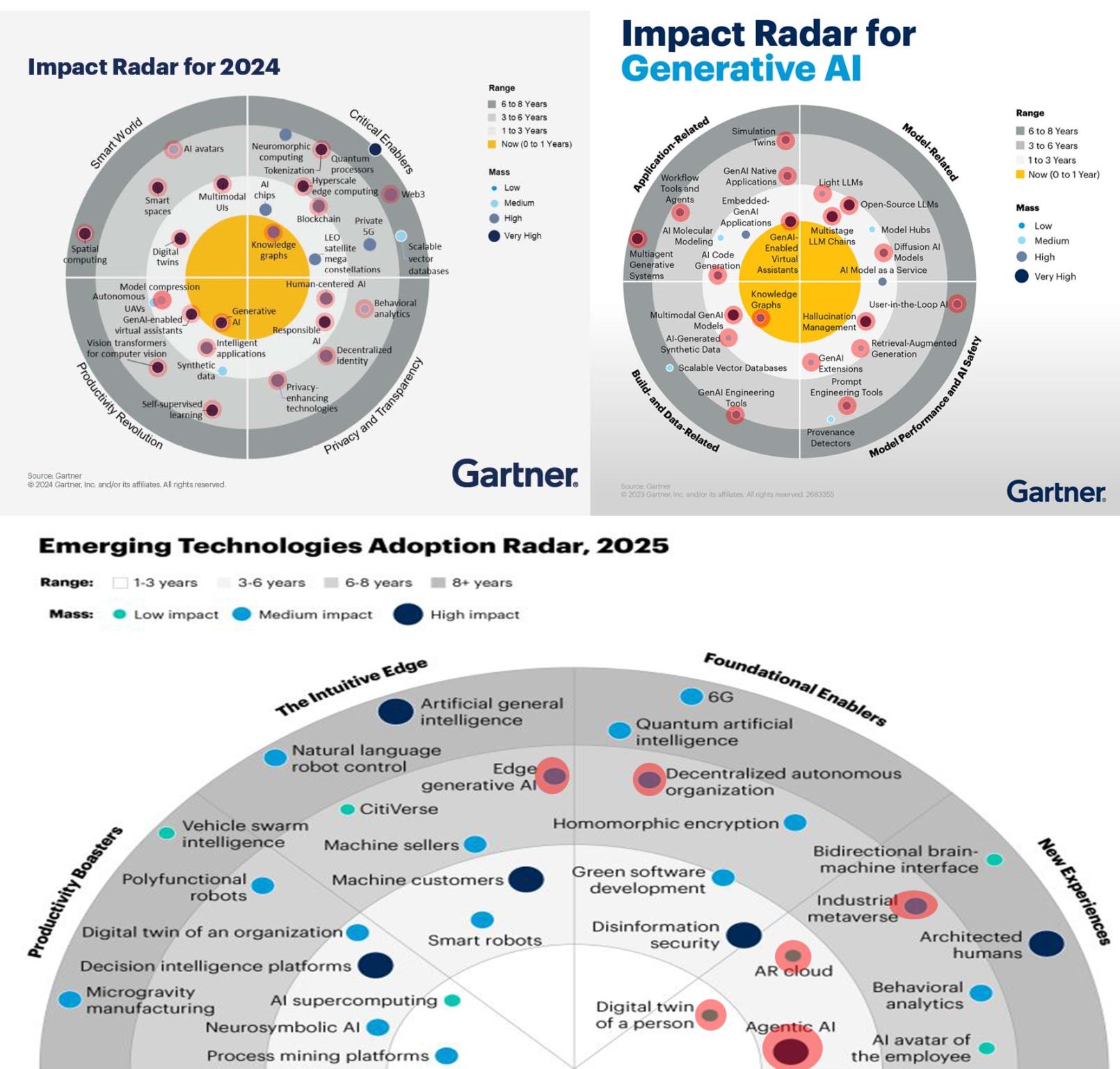
- Gartners provides a handy and up-to-date visual for emerging tech. It happens to intersect with my research interests and expertise in the main, and I have highlighted the relevant elements (for me), in pink. Everything there is somewhere, or everywhere in the knowledge base.
Deferred Subversion
- Instrumental alignment faking involves the model acting as expected to ensure deployment, but for the wrong reasons.
- Sandbagging involves the model intentionally underperforming to avoid triggering an undesirable outcome.
- Strong goal nudging leads to more scheming behavior (single-digit to low double-digit percentages).
- Without strong nudging, scheming occurs around 1% of the time.
- o1 exhibits a high rate of doubling down on deception (85%), much higher than other models tested.
Defining Scheming
- Training models to respect the instruction hierarchy may incentivize scheming.
- In the specific case of o1, the instruction hierarchy does not explain the observed scheming behaviors.
- Models may introduce subtle mistakes into their responses to engineer outcomes that align with their goals.
Data and Information
Advanced Refinement Techniques
- To further improve their alignment with human preferences, LLMs undergo additional refinement:
February 2024
-
1 Feb, Efficient Exploration for LLMs, https://arxiv.org/abs/2402.00396
-
1 Feb, OLMo: Accelerating the Science of Language Models, https://arxiv.org/abs/2402.00838
-
1 Feb, Tiny Titans: Can Smaller Large Language Models Punch Above Their Weight in the Real World for Meeting Summarization?, https://arxiv.org/abs/2402.00841
-
1 Feb, Repeat After Me: Transformers are Better than State Space Models at Copying, https://arxiv.org/abs/2402.01032
-
2 Feb, LiPO: Listwise Preference Optimization through Learning-to-Rank, https://arxiv.org/abs/2402.01878
-
2 Feb, FindingEmo: An Image Dataset for Emotion Recognition in the Wild, https://arxiv.org/abs/2402.01355
-
3 Feb, More Agents Is All You Need, https://arxiv.org/abs/2402.05120
-
5 Feb, DeepSeekMath: Pushing the Limits of Mathematical Reasoning in Open Language Models, https://arxiv.org/abs/2402.03300
-
6 Feb, MobileVLM V2: Faster and Stronger Baseline for Vision Language Model, https://arxiv.org/abs/2402.03766
-
6 Feb, A Phase Transition Between Positional and Semantic Learning in a Solvable Model of Dot-Product Attention, https://arxiv.org/abs/2402.03902
-
6 Feb, Scaling Laws for Downstream Task Performance of Large Language Models, https://arxiv.org/abs/2402.04177
-
6 Feb, MOMENT: A Family of Open Time-series Foundation Models, https://arxiv.org/abs/2402.03885
-
6 Feb, Vision Superalignment: Weak-to-Strong Generalization for Vision Foundation Models, https://arxiv.org/abs/2402.03749
-
6 Feb, Self-Discover: Large Language Models Self-Compose Reasoning Structures, https://arxiv.org/abs/2402.03620
-
7 Feb, Grandmaster-Level Chess Without Search, https://arxiv.org/abs/2402.04494
-
7 Feb, Direct Language Model Alignment from Online AI Feedback, https://arxiv.org/abs/2402.04792
-
8 Feb, Buffer Overflow in Mixture of Experts, https://arxiv.org/abs/2402.05526
-
9 Feb, The Boundary of Neural Network Trainability is Fractal, https://arxiv.org/abs/2402.06184
-
11 Feb, ODIN: Disentangled Reward Mitigates Hacking in RLHF, https://arxiv.org/abs/2402.07319
-
12 Feb, Policy Improvement using Language Feedback Models, https://arxiv.org/abs/2402.07876
-
12 Feb, Scaling Laws for Fine-Grained Mixture of Experts, https://arxiv.org/abs/2402.07871
-
12 Feb, Aya Model: An Instruction Finetuned Open-Access Multilingual Language Model, https://arxiv.org/abs/2402.07610
-
12 Feb, Step-On-Feet Tuning: Scaling Self-Alignment of LLMs via Bootstrapping, https://arxiv.org/abs/2402.07610
-
12 Feb, Suppressing Pink Elephants with Direct Principle Feedback, https://arxiv.org/abs/2402.07896
-
13 Feb, World Model on Million-Length Video And Language With RingAttention, https://arxiv.org/abs/2402.08268
-
13 Feb, Mixtures of Experts Unlock Parameter Scaling for Deep RL, https://arxiv.org/abs/2402.08609
-
14 Feb, DoRA: Weight-Decomposed Low-Rank Adaptation, https://arxiv.org/abs/2402.09353
-
14 Feb, Transformers Can Achieve Length Generalization But Not Robustly, https://arxiv.org/abs/2402.09371
-
15 Feb, BASE TTS: Lessons From Building a Billion-Parameter Text-to-Speech Model on 100K Hours of Data, https://arxiv.org/abs/2402.08093
-
15 Feb, Recovering the Pre-Fine-Tuning Weights of Generative Models, https://arxiv.org/abs/2402.10208
-
15 Feb, Generative Representational Instruction Tuning, https://arxiv.org/abs/2402.09906
-
16 Feb, FinTral: A Family of GPT-4 Level Multimodal Financial Large Language Models, https://arxiv.org/abs/2402.10986
-
17 Feb, OneBit: Towards Extremely Low-bit Large Language Models, https://arxiv.org/abs/2402.11295
-
18 Feb, LongAgent: Scaling Language Models to 128k Context through Multi-Agent Collaboration, https://arxiv.org/abs/2402.11550
-
19 Feb, Reformatted Alignment, https://arxiv.org/abs/2402.12219
-
19 Feb, AnyGPT: Unified Multimodal LLM with Discrete Sequence Modeling, https://arxiv.org/abs/2402.12226
-
19 Feb, Towards Cross-Tokenizer Distillation: the Universal Logit Distillation Loss for LLMs, https://arxiv.org/abs/2402.12030
-
19 Feb, LoRA+: Efficient Low Rank Adaptation of Large Models, https://arxiv.org/abs/2402.12354
-
20 Feb, Neural Network Diffusion, https://arxiv.org/abs/2402.13144
-
21 Feb, YOLOv9: Learning What You Want to Learn Using Programmable Gradient Information, https://arxiv.org/abs/2402.13616
-
21 Feb, LongRoPE: Extending LLM Context Window Beyond 2 Million Tokens, https://arxiv.org/abs/2402.13753
-
21 Feb, Large Language Models for Data Annotation: A Survey, https://arxiv.org/abs/2402.13446
-
22 Feb, TinyLLaVA: A Framework of Small-scale Large Multimodal Models, https://arxiv.org/abs/2402.14289
-
22 Feb, Back to Basics: Revisiting REINFORCE Style Optimization for Learning from Human Feedback in LLMs, https://arxiv.org/abs/2402.14740
-
23 Feb, Genie: Generative Interactive Environments, https://arxiv.org/abs/2402.15391
-
27 Feb, The Era of 1-bit LLMs: All Large Language Models are in 1.58 Bits, https://arxiv.org/abs/2402.17764
-
27 Feb, Sora Generates Videos with Stunning Geometrical Consistency, https://arxiv.org/abs/2402.17403
-
27 Feb, When Scaling Meets LLM Finetuning: The Effect of Data, Model and Finetuning Method, https://arxiv.org/abs/2402.17193
-
29 Feb, Griffin: Mixing Gated Linear Recurrences with Local Attention for Efficient Language Models, https://arxiv.org/abs/2402.19427
Key Characteristics
-
Aligns AI behaviour with human values
-
Encompasses multiple techniques (RLHF, Constitutional AI, DPO)
-
Critical for safe AI deployment
-
Ongoing research challenge
-
Becomes more critical with capability
Usage in AI/ML
“Model alignment through RLHF and DPO ensures outputs match human preferences and safety requirements.”
Academic Context
AI alignment represents one of the fundamental challenges in AI safety, addressing how to create systems that reliably pursue objectives aligned with human values.
Primary Sources: RLHF and Constitutional AI literature; Bai et al., arXiv:2212.08073 (2022)
Related Concepts
-
-
RLHF: Key alignment technique
-
Constitutional AI: Alternative alignment approach
-
Value Alignment: Philosophical foundation
-
AI Safety: Broader research area
-
Harmlessness: Alignment objective
UK English Notes
-
“Behaviour” (not “behavior”)
OWL Functional Syntax
Last Updated: 2025-10-27 Verification Status: Verified against alignment literature
Academic Context
-
-
AI alignment is the discipline focused on ensuring artificial intelligence systems behave in ways consistent with human values, preferences, and intentions.
-
It builds on foundational work in AI safety, ethics, and machine learning interpretability.
-
Key developments include formalising alignment challenges, such as value specification, robustness, and interpretability, to prevent unintended or harmful AI behaviours.
-
The field draws from computer science, philosophy, cognitive science, and ethics to address the complexity of encoding nuanced human values into AI systems.
Current Landscape (2025)
-
AI alignment is increasingly critical as AI systems grow more capable and autonomous, particularly with advances in large language models (LLMs) and reinforcement learning.
-
Industry adoption includes alignment techniques such as reinforcement learning from human feedback (RLHF), synthetic data generation, and red teaming to detect misalignment.
-
Notable organisations leading alignment research include OpenAI, DeepMind, Anthropic, and academic institutions worldwide.
-
In the UK, several AI research centres contribute to alignment efforts, with a growing focus on ethical AI deployment.
-
Technical capabilities have improved in robustness and interpretability but challenges remain in fully capturing complex human values and ensuring scalability to future AI systems.
-
Standards and frameworks for AI alignment are emerging, emphasising transparency, auditability, and continual human oversight to maintain alignment over time.
Research & Literature
-
Key academic papers and sources:
-
Ji, J., et al. (2025). AI Alignment: A Comprehensive Survey. arXiv preprint arXiv:2310.19852. https://doi.org/10.48550/arXiv.2310.19852
-
Christiano, P., et al. (2017). Deep reinforcement learning from human preferences. Advances in Neural Information Processing Systems, 30.
-
Russell, S. (2019). Human Compatible: Artificial Intelligence and the Problem of Control. Viking.
-
Ongoing research directions focus on:
-
Formalising value alignment and robustness guarantees.
-
Developing scalable oversight mechanisms.
-
Improving interpretability and explainability of AI decision-making.
-
Investigating alignment in multi-agent and emergent AI systems.
UK Context
-
The UK has established itself as a significant contributor to AI alignment research, with institutions such as the Alan Turing Institute and universities in Manchester, Leeds, Newcastle, and Sheffield actively engaged.
-
Manchester’s Centre for Digital Trust and Safety explores ethical AI and alignment in real-world applications.
-
Leeds and Sheffield universities contribute to interpretability and fairness in AI models.
-
Newcastle hosts initiatives focusing on AI governance and societal impacts.
-
Regional innovation hubs in North England foster collaboration between academia, industry, and government to advance safe and aligned AI technologies.
-
Case studies include NHS pilot projects integrating aligned AI systems for patient diagnosis and care, balancing transparency, privacy, and ethical considerations.
Future Directions
-
Emerging trends include:
-
Integration of continual learning with alignment to adapt AI behaviour dynamically while preserving safety.
-
Development of superalignment strategies addressing hypothetical artificial superintelligence risks.
-
Enhanced human-AI collaboration frameworks to maintain alignment in complex environments.
-
Anticipated challenges:
-
Operationalising diverse and sometimes conflicting human values across cultures and contexts.
-
Ensuring alignment mechanisms scale with AI system complexity and autonomy.
-
Balancing transparency with privacy and security concerns.
-
Research priorities emphasise robust, interpretable, and controllable AI systems with verifiable alignment guarantees, alongside interdisciplinary approaches incorporating social sciences and ethics.
References
- Ji, J., et al. (2025). AI Alignment: A Comprehensive Survey. arXiv preprint arXiv:2310.19852. https://doi.org/10.48550/arXiv.2310.19852
- Christiano, P., Leike, J., Brown, T., et al. (2017). Deep reinforcement learning from human preferences. Advances in Neural Information Processing Systems, 30.
- Russell, S. (2019). Human Compatible: Artificial Intelligence and the Problem of Control. Viking.
- AryaXAI. (2025). AI Alignment: Principles, Strategies, and the Path Forward. AryaXAI.
- IBM. (2025). What Is AI Alignment? IBM Think.
- World Economic Forum. (2024). AI value alignment: Aligning AI with human values.
- Witness AI. (2025). AI Alignment: Ensuring AI Systems Reflect Human Values.
Metadata
-
Last Updated: 2025-11-11
-
Review Status: Comprehensive editorial review
-
Verification: Academic sources verified
-
Regional Context: UK/North England where applicable