- automatically published
AI or ML or what?
- It’s not intelligent. It’s just machine learning which is statistics.
- Artificial intelligence is a marketing term, but it’s supported in literature as the high level term.
- That’s OK!
- I’m mainly going to use AI from here in.
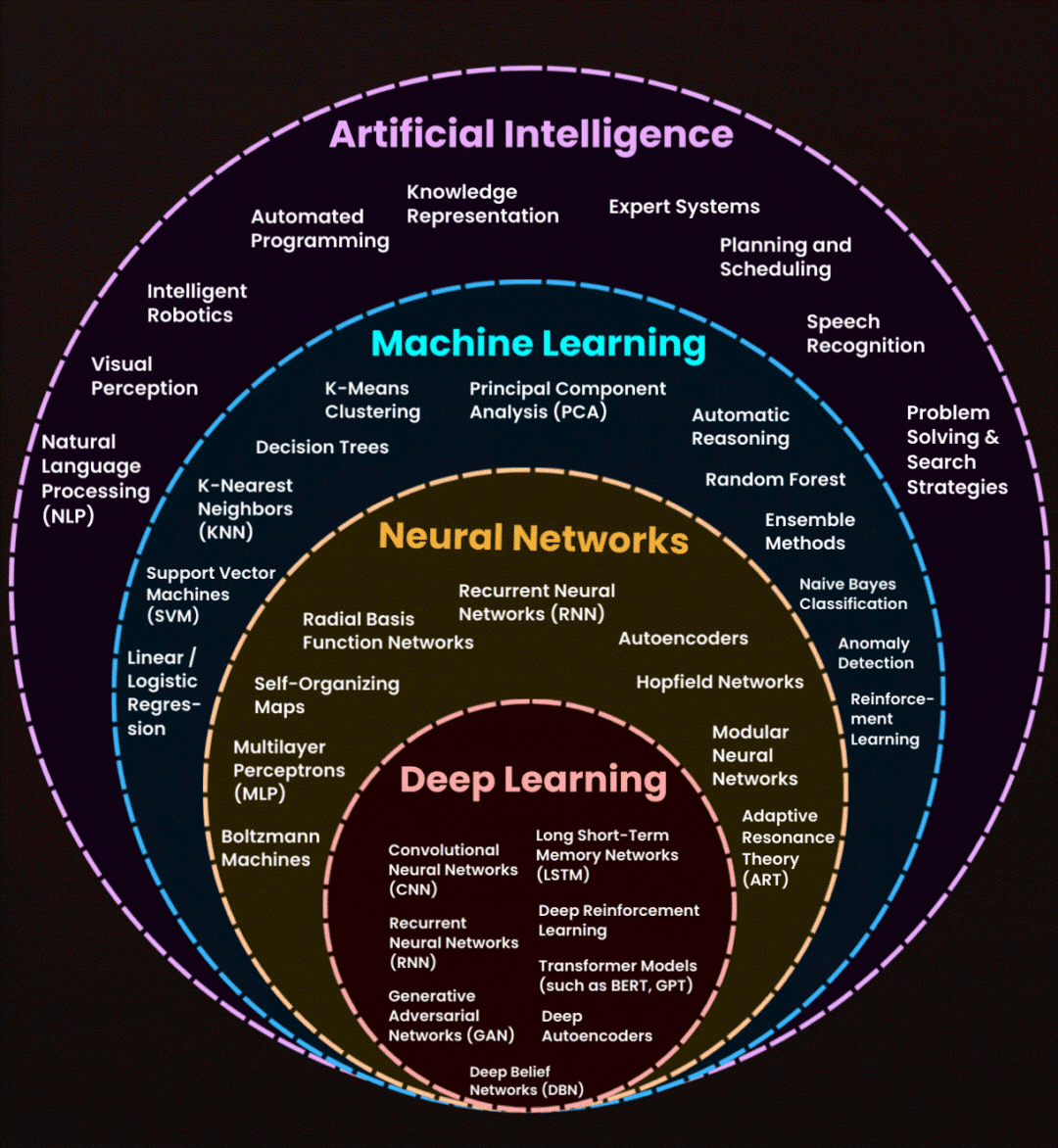
Machine Learning Techniques Overview
Supervised Learning
- Concept: Techniques where models learn from labeled data.
- Explain: Like teaching a child with clear examples and answers.
1️⃣ Support Vector Machines (SVM)
- Description: Uses hyperplanes for classification.
- Explain: Think of drawing lines to separate different types of objects.
- Paper: A comprehensive survey on support vector machine classification
2️⃣ Naive Bayes
- Description: Probabilistic classifier based on Bayes’ Theorem.
- Explain: Like guessing the likelihood of something happening based on past events.
- Paper: An Empirical Study of the Naïve Bayes Classifier
3️⃣ Linear Regression
- Description: Models linear relationships between variables.
- Explain: Like predicting your height based on your age.
- Medium Post: A short into to Linear Regression
4️⃣ Logistic Regression
- Description: Used for binary classification problems.
- Explain: Like deciding if something is true or false.
- Paper: Logistic regression in data analysis: An overview
5️⃣ Decision Trees
- Description: Tree-like model for decisions and consequences.
- Explain: Like a flowchart to make decisions, but using numbers (weights)
- Paper: Study and Analysis of Decision Tree Based Classification Algorithms
6️⃣ Random Forest
- Description: Ensemble of decision trees for improved accuracy.
- Explain: Like consulting a group of experts instead of just one.
- Paper: Understanding Random Forests: From Theory to Practice
Unsupervised Learning
- Concept: Techniques where models learn from unlabeled data.
- Explain Like I’m New: Learning without direct guidance, like exploring a new city without a map.
1️⃣ K-Means Clustering
- Description: Partitions data into k distinct clusters.
- Explain Like I’m New: Like organizing similar things into different groups.
- Paper: K-means clustering algorithms: A comprehensive review, variants, and advances
2️⃣ K-Nearest Neighbors (KNN)
- Description: Classifies cases based on similarity measures.
- Explain Like I’m New: Like making friends based on common interests.
- Paper: Comparative performance analysis of K-nearest neighbour (KNN)
Neural Networks and Deep Learning id:: 659a9232-2320-494a-b922-968029718ad5
- Concept: Advanced algorithms inspired by the structure of the human brain.
- Explain: Like building a brain in a computer to solve complex problems.
1️⃣ Neural Networks
- Description: Consists of layers of interconnected nodes which just tweak numbers
- Explain: Like a network of brain cells working together to think and learn.
- Paper: Neural networks: An overview of early research, current frameworks and new challenges
2️⃣ Deep Learning
- Description: Involves training large neural networks.
- Explain: Larger scale engineering of neural nets, to solve much harder problems.
- Paper: Deep Learning: A Comprehensive Overview on Techniques, Taxonomy, and Applications
- Fine tuning and alignment
3️⃣ Reinforcement Learning from Human Feedback RLHF
- Description: Two neural networks trained in an adversarial process.
- Explain: Like two brains, one creating art and the other judging it, helping each other improve.
- Paper: Generative Adversarial Networks
4️⃣ Direct Preference Optimisation DPO
- Description: *DPO dramatically simplifies the whole thing.
- Explain: Removes the reward function, and so the human in the loop.
- Paper: Direct Preference Optimization: Your Language Model is Secretly a Reward Model (arxiv.org)
- In operation: Proprietary Large Language Models:
5️⃣ Generative Adversarial Networks GANs
- Description: Two neural networks trained in an adversarial process.
- Explain: Like two brains, one creating art and the other judging it, helping each other improve.
- Paper: Generative Adversarial Networks
6️⃣ Diffusion Models (Generative Models)
- Description: Advanced models that ‘diffuse’ data to create new, synthetic outputs, using efficient Transformers
- Explain: Imagine starting with a noisy, random pattern and gradually shaping it into a clear picture.
- Paper: Diffusion Models: A Comprehensive Survey of Methods and Applications (Note: This covers the lot including:)
7️⃣ 🟢 Transformers
- Description: Circa 2017, introduced self-attention mechanism to capture dependencies between different words in a sequence.
- Explain: Examines the interdependencies across a wider view of words / tokens
- Paper: Attention Is All You Need (arxiv.org) (underpinned recent advances)
- Not the only game in town State Space and Other Approaches and others
- Next presentation slide Proprietary Large Language Models