The market penetration analysis for VR which rings most true for us isprovided by Thrive Analytics, and ARtillery Intelligence. Their reportis titled “VR Usage & Consumer Attitudes, WaveVI”.In the USA (which is the cohort they surveyed) they found that adoptionof VR headsets is slower than predicted (their work is longitudinal),but steady. Some highlight points are:
23 percent of U.S. adults own or ithave used VR technology. This is around 4% up from the previous survey in 2020. Frustratingly, and very much in keeping with such industry surveys they conflate ‘own’ with ’have used’ making this data pretty meaningless from an adoption point of view.
there is a skew toward male users of around 10%, and a far larger skew toward younger users, and a bias toward richer households. These are indicative of a technology that’s still early in it’s adoption cycle.
Of the owners of the technology (no indication what percentage this is) they found that around a third used the equipment regularly, but that this retention number was gently falling.
Standalone headsets (Quest 2 and Pico 4) without a cabled connection to a computer are far more popular, and have better user retention. This makes sense as the alternative demands either space or setup time.
Buyers of these more popular headsets are very sensitive to price. Note here that Meta is selling Quest2 at a loss to drive the market. This is unsustainable.
Overall this snapshot of adoption feels pretty neutral, and is being driven by losses to Facebook/Meta share price.
Deloitte have just conducted a UKsurvey.This covers “metaverse, virtual reality, and web3 (i.e. blockchain-basedassets like Bitcoin”, and so is perfect for our needs. They have similarresults to the bigger US survey. Their key finding are quoted belowverbatim:
63% of respondents have heard of the term “metaverse”. However, roughly half of those know nothing about it.
Only 18% of VR headsets are used daily, from the 8% of individuals that claim to have access to one.
Consumers may be wary of web 3. While most people (93%) have heard of cryptocurrency, only one in five (19%) know at least a “fair amount” about it. Knowledge of NFTs is rarer still.
70% of those who have heard of these assets say they are unlikely to buy them in the next, and cite fraud, scams and a lack of regulation as key concerns.
Deloitte feel that “content is key” for virtual reality to be a success,but we would instead argue that applications are key. Nearly half oftheir respondents were simply “not interested in VR”. We think thismatches our longstanding understanding of the reality of the market. Afew vocal proponents of the technology does not necessarily lead to adeveloped and mature mass appeal. Again, we feel that real world usecases will drive adoption over a longer time frame. Virtual meetings donot feel like that application to us.
They feel that ‘one metaverse’ would require blockchain/web3 tooling fora common consensus frame, and we agree with this. It seems like a verylong way to that point, and perhaps not worth the effort. They, like us,see compatible silos as being the interim step.
They (unusually) have a legal opinion in the text, and this is valuableenough to quote verbatim once again. it“The metaverse amplifies existinglegal issues and raises new ones. Centralised metaverses, such as thosefocused on games, tend to engage consumers in a controlled space andoperate within familiar legal frameworks. For example, users purchasinga virtual accessory are likely to understand its use will be withintightly prescribed parameters. Decentralised metaverses, whichincorporate web3 (such as NFTs) are more challenging, as users mayexpect virtual assets to be portable. However, those assets are governedby inconsistent and often unclear terms, and the lack of technicalstandards can result in limited interoperability between metaverses. Forthe user, social interactions in virtual worlds can feel realistic,inviting scrutiny from policymakers and regulators focused on onlinesafety. An increased legislative focus on children online will alsorequire platforms to assess or verify the age of users. And collectionof personal data – such as eye movement within a VR headset – willrequire informed consent under data protection laws, and a clearunderstanding of who is controlling that data at any given time.Finally, as content is key, clear contractual parameters are required toframe how intellectual property is used, whether user-generated contentis permitted, and how illegal/harmful content is managed. Amid all ofthis, metaverse builders, content owners and brands must ensure theyhave a risk assessment and risk management framework in place to avoidcostly mistakes, both reputational and financial, in an increasinglyregulated space.”
The Drum is a market awarenesswebsite andcompiledthe following statistics, which have been linked back to their sourceand annotated for our needs. it
89.4 million Americans are expected to use virtual reality (VR) in 2022, according to insiderintelligence. That number, according to the same source, is expected to climb to 110.3 million in 2025. As a counter to this only around 16M VR headsets were sold in 2022
51% of gen Z and 48% of millennials envision doing some of their work in the metaverse in the next two years, according to Microsoft’s Work Trend Index 2022.
38% of respondents said they would “try extreme sports like skydiving, bungee jumping, or paragliding” in the metaverse according to a recent Statista survey called ‘What things would you do in the metaverse but never in real life?’ Unsettlingly, 18% of respondents said they would “conduct unethical experiments on virtual humans”
87% of Americans between the ages of 13-56 would be interested in engaging with a virtual experience in the metaverse “that is built around a celebrity they love,” according to new research from UTA and Vox Media
$678bn is forecasted to be the total market valuation of the metaverse by 2030, per Grand View Research. According to the report, that market value was just shy of
$39bn in 2021, giving it a predicted compounded annual growth rate over a 10-year period of around 39
46% of all people across age groups say that the ability to visualize a virtual product in an IRL context – “such as seeing a digital painting in their home using augmented reality (AR) glasses” – is the primary factor that would motivate them to make a purchase in the metaverse, per a Productsup survey
24% of US adult internet users say “that lower-priced VR headsets were a very important factor when deciding whether to try using the metaverse,” per a recent Statista survey. On the other hand, 54% say that their workplace using the metaverse would “not [be] important at all” in their decision to give the metaverse a try
15% of gen Zs’ “fun budget” is spent in the metaverse, per a report from Razorfish and Vice Media Group. In five years that number is projected to climb to 20%
Nearly 77% believe that the metaverse “can cause serious harm to modern society,” per a recent survey from customer service platform Tidio. The survey, which received feedback from 1,000 participants, identified three major causes of anxiety related to the metaverse and its potentially negative social impacts: “addiction to a simulated reality” was the number one concern, followed by “privacy issues” and “mental health issues,” which were tied for second
By 2026, about 2 billion people worldwide “will spend at least one hour a day in the metaverse to work, shop, attend school, socialize or consume entertainment,” per McCann Worldgroup. By that same year, the total value of the virtual goods market in the metaverse could be as high as $200bn
NFTs Over 37bnhasbeenspentinNFTmarketplacesasofMay2022,perdatafromChainalysis.Attheircurrentrate,thisyear’sNFTsalescouldpotentiallysurpasslastyear’s,whichhadatotalvaluationofaround40bn, according to the data
$91.8m was the sale price of ‘The Merge,’ the most valuable NFT to date. Created by the artist Pak, it sold for its record-breaking value in December 2021
64% of sports fans are open to the idea of learning more about NFTs and would consider purchasing one in the future, according to the National Research Group. The report also found that 46% of sports fans “would be more likely to attend live sporting events if they were rewarded with a commemorative NFT – for example, if their ticket turned into a digital collectible after the game”
Only 9% of people aged 16-44 own a NFT, and less than half (44%) have purchased or invested in crypto, per a new survey from agency SCS. On the other hand, among the survey’s 600 respondents, 64% were “aware” of the metaverse, and 65% of that subgroup say they are “interested in exploring it further for everything from traveling to new places and playing games to making money and shopping”
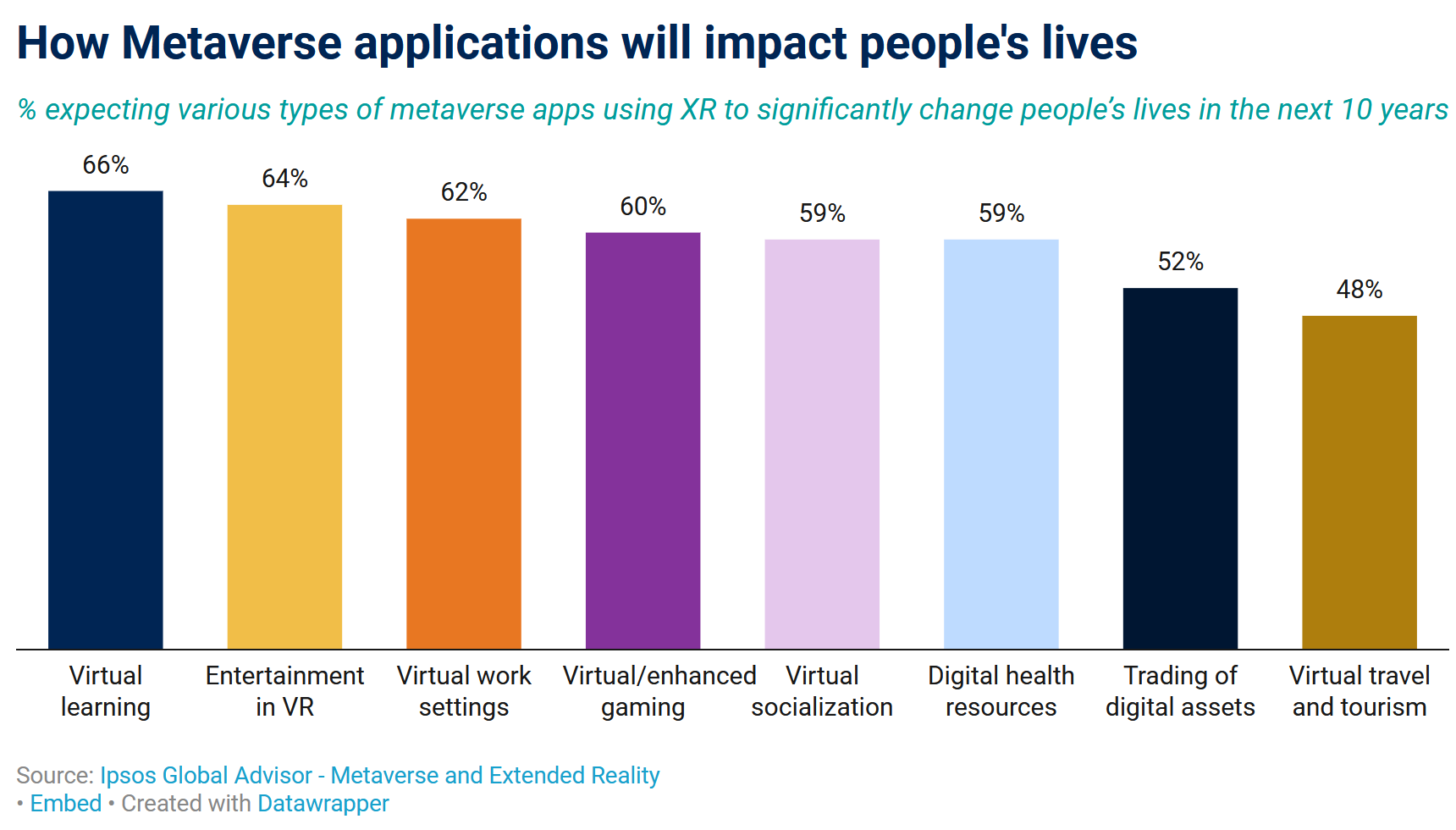
Polling company IPSOS haveconducteda global survey for the World Economic Forum. Some highlights are:
“Excitement about extended reality is significantly higher in emerging countries than it is in most high-income countries. In China, India, Peru, Saudi Arabia, and Colombia, more than two-thirds say they have positive feelings about the possibility of engaging with it.”
“Familiarity and favorability toward the new technologies are also significantly higher among younger adults, those with a higher level of education, and men than they are among older adults, those without a college-level education, and women.”
Excitingly for our exploration of the topic it can be seen in Figure[fig:applications]that education within metaverse spaces is the most anticipatedapplication, and we have seen that the emerging globals markets are themost optimistic about the technology overall. This is highly suggestiveof an opportunity.