It’s very likely that the ‘social first’ metaverse attempts such as Meta Horizons, Sandbox, and Decentraland represent failures to capture audiences. They crashed back down the hype curve as ‘Second Life’ did before them. Games based worlds such as Roblox are fairing far better, with millions of users, but it’s unclear if they have longevity, and they do not fulfil ambitions of an open metaverse.
Worse yet it seems that metaverse is not the most useful way to conduct business. It is evident that there are multiple factors which contribute to successful human-human communication. These factors remain important in telecommunication supported by technology, and are variously supported, unsupported, or modified by particular technologies. Third person large scale metaverse are clearly amongst the worse of the solutions.
While formal meeting paradigms are pretty well supported by commercially deployed systems, such ICT can be expensive, may need to be professionally managed, and high end equipment in board rooms are generally booked well in advance. These meetings seem to demand many
smaller supporting meetings between parties or groups of parties. The pressure here is clearly toward the now ubiquitous Teams and Zoom style formats, and these offer very poor support for social cues, and incur additional fatigue. These are known and well researched problems, and it is possible that the strategic pairing of Meta Horizons and Microsoft Teams will succeed where previous attempted have failed, or that somehow Microsoft Mesh for Teams will find and audience. They both seem to finally have the right assets and opportunity in principle. Apple also seem well positioned now, though how many users they can expect to own and work in their heavy spatial computing headset is unclear.
The ‘problem’ is a supporting technology for small less formal groups,or ad-hoc groups meeting to add clarity or context to formal meetings.Metaverse allows this kind of interaction, while not seeming to replaceformal meeting utility. Metaverse also may connect home and work spaceswithout bringing in those backgrouds, creating a level playing field. Amore advanced metaverse interface could also allow dynamism andmovement, connection of natural non vocal cues, without too muchencumbering technology overhead.
Core Assumptions
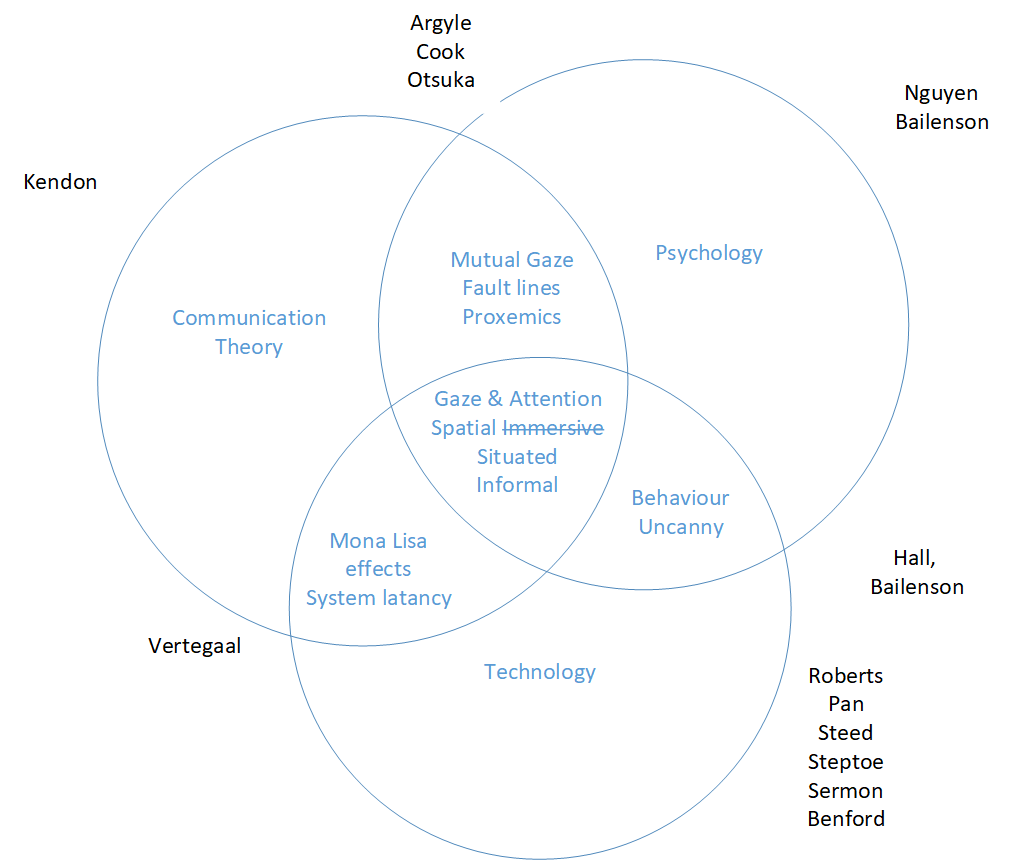
Figure[fig:Framework]shows the interlocking relationships between baseline communicationwhere the participants are present, and technology which attempts tosupport across distance.
Of most interest to this research is the centre of the Venn where meeting styles which are less formal, and perhaps dynamic, may occur. Looking at these items one by one gives us our core assumptions.
Gaze
Gaze is broadly agreed to be highly important for mediating flow. Mutual gaze is a rich emotional channel. The research must consider gaze. All of the researchers listed around the Venn have at some point engaged with this topic.
Attention
The non-verbal communication channel employed in ‘attention’ is assumed based upon the literature to be critical to smoothly leaving and entering a fast flowing conversation where concentration around a defined problem may be high (gesturing to a chair for instance). Again, all of the listed researchers have made reference to attention in their work.
Spatial (immersive)
Support for spatiality is important in a group setting so that directional non-verbal cues can find their target. The topic of spatial relationships between interlocutors cuts across all of the researchers, but this is not true of immersion. Immersion in a shared virtuality can certainly support the underlying requirements spatial, but the technical infrastructure required is out of scope (so this is struck through on the diagram). Roberts and Steed are the main expertise referenced even though this element is not expanded in the research.
Situated
Situated displays are those which are appropriate for their surrounding context, in this case the informal meeting. Roberts, Pan, Steed and Steptoe seem the most relevant researchers in these technology spaces.
Informal
Based on the literature proxemics is believed to be relevant in a meeting where subgroups can be instantiated and destroyed as the meeting evolves, and those where people can be invited in from outside the physical bounds of the meeting (informal spaces). Hall is the best source for this work. If it is assumed that people may come and go, and subgroups may be convened then Sermon and Benford are the best references through their work blending real and virtual spaces. This may be more consistent with less organised meetings such as those convened on demand (ad-hoc).
Peripheral Assumptions
Surrounding the centre of the Venn are additional relevant topics fromsocial science branches of theory
From verbal communication
It is assumed that the directionality of sound is important,Aoki2003and this will be engineered into the experimental design. It is assumedthat movement of the lips is an indicator and this is tied to latencyand frame rate in the vision system.
From non-verbal communication
It is assumed that eye gaze is of high importance, and that this information channel is supported by head gaze and body torque to a high degree. It is further assumed that mutual eye gaze is of less relevance in a multi party meeting where there is a common focus for attention but can be significant for turn passing. It is assumed that upper body framing and support for transmission of micro and macro gesturing is important for signalling attention in the broader group, and for message passing in subgroups.
Post ‘Meta’ metaverse
The current media around “metaverse” has been seeded by Mark Zuckerberg’s rebranding of his Facebook company to ‘Meta’, and his investment in the technology. Kraus et al suggest that this seems more a marketing and communication drive than a true shift in the company business model,kraus2022facebook but despite this Park and Kim identify dozens of recent papers of metaverse research emerging from Meta labs.park2022metaverse
In Stephenson’s ‘Snow Crash’ the Hero Protagonist (drolly called Hiro Protagonist) spends much of the novel in a dystopian virtual environment called the metaverse. It is unclear if Facebook is deliberately embracing the irony of aping such a dystopian image, but certainly their known predisposition for corporate surveillance, alongside their attempt at a global digital money is ringing alarmbells,as is their currentplanfor monetisation.
The second order hype is likely a speculativeplayby major companies on the future of the internet. Grayscale investmentpublished areportwhich views Metaverse as a potential trillion dollar global industry.Such industry reports are given to hyperbole, but it seems thetechnology is becoming the focus of technology investment narratives.Some notable exerts from a 2021reportby American bank JPMorgan show how the legacy financial institutions seethis opportunity:
In the view of the report it“The metaverse is a seamless convergence of our physical and digital lives, creating a unified, virtual community where we can work, play, relax, transact, and socialize.”
this isn’t the worst definition, and very much plays into both the value and mixed reality themes explored in this book.
They agree with the industry that monetisation of assets in metaverse applications is called “Metanomics”. It’s worth seeing this word once, as it’s clearly gaining traction, but it won’t be used in this book.
They make a point which is at the core of this book, that value transaction within metaverses may remove effective border controls for working globally. Be this teleoperation of robots, education, or shop fronts in a completely immersive VR world. They say: it“One of the great possibilities of the metaverse is that it will massively expand access to the marketplace for consumers from emerging and frontier economies. The internet has already unlocked access to goods and services that were previously out of reach. Now, workers in low-income countries, for example, may be able to get jobs in western companies without having to emigrate.”
There is a passage which foreshadows some of the choices made in this book: it“Expanded data analytics and reporting for virtual spaces. These will be specifically designated for commercial and marketing usage and will track business key performance indicators (this already exists in some worlds, such as Cryptovoxels)”. More on this later.
The report attempts to explore the web3 & cryptocurrency angles of metaverse. That’s also the aim of this book, but they have taken a much more constrained approach, ignoring the possibilities within Bitcoin.
They assert that strong regulatory capture, identification, KYC/AML etc should underpin their vision of the metaverse. This is far from the community driven and organically emergent narratives that underpin Web3. This is their corporate viewpoint, something they have to say. On the back of this they pitch their consultancy services in these areas.
There has been a reactive pushback against commercialisation andcorporateisation by the wider tech community, who are concernedaboutthe aforementioned monetisation of biometrics. Observers do nottrustthese ‘web’ players with such a potentially powerful social medium. Itis very plausible that this is all just a marketing play that goesnowhere and fizzles out. It is by no means clear that people want tospend time socialising globally in virtual and mixed reality. Thesemajor companies are making an asymmetric bet that if there is a moveinto virtual worlds, then they need to be stakeholders in thegatekeeping capabilities of those worlds.
To paraphrase Olson; the salesmen peddling the inevitability of themetaverse are stuck clinging to aesthetic details because, without them,they’re just talking about the internet. While virtual reality isenjoying hype right now, and will continue to develop, it facessignificant challenges related to the human body’s physiologicallimitations. For instance, the inner ear can become disoriented when auser experiences virtual movement without physically moving. This issuehas led to the development of VR applications that require compromisesbetween immersion and physical comfort.
Open Source
The Openstand principles are a great starting place for what an open metaverse might mean. They are
1. Cooperation
Respectful cooperation between standards organizations, whereby each respects the autonomy, integrity, processes, and intellectual property rules of the others.
2. Adherence to Principles
Adherence to the five fundamental principles of standards development:
Due process. Decisions are made with equity and fairness among participants. No one party dominates or guides standards development. Standards processes are transparent and opportunities exist to appeal decisions. Processes for periodic standards review and updating are well defined.
Broad consensus. Processes allow for all views to be considered and addressed, such that agreement can be found across a range of interests.
Transparency. Standards organizations provide advance public notice of proposed standards development activities, the scope of work to be undertaken, and conditions for participation. Easily accessible records of decisions and the materials used in reaching those decisions are provided. Public comment periods are provided before final standards approval and adoption.
Balance. Standards activities are not exclusively dominated by any particular person, company or interest group.
Openness. Standards processes are open to all interested and informed parties.
3. Collective Empowerment
Commitment by affirming standards organizations and their participants to collective empowerment by striving for standards that:
are chosen and defined based on technical merit, as judged by the contributed expertise of each participant;
provide global interoperability, scalability, stability, and resiliency;
enable global competition;
serve as building blocks for further innovation; and
contribute to the creation of global communities, benefiting humanity.
4. Availability
Standards specifications are made accessible to all for implementation and deployment. Affirming standards organizations have defined procedures to develop specifications that can be implemented under fair terms. Given market diversity, fair terms may vary from royalty-free to fair, reasonable, and non-discriminatory terms (FRAND).
5. Voluntary Adoption
Standards are voluntarily adopted and success is determined by the market.
Primitives
OpenAI identified the following 5 points about metaverse, in response to the query “What are 5 key points I should know when studying metaverse?“. This is an unexpectedly great answer, probably the cleanest I have found, but I cannot longer find it online.
Metaverse is a virtual reality platform that allows users to interact with each other and with digital objects in a virtual space.
Metaverse is a decentralized platform, meaning that there is no central authority or server that controls the platform.
Metaverse is an open platform, meaning that anyone can develop applications for the platform.
Metaverse is a secure platform, meaning that all data and transactions are encrypted and secure.
Metaverse is a scalable platform, meaning that it can support a large number of users and a large number of transactions.
The Metaverse Standard Forum highlights the following, which reads like the output from a brainstorm between academia and industry stakeholders.
collaborative spatial computing
interactive 3D graphics
ugmented and virtual reality
photorealistic content authoring
geospatial systems
end-user content tooling
digital twins
real-time collaboration
physical simulation
online economies
multi-user gaming
new levels of scale and immersiveness.
It’s not a useless list by any means, but it lacks the kind of product focus we need for detailed exploration of value and trust transfer.
Mystakidis identifies the following [155]:
Principles
Interoperable
Open
Hardware agnostic
Network
Technologies
Virtual reality
Augmented reality
Mixed reality
Affordances
Immersive
Embodiment
Presence
Identity construction
Challenges
Physical well-being
Psychology
Ethics
Privacy
This is quite an academic list. A lot of these words will be explored in the next section which is more of an academic literature review.
Nevelsteen attempted to identify key elements for a ‘virtual work’ in 2018 and these are relevant now, and described rigorously in the appendix of his
paper [156]:
Shared Temporality, meaning that the distributed users of the virtual world share the same frame of time.
Real time which he defines as “not turn based”.
Shared Spatiality, which he says can include an ‘allegory’ of a space, as in text adventures. It seems this might extend to a spoken interface to a mixed reality metaverse.
ONE Shard is a description of the WLAN network architecture, and conforms to servers in a connected open metaverse.
Many human agents simply means that more than one person can be represented in the virtual world and corresponds to ‘social’ in our description.
Many Software Agents corresponds to AI actors in our descriptions. Non playing characters would be the gaming equivalent.
Virtual Interaction pertains to any ability of a user to interact actively with the persistent virtual scene, and is pretty much a given these days.
Nonpausable isn’t even a word, but is pretty self explanatory.
Persistence means that if human participants leave then the data of the virtual world continues. This applies to the scenes, the data representing actions, and objects and actors in the worlds.
Avatar is interesting as it might seem that having avatar representations of connected human participants is a given. In fact the shared spaces employed by Nvidia for digital engineering do not.
Turning to industry; John Riccitiello, CEO of Unity Technologies says that metaverse is “The next generation of the internet that is:
always real-time
mostly 3D
mostly interactive
mostly social
mostly persistent
Expanding this slightly I choose the following primitives of what I think are important for a metaverse:
Fusing of digital and real life
Social first
Real time interactive 3d graphics first
Persistent
Supports ownership
Supports user generated content [157]
Open and extensible
Low friction economic actors and actions
Trusted / secure
Convergence of film and games
Blurring of IP boundaries
Blurring of narrative flow
Multimodal and hardware agnostic
Mobile first experiences
Safeguarding, and governance
Scaffolded by GenAI
Supports Agentic AI actors
Generalised and AI mediated ontologies
Societal glue and translational layer need to be AI mediated by a specialised and trained ontological specialist AI. This is a tremendous opportunity
Within the NFT, Web3 and crypto community it is normalised to refer to ownership of digital tokens as participation in a metaverse. This is reflected in the market analysis above. This fusing of narratives is reviewed in detail by Gadekallu et al in their excellent recent paper on Metaverse and Blockchain.gadekallu2022blockchain They conclude that much remains to be done here. This CNBC article highlights the confusion, as this major news outlet refers to Walmart prepares toofferNFTs”as an entry “into the metaverse”.
Lessons from MMORGS
The concept of ‘instrumental play’ was introduced by literary theoristWolfgang Iser in his 1993 essay “The Fictive and theImaginary.”iser1993fictive Iser divided play into two categories,free play and instrumental play, based on their relationship to goals.In his view, play becomes instrumental the moment it has a goal or a setof rules. The application of this concept to massively multiplayeronline games was later explored by sociologist T.L Taylor in her 2006book ‘Play Between Worlds.’taylor2009play According to Taylor,instrumental play is a goal-oriented approach that values efficiency,expertise, and strategy optimization. The point of playing is not toreach the end but to find the best way to get there.
The distinction between instrumental play and fun is often seen as afalse dichotomy. The two are not mutually exclusive but exist intension. Optimization can result in player behaviours that are simply nofun, but achieving goals or improving skills can also bring enjoyment.René Glas in his book ‘Battlefields ofNegotiation’glas2013battlefields describes the movement betweeninstrumental and free play in World of Warcraft, which has thedistinction of evolving across entirely different iterations of theInternet.
These virtual worlds of massively multiplayer online games are”interactively stabilized” systems, the result of the interactionbetween game designers and players. The social codes of practiceestablished by players can shape what is considered legitimate play.Success in these games is dynamically defined by consensus, as seen inMark Chen’s study of World of Warcraft ‘Leet Noobs.’chen2011leet
Tom Boellstorff conducted a study of user experiences in SecondLife,serapis2008coming which was criticized for not involving reallife or other websites or software in the analysis. The virtual worldsof massively multiplayer online games are not enclosed and players canengage with these games through various platforms, such as Discord,Twitch, Twitter, and Google Docs, without physically inhabiting thevirtual world. This concept of “paratext” was first introduced by Frenchliterary theorist Gerard Genette. He saw a book as containing the textof the book and additional components, such as the cover, title,foreword, etc., that are necessary to complete the book but not part ofthe primary text. These additional texts influence the meaning of theprimary text. The definition was later expanded by Mia Consalvo, whodefined paratext as any text that “may alter the meanings of a text,further enhance meanings, or provide challenges to sedimented meanings.”Examples of paratext include reviews, pre-release trailers, etc.Kristine Ask observed the impact of paratext on theorycrafting expertisein World of Warcraft, which was later confirmed by the rise of twitchstreams. Mark Chen’s dissertation Leet Noobs focuses on how AddOns inWorld of Warcraft can become essential agents in raid groups by assumingcognitive load. The concept is based on the idea of object-orientedontology and actor-network theory.cole2013call These theories arecomplex and contested, but the boundaries between real people andvirtual AI actors in virtual social spaces are certainly blurred.
Virtual spaces are not separate from the real world, but are instead anextension of it. The key factor in making a virtual world compelling isnot its realism, but the fact that people give meaning to their lives byentangling themselves in projects with others, even when those othersare not other people. Worlds become real when people care about them,not when they look like the real world.
Immersive and third person XR
In considering the needs of business to business and business to clientsocial VR is it useful to compare software platforms. We have seen thata global connected multiverse is a marketing proposition only, and maybe a decade or more away. Contenders currently look more like one ofthree catagories; games, limited massively multiplayer worlds, ormeeting support software. These will converge.
More like a digital twin
One of the most intuitive ways to view a metaverse is as a virtual landscape. This is how metaverse was portrayed in the original Neal Stephenson use of the word. ‘Digital twin’ is another much abused industry term which trends toward a 3D representation of real worldspaces and objects. Sometimes these virtual objects are connected to the real by telemetry, allowing industrial monitoring applications. Much is made of such systems in simulation brochures, and on the web, but it’s surprisingly hard to find real world applications of the idea outside of complex large scale systems engineering (aerospace). The costs of maintenance are simply too high. The US army owns the digital twin which could be called closest to “The Metaverse” (note the intentional capitalisation). Their global simulation environment mirrors real world locations for their training needs. The European space agency is building an Earth digital twin for climate research, as is Nvidia,but again it’s unclear what this offers over and above access to direct data feeds, and of course such an ambitious project likely has an ecological cost!
Within industry digital twins are seen as the primary use case for metaverse, with even the world economic forum subscribing to the hype.To be clear, there is enormous effort, investment, and potential here, with NVIDIA choosing to bind their Omniverse platform to their substantial hype wave.
Omniverse has become the darling of 2024 and we will investigate it further Update Cycle
Key new capabilities announced:
Integration of generative AI like Adobe Firefly to enhance creation workflows (wow!)
New developer tools and templates for building apps and experiences
Semantic search capability with Deep Search to find 3D assets easily Optimizations for photorealistic real-time rendering and path tracing withAI-accelerated denoising powered by new RTX GPUs XR capabilities native to the platform (so you can deploy on AR/VR headsets)
Upgrades to core apps like Omniverse Audio2Face and USD Composer Graphics Delivery Network (GDN) to performantly serve your 3D experience around the world Support for new workflows across industrial use cases like digital twins
Geolocated AR
Overlaying geospecific data into augmented reality (think Pokemon Go) isprobably the ultimate utility of digital twin datasets. It’s such acompelling application space that we will have more on this later.
More like a metaverse
Second Life
Notable because it’s the original and has a decently mature marketplace.Some 80Mwas[paidtocreators](https://www.zdnet.com/article/high−fidelity−invests−in−second−life−to−expand−virtual−world/)inSecondLifein2021inawidereconomicecosystemofaround650M.It’s possible to write a whole book on Second life, and indeed manyhave. It’s longevity means that there’s more study of business uses ofsuch systems than in any other platform.
Mozilla Hubs
Hubs is a great option for this proposal, and might be worth integratinglater. It runs well in a browser and on VR hardware.
Open source, bigger scale, more complex
Choose avatars, or import your own
Environments are provided, or can be designed
Useful for larger conferences with hundreds or thousands of members but is commensurately more complex
Quest and PC
Larger scenes within scenes
Counter social realms
A relatively new platform linked to a new model of social media which excludes countries which habitually spam. It uses Mozilla Hubs for it’s engine.
Roblox
If anything can currently claim to be the metaverse it’s Roblox. Around 60 billion messages are sent dailyin Roblox. Investment in the metaverse ‘angle’ of the platform isstepping up with recent announcements such as “SpotifyIsland”.The company has announced text based generative art creation of scenes,and is integrating the playstation headset in their PS4 release. It’svery notable that it still hasn’t become a profitablebusiness.It is important to note that Roblox has banned NFTs. Nike have garneredsignificantattentionfor their metaverse store, front with their Roblox based metaverse. AsTheoPriestleypoints out this is likely just another expensive experiment, with afinite lifespan. expanding into generativeAI
This text is from wikipedia and will be updated when we have a chance totry VRChat properly. It’s much loved already by the Bitcoin community.
“VRChat’s gameplay is similar to that of games such as Second Life andHabbo Hotel. Players can create their own instanced worlds in which theycan interact with each other through virtual avatars. A softwaredevelopment kit for Unity released alongside the game gives players theability to create or import character models to be used in the platform,as well as build their own worlds.
Player models are capable of supporting “audio lip sync, eye trackingand blinking, and complete range of motion.
VRChat is also capable of running in “desktop mode” without a VRheadset, which is controlled using either a mouse and keyboard, or agamepad. Some content has limitations in desktop mode, such as theinability to freely move an avatar’s limbs, or perform interactions thatrequire more than one hand.
In 2020, a new visual programming language was introduced known as”Udon”, which uses a node graph system. While still considered alphasoftware, it became usable on publicly-accessible worlds beginning inApril 2020. A third-party compiler known as “UdonSharp” was developed toallow world scripts to be written in C sharp.”
Meta Horizon Worlds & Workrooms
Horizon Worlds is the Meta (Facebook) meteverse, and Workrooms it’sbusiness offering and a subset of the “Worlds” global system. It iscurrently a walled garden without connection to the outside digitalworld, and arguably not therefore a metaverse.
The Financial Times [took a look](needs a link) at their patent applications and noted that the travel is toward increased user behaviour tracking, and targeted advertising.
Facebook actually have a poor history on innovation and diversification of their business model. This model has previously been tracking users to target ads on their platform, while increasing and maintaining attention using machine learning algorithms.
It makes complete sense then to analyse the move by Meta into 3D socialspaces as an attempt to front run the technology using their hugeinvestment capacity. Facebook have recently taken a huge hit to theirshare price. Nothing seems to have changed in the underling businessexcept Zuckerberg’s well publicised shift to supporting a money losinggamble on the Metaverse. It is by no means clear that users want this,that Meta will be able to better target ads on this new platform, orthat the markets are willing to trust Zuckerburg on this proactive move.
With all this said the investment and management capacity and capabilityat Meta cannot be dismissed. It is very likely that Meta will be able torapidly deploy a 3D social space, and that it’s development willcontinue to be strong for years. The main interface for Horizon Worldsis through the Meta owned and developer Oculus headset, which isexcellent and reasonably affordable. It has been quite poorly receivedbyreviewersbut will likely improve, especially if users are encouraged to innovate.
Webaverse
Webaverse are an open collective using opensource tools to create interoperable metaverses.
Vircadia
The applications and platforms detailed above have their benefits, butfor the application stack in the next section of the book Vircadia hasbeen chosen. The following text is from their website, and is aplaceholder which gives some idea. This section will be written outcompletely to reflect our use of the product to support emerging market users.
Vircadia is open-source software which enables you to create and sharevirtual worlds as virtual reality (VR) and desktop experiences. You cancreate and host your own virtual world, explore other worlds, meet andconnect with other users, attend or host live VR events, and much more.
The Vircadia metaverse provides built-in social features, includingavatar interactions, spatialized audio, and interactive physics.Additionally, you have the ability to import any 3D object into yourvirtual environment. No matter where you go in Vircadia, you will alwaysbe able to interact with your environment, engage with your friends, andlisten to conversations just like you would in real life.
More like crypto NFT virtual land
This next three are a placeholder taking text from the linkedsiteand will be swapped out: The digital land narrative isfading.
Decentraland
Decentraland is a large 3D (but not VR) space developed by Argentinedevelopers Esteban Ordano and Ari Meilich. It is a decentralizedmetaverse purporting to be owned by its users, but actually ownedcompletely by a foundation based inPanama.The users can shop, buy things, invest, and purchase goods in a virtualspace. The project is built on Ethereum and has a (speculative)valuation in the billions of dollars.
Decentraland was launched in February 2020, and its history includes aninitial coin offering in August 2017, where their MANA token sale raisedapproximately 24milliondollarsincryptocoins.Thiswasfollowedbya“terraformingevent”whereparcelsofland,denominatedinLANDtokens,wereauctionedoffforanadditional28 million in crypto. Theinitial pitch for Decentraland emphasized the opportunity to own thevirtual world, create, develop, and trade without limits, make genuineconnections, and earn real money. However, the actual experience inDecentraland has faced criticisms such as poor graphics, performanceissues, and limited content. They have recently dropped their pretenceof ever supporting VR.
One example of these limitations is the now-defunct pizza kiosk thataimed to facilitate ordering Domino’s pizza via the metaverse usingcryptocurrency. This concept, though intriguing, was hindered by a lackof official support from Domino’s and the inherent inefficiencies ofusing a virtual world as an intermediary for purchasing goods andservices.
Similarly, attempts to create virtual amusement park rides andattractions within Decentraland have suffered from poor performance anda lack of interactivity. These issues stem from the limitations of thetools and resources available for building experiences within theplatform, as well as the inherent difficulties in creating engagingexperiences in a ‘world’ that is supposed to perform too many functionsat once.
In addition to the technical challenges, Decentraland (and all thesecrypto metaverse projects) have clearly promoting unrealisticexpectations to foster speculative investments. The notion thatbusinesses and individuals will eventually “live inside” the metaverseis not only a poetic interpretation but also an unrealistic expectationgiven the current state of VR technology.
As it stands, Decentraland is unlikely realize its supposed potential asan invisible, seamless infrastructure for a wide range of digitalexperiences. Until the platform can address its core issues, it islikely that projects like the ‘Decentraland Report’ (it’s user deliverednews platform), and others will continue to fail to deliver on theirpromises. To quote Olson’s highlycritical (and correct)presentation on Decentraland: “..it can’t even handle properlyemulating Breakout, a game from 1976 that you can play on goddamn Googleimages! Steve Wozniak built Breakout fifty years ago to run on 44 TTLchips and a ham sandwich and that’s still somehow too demanding a gamingexperience …”
Like all of these attempts the actual information content of withinDecentraland boils down to text on billboards, and links to the outsideWeb. It’s a terrible product, and really just another example of acrypto scam which never really intended to be developed for the longhaul.
Sandbox
The Sandbox, a decentralized gaming platform built on the Ethereumblockchain, has garnered attention for its promise of a vibrantecosystem filled with user-generated content. However, despite itsambitious vision, the project has faced various challenges andcriticisms similar to Decentraland. Limited use cases and adoptionremain a significant challenge for The Sandbox. While the platform aimsto create a vast and engaging gaming ecosystem, it has yet to gainwidespread adoption, leading to a limited number of users anddevelopers. This lack of user engagement raises questions about thelong-term viability of the project, as the value of virtual land,assets, and in-game experiences may remain limited without a thrivingcommunity. Like Decentraland it is a manipulated hype bubble, attractingglowing paid press reports in some media, and ‘interest’ from nationaland regional ‘branches’ of global brands which are then spun to createartificial hype in main stream media. The tradable NFTs within theseearly platforms are obviously subject to insider trading, pricevolatility, wash trading, and other harmful activities.
The Sandbox places too much emphasis on the speculative aspect ofvirtual land and asset trading, rather than focusing on creating agenuinely engaging gaming ecosystem. This focus on speculation couldlead to an unsustainable bubble with inflated asset prices, and it seemslikely we have already seen most of the collapse of this ecosystem.
The actual experience of interacting with The Sandbox’s gaming productsleaves much to be desired. For instance, the platform’s games may sufferfrom lag and poor performance due to the technical limitations ofblockchain technology. Additionally, the quality of user-generatedcontent can be highly variable, as not all creators possess the skillsand resources to develop engaging gaming experiences. As a result, usersmight find themselves sifting through a plethora of low-quality games,which can be frustrating and time-consuming.
Concerns about centralization persist, as some critics argue that theproject is not entirely decentralized. The team behind The Sandbox stillholds a significant amount of control over the platform’s developmentand governance, potentially undermining the project’s core vision of adecentralized gaming ecosystem.
Space Somnium
Somnium Space is just another one of these, but with more VR. It allowsusers to join in either through a downloadable VR client or abrowser-based version to function like any other web app. It sufferedthe same problems at Decentraland and Sandbox. They are terribleproducts, with hype, manufactured by money, extracted from users, oftenconvinced by paid celebrity endorsements. It’s the NFT space, butsadder, and technically worse, and likely not for very much longer.
More like industrial application
As the word metaverse has gained in use, so have some traditional usersand researchers in mixed reality switched to use of the term. Siyaev andJo describe an aircraft training metaverse which incorporates ML basedspeech recognition.siyaev2021towards This class of mixed realitytrainer traditionally finds positive results, but is highly taskspecific.
Global enterprise perspective
Microsoft bought Activision / Blizzard for around seventybillion dollars. This has been communicated by Microsoft executives as a“Metaverse play”, leveraging their internal game item markets, and theirmassive multiplayer game worlds to build toward a closed metaverseexperience like the one Meta is planning. This builds on the success ofearly experiments like the Fornite based music concerts, which attractedmillions of concurrent users to live events.
There are three emerging focuses, the social metaverses for pleasure,and business metaverses for larger group meetings andtraining,heiphetz2010training; @aldrich2005learning and a Nvidia’sevolving collaborative creationmetaversefor digital engineers and creatives. They’re all pretty different‘classes’ of problem. The social metaverse angle where Facebook isconcentrating most effort is of less interest to us here, thoughobviously markets will exist in such systems for business to customer.The next section will explore some of the software tools available toconnect people. Everything looks pretty basic right now in all theavailable systems, but that will likely change over the next couple ofyears.
More like meeting support
Spatial
Spatial is worth a quick look because it’s a business first meetingtool, and comparatively well received by industry for that purpose.
Very compelling. Wins at wow.
Great avatars, user generated
AR first design
Limited scenes
Smaller groups (12?)
Limited headset support
Intuitive meeting support tools
No back end integration
MeetinVR
Good enough graphics, pretty mature system
OK indicative avatars, user selected
VR first design
Limited scenes
Smaller groups (12?)
Quest and PC
Writing and gestures supported
Some basic enterprise tools integration
Bring in 3D objects
Need to apply for a license?
Glue
Better enterprise security integration
Larger environments, potential for breakouts in the same space. Workshop capable
3D object support, screen sharing, some collaborative tools
Apply for a license
Fairly basic graphics
Basic avatars
Quest and PC
Writing and gestures supported
Mac support
FramesVR
Really simple to join
Basic avatars
Bit buggy
3D object support, screen sharing, some collaborative tools
Quest and PC
Larger scenes within scenes
Runs in the browser
Engage
Great polished graphics
Fully customisable avatars
Limited scenes
Presentation to groups for education and learning
PC first, quest is side loadable but that’s a technical issue
BigScreen VR
Seated in observation points in a defined shared theatre
Screen sharing virtual communal screen watching, aimed at gamers, film watching
up to 12 user
Gather
Gather is an oddball meeting space based around fully customisable 2Drooms with a game feel. It’s really a spatialised twist on videoconferencing but interesting.
NEOSVR
Notable because it’s trying to integrate cryptomarketplaces, but we haven’t tried it yet.
Mixed reality as a metaverse
Spatial anchors allow digital objects to be overlaid persistently in the real world. With a global ‘shared truth’ of such objects a different kind of metaverse can arise. One such example is clearly the AppleVision Pro
Augmented reality
Marc Petit, general manager of Epic Games envisages a 2 watt pair ofglasses, connected to a 10 watt phone, connected to a 100 watt computeron the edge. This is a device cascade problem which has not yet beensolved, and is at the edge of achievable thermodynamics and latency.
The closest technology at this time seems to be Lumus’ waveguideprojectors which are light, bright and highresolution. Peggy Johnson, CEO of Magic Leap, one of the market leaderssaid: it“If I had to guess, I think, maybe, five or so years out, forthe type of fully immersive augmented reality that we do.”
In a GQprofileCook, the Apple CEO talked at length about the challenges andopportunities of AR headsets. He has been emphasizing the importance ofaugmented reality over VR for almost a decade, believing that AR canenhance communication and connection by overlaying digital elements onthe physical world. Cook’s vision aligns with Apple’s rumoured mixedreality headset, which is expected to cost around $3,000 and focus on‘copresence’, which we have discussed at length in this chapter. Apple’sapproach differs from Meta’s metaverse, as Apple aims to integratedigital aspects into the real world rather than create purely digitalspaces. This is an interesting area for our applications of bringingsmall teams together, but the pricing at this time is significantly atodds with our chosen market. Cook, like this book, has highlighted AR’spotential in education and its ability to bring people together in thereal world.
Ubiquitous displays
This includes laser retinaldisplays,and smart screens which are context and user aware.