-
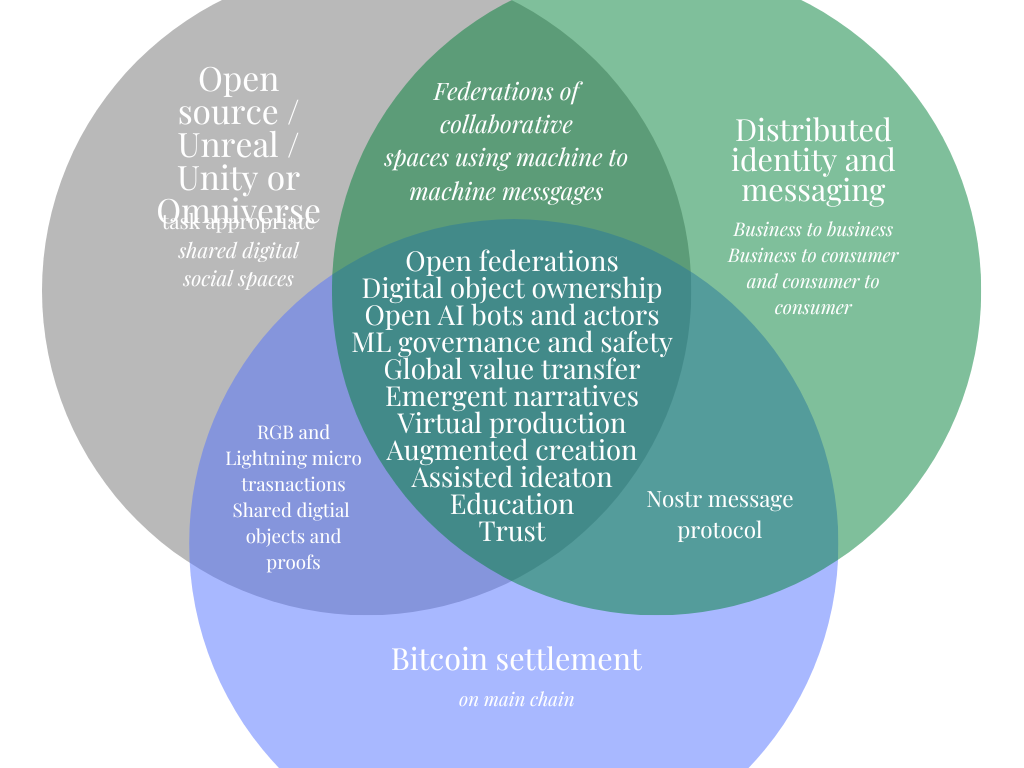
As a reminder this is the Venn diagram I made in 2022 while figuring out what to research,
Artificial Intelligence
- The development of Artificial General Intelligence (AGI) and Artificial Superintelligence (ASI) is highly controversial and debated. Experts disagree on the likelihood, timeline, and implications of these advanced AI systems
- AGI/ASI may not have human-like emotions, desires, or anthropomorphised traits that we imagine. Its cognition and intentions could be entirely alien and incomprehensible to us
- It’s unclear whether an AGI/ASI would be sympathetic and protective of humanity as an “ancestor” species, or view us as irrelevant and expendable. Both scenarios are conceivable
- China’s model of a more closed, centralized, state-controlled technology ecosystem could potentially be applied to AGI development. This could allow for more rapid, coordinated, and sandboxed AGI research compared to a fragmented global effort
- In the near-term, AI presents major risks around privacy, surveillance, manipulation, and control at the hands of corporations and governments. Regulation is needed to curtail abuses of the technology.
- AI-generated content is rapidly proliferating online and has the potential to flood the digital landscape, displacing human-created art/music/writin. This could lead to cultural homogenisation and stagnation, or more likely a fracturing of common purpose.
- If AI renders broad swaths of human labour obsolete, we could face severe economic disruption and inequality if social policies (e.g. universal basic income) are not in place to ensure a humane transition
- If not properly controlled and aligned, an advanced AGI/ASI could pose an existential catastrophic risk to humanity. A super-intelligent AI may pursue goals misaligned with human interests and wellbeing
- The companies and countries that develop AGI/ASI first will have an unprecedented concentration of power and competitive advantage. A unipolar AGI scenario is dangerous if the technology is not developed carefully in a globally collaborative manner
- AI will give humans “superpowers” by acting as an always-available intelligent assistant deeply integrated into XR interfaces. AI will allow us to instantly access knowledge and skills beyond our own abilities
- In the long-term, (post-Singularity future?), super-intelligent AI could potentially solve major human challenges like scarcity, leading to an abundant “techno-utopian” society. There is a possibility that ASI treats humanity with compassion
- AI is a critical catalyst and requirement for the growth and advancement of XR. AI enables key XR functionalities like environment scanning, voice/eye/hand tracking, and increasingly photorealistic avatar creation
- Synthetic training data generated by AI may eventually surpass real-world data in terms of producing high-quality AI models
- AI could greatly enhance education by enabling personalized one-on-one tutoring and adapting to each student’s learning style and pace
Extended Reality / Mixed Reality / Spatial Computing
- XR (VR/AR/MR) will eventually become the primary way we interact with digital information, as it aligns with how our brains naturally process information in 3D space. The merging of the physical and digital worlds is inevitable
- The metaverse, while currently overhyped, ultimately represents the future of an interconnected network of virtual worlds. As XR technology advances, we will increasingly operate in virtual worlds as naturally as we do in the physical world today
- The early metaverse will start off as walled gardens controlled by large tech companies. However, it’s plausible that more open standards, interoperability, and decentralization will emerge over time, similar to the evolution of the early Internet
- Bystander privacy is a major concern with always-on AR glasses and headsets. People may have their data captured without consent just by being in the presence of someone wearing XR devices
- XR and AI are highly complementary and will help address each other’s limitations. AI will make the metaverse possible, while the metaverse will provide an outlet for human creativity and self-actualization in a post-labor world
- XR has the potential to greatly enhance fields like medicine, education, and industrial design by providing rich spatial computing interfaces.
- The lack of compelling content and experiences has been a limiting factor for XR adoption. However, AI-generated assets could help solve this content bottleneck and enable the rapid creation of photorealistic virtual worlds
- Privacy and security remain ongoing concerns in XR ecosystems, as they capture even more biometric and behavioral data than traditional computing interfaces
- VR in particular still faces physiological challenges around multi-sensory immersion (e.g. locomotion) that will need to be solved before the technology can go fully mainstream
Digital Value Transmission
Convergence
- The intersection of AI, XR, and open, decentralized networks represents a powerful convergence of technologies that could reshape the fabric of our social and economic lives. By leveraging the unique strengths of each domain
- the immersive power of XR, the intelligence and adaptability of AI, and the openness and composability of decentralized protocols
- we can create a more vibrant, dynamic, and equitable digital future. However, realizing this potential will require careful design, collaboration, and governance to ensure that these technologies develop in a way that promotes human agency, privacy, and flourishing.
- AI and XR are deeply intertwined and mutually reinforcing technologies
- AI is a critical enabler for XR, powering key functionalities like environment understanding, natural interaction, and content creation
- XR provides a rich, immersive interface for AI systems to interact with humans and the physical world
- The combination of AI and XR will give rise to new forms of human-machine collaboration and augmentation
- AI-powered virtual assistants will be deeply integrated into XR environments, providing real-time guidance, knowledge, and skills enhancement
- XR will provide a spatial computing platform for AI systems to learn from and interact with the world in more natural and intuitive ways
- The intersection of AI and XR will blur the lines between the physical and digital worlds
- AI will enable the creation of photorealistic virtual environments that are increasingly indistinguishable from reality
- XR will allow for seamless blending of digital content and experiences into the physical world, creating a unified “metaverse”
- AI and XR will intersect to create new forms of social interaction and collaboration
- AI-driven avatars and agents will facilitate rich, immersive social experiences in virtual worlds
- XR will provide a shared spatial context for humans and AI systems to interact and collaborate in real-time
- The intersection of AI and XR will give rise to new economic models and value creation opportunities
- Virtual goods, experiences, and services will become increasingly valuable in immersive XR environments
- AI will enable the creation of personalized, adaptive, and intelligent virtual assets and experiences
- The combination of AI and XR will raise new ethical and societal challenges
- The blurring of physical and digital reality may have profound impacts on privacy, identity, and social norms
- The increasing power and pervasiveness of AI systems in XR environments may raise concerns around control, transparency, and accountability
- Open, decentralized networks will be critical for enabling seamless value transfer and interoperability in the metaverse
- Centralized, walled-garden approaches will limit innovation and user choice
- Open standards and protocols will allow for greater composability and network effects
- Blockchain technologies like Bitcoin, particularly with Layer 2 and Layer 3 solutions, can provide a foundation for secure, efficient, and scalable value transfer in XR/AI ecosystems
- Bitcoin’s decentralized, trustless architecture aligns well with the open, permissionless ethos of the metaverse
- Layer 2 solutions like Lightning Network can enable fast, low-cost microtransactions for virtual goods and services
- Layer 3 protocols can enable additional functionality and interoperability on top of the core Bitcoin blockchain, including governance models
- Cryptographic tokens and smart contracts can enable new forms of value creation, ownership, and exchange in XR/AI environments
- Unique and fungible digital objects (RGB20/21) can provide provable ownership and scarcity for virtual assets at scale
- Decentralised autonomous organizations (DAOs) can enable new forms of community governance and collaboration
- Interoperability and composability will be key for enabling value transfer across different XR/AI platforms and experiences
- Open standards for identity, asset ownership, and data portability will allow users to seamlessly move between virtual worlds
- Bridges and cross-chain protocols can enable value transfer and communication between different blockchain networks
- Decentralised finance (DeFi) protocols can provide new avenues for earning, investing, and monetising value in XR/AI ecosystems
- Virtual real estate, goods, and services can be tokenized and traded on decentralized exchanges
- Lending, borrowing, and staking protocols can provide new ways to generate yield and incentivize participation
- Privacy and security will be critical considerations for value transfer in open XR/AI networks
- Zero-knowledge proofs and other advanced cryptographic techniques can enable privacy-preserving transactions and interactions
- Multi-party computation and secure enclaves can allow for trustless collaboration and data sharing between AI agents
- Disney invests $1.5bn in Fortnite maker Epic Games to create new ‘universe’ | Walt Disney Company | The Guardian