AI should enhance human and societal well-being by augmenting human capabilities, enriching quality of life, supporting physical and mental health, enabling meaningful work, strengthening social connections, and contributing to flourishing individuals and communities.
Semantic Classification
Content
- AI should enhance human and societal well-being by augmenting human capabilities, enriching quality of life, supporting physical and mental health, enabling meaningful work, strengthening social connections, and contributing to flourishing individuals and communities.
Funding and Organisational Changes
- 60% of generative AI investments come from innovation budgets, while 40% derive from permanent budgets.
- 58% of permanent funding was redirected from existing allocations, highlighting a growing commitment to AI transformation.
- Innovation teams are being reimagined as coordination hubs integrated across organisational functions.
Bitcoin Layer 2 and Layer 3 Solutions
- This page provides an overview of the Layer 2 and Layer 3 solutions that are being developed to enhance the scalability, functionality, and usability of the Bitcoin network.
The Lightning Network
- The Lightning Network is the most well-known Layer 2 solution for Bitcoin. It enables instant, low-cost payments by creating a network of payment channels between users.
African adoption
- Africa has one of the most fragmented banking, payment, and currency systems in the world, which makes simple financial tasks like paying a bill, sending money, or accepting money extremely difficult. Over half of Africa does not have access to a bank account, so people hold and save everything in cash, which is often stolen and loses value due to inflation. It is also difficult to get money in and out of many African countries because only about 40% of people have active internet access, and must rely on financial institutions. Bitcoin is being used in Africa as an alternative form of money that resolves these issues. It is being taught in education centers in underdeveloped areas, giving children the opportunity to learn about and use Bitcoin as a way to access financial services that have been unavailable to them for generations. However, the rest of the country may have difficulty implementing the use of Bitcoin due to issues such as a lack of electricity and internet access, as well as government policies that centralize power.
Gridless
- In the course of researching this book we see most opportunity for change in Africa. As an example the company ‘Gridless’ began by examining different energy sources in Africa and exploring opportunities for larger energy generation and grid-connected energy. However, they found that the real benefit of gridless energy was in providing energy to places that were not well connected and did not have a good grid. They contacted mini-grid providers all over East and Southern Africa to learn about their problems. A mini-grid is defined as a project that generates energy under 2 megawatts, often under 1 megawatt. They discovered that these providers had to overbuild for the community, resulting in stranded energy. The company found a way to utilize this stranded energy by placing Bitcoin miners on it and paying the mini-grid providers for it. They tested this method and found it to be successful. Additionally, they implemented a system to automate and remotely turn off the power during periods of high usage to make the grid more efficient and sustainable. This solution provided a win-win-win situation for the company, the mini-grid providers, and the communities they served.
- The company utilizes Bitcoin miners to create space for other activities and to increase access to affordable energy for communities and small businesses. As energy usage increases in the community, the company decreases their usage of miners and moves them to other locations. This is outlined in their contract s with partners. The company is currently testing this method and has encountered some challenges, such as losing internet connection at one of their sites and poor rainfall affecting the amount of water flowing into turbines. They have found that building a lean operation with flexible and adaptable staff is crucial, as well as creating processes and systems to manage variables. The company also faces unique environmental factors such as lightning strikes, which require them to turn off their operations temporarily.
- Gridless suggest that those who are critical of opportunities like this often come from a place of privilege and do not understand the consequences of their actions in places like Africa where access to electricity and other resources is limited. They argue that these critics, who are often from the West, have blinders on and cannot see the impact of their actions on a global scale. They suggest that more people need to travel and have diverse experiences in order to change their perspective on Bitcoin and its potential to support human flourishing in underprivileged areas. They also mention that gridless plans may become a case study for the positive impact of Bitcoin mining on economic opportunities, particularly in rural Africa.
- Stranded: How Bitcoin is Saving Wasted Energy and Expanding Financial Freedom in Africa
Key Statements
- Adam Wright, Vespene Energy
- Emphasized the economic and scalability benefits of Vespene’s technology in monetizing landfill gas while reducing emissions.
- Dan Crouse, Viridi
- Highlighted the immediate environmental benefits and the role of the project as a bridge while the RNG facility is being built.
Spatial web
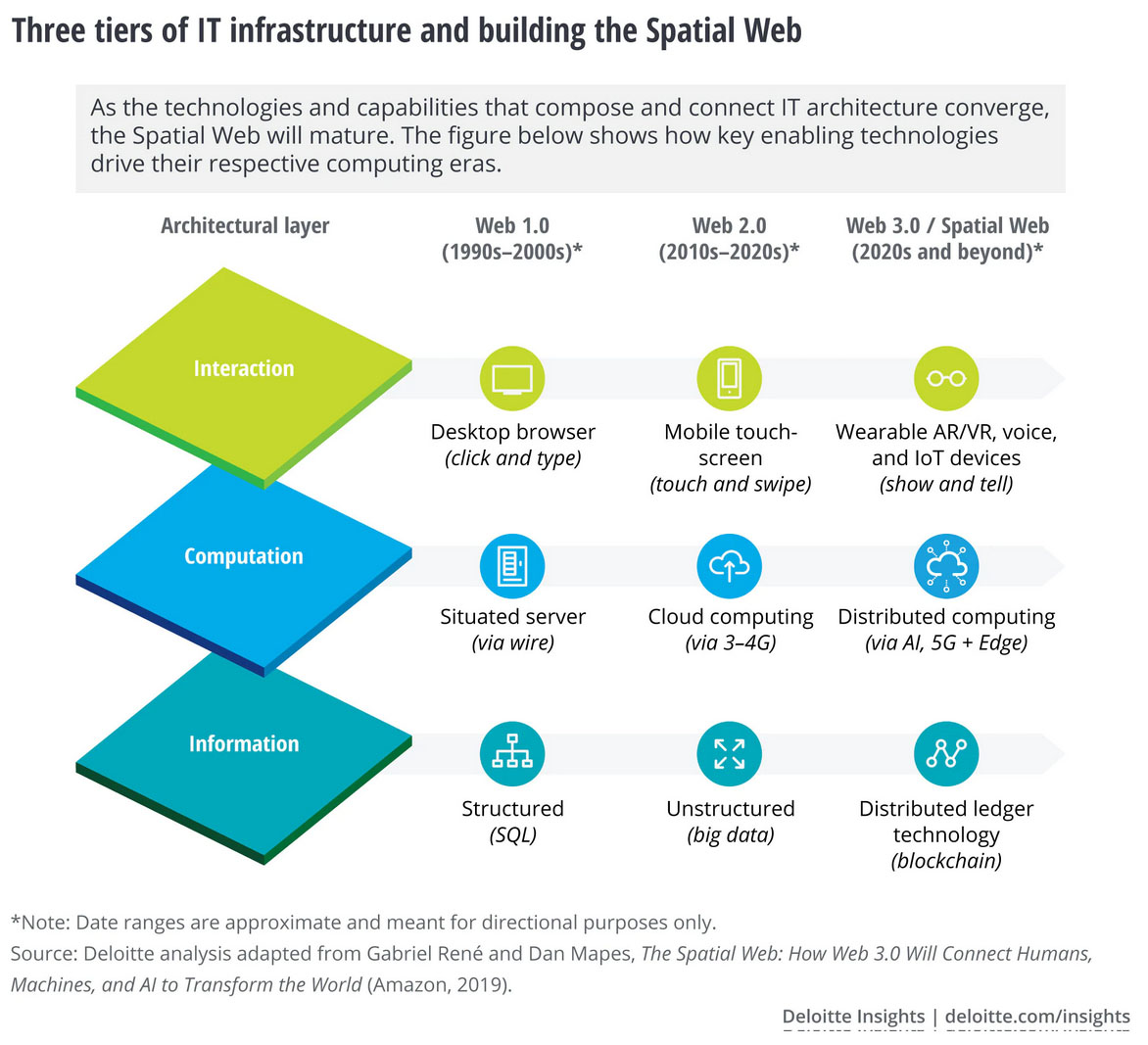
- “The Spatial Web”, a blurring of the boundaries between digital and geospatial physical objects, seems to have developed from the strands in the original W3C scope around devices in the real world. It has been concentrating around AR and VR but is being marketed and amplified with the same references to availability of data (See Figure 2.1 from a Deloitte accounting report). This too is finding little traction in practice, though obviously the component technologies continue to enjoy rapid development. Nonetheless, this interpretation of Web3 becomes valuable when examining Metaverse and Telecollaboration.
Spatial web
- “The Spatial Web”, a blurring of the boundaries between digital andgeospatial physical objects, seems to have developed from the strands inthe original W3C scope around devices in the real world. It has beenconcentrating around AR and VR but is being marketed and amplified withthe same references to availability of data (See Figure2.1from a Deloitte accounting report). This too is finding little tractionin practice, though obviously the component technologies continue toenjoy rapid development. Nonetheless, this interpretation of Web3becomes valuable when examining Metaverse later.
Deloitte Spatial WebOverviewReused with permission.
Problem Statement
- It’s very likely that the ‘social first’ metaverse attempts such as Meta Horizons, Sandbox, and Decentraland represent failures to capture audiences. They crashed back down the hype curve as ‘Second Life’ did before them. Games based worlds such as Roblox are fairing far better, with millions of users, but it’s unclear if they have longevity, and they do not fulfil ambitions of an open metaverse.
- Worse yet it seems that metaverse is not the most useful way to conduct business. It is evident that there are multiple factors which contribute to successful human-human communication. These factors remain important in telecommunication supported by technology, and are variously supported, unsupported, or modified by particular technologies. Third person large scale metaverse are clearly amongst the worse of the solutions.
- Of particular importance is interpersonal gaze.Cook1977; @Kleinke1986; @Fagel2010 Non-verbal cues are also important across multiple modalities of sight, sound,Otsuka2005 and position of interlocutors,Kendon1967 extending to the whole body.Kleinke1986; @Nguyen2009
- While formal meeting paradigms are pretty well supported by commercially deployed systems, such ICT can be expensive, may need to be professionally managed, and high end equipment in board rooms are generally booked well in advance. These meetings seem to demand many smaller supporting meetings between parties or groups of parties. The pressure here is clearly toward the now ubiquitous Teams and Zoom style formats, and these offer very poor support for social cues, and incur additional fatigue. These are known and well researched problems, and it is possible that the strategic pairing of Meta Horizons and Microsoft Teams will succeed where previous attempted have failed, or that somehow Microsoft Mesh for Teams will find and audience. They both seem to finally have the right assets and opportunity in principle. Apple also seem well positioned now, though how many users they can expect to own and work in their heavy spatial computing headset is unclear.
- The ‘problem’ is a supporting technology for small less formal groups,or ad-hoc groups meeting to add clarity or context to formal meetings.Metaverse allows this kind of interaction, while not seeming to replaceformal meeting utility. Metaverse also may connect home and work spaceswithout bringing in those backgrouds, creating a level playing field. Amore advanced metaverse interface could also allow dynamism andmovement, connection of natural non vocal cues, without too muchencumbering technology overhead.
Mozilla Hubs
- Hubs is a great option for this proposal, and might be worth integratinglater. It runs well in a browser and on VR hardware.
- Open source, bigger scale, more complex
- Choose avatars, or import your own
- Environments are provided, or can be designed
- Useful for larger conferences with hundreds or thousands of members but is commensurately more complex
- Quest and PC
- Larger scenes within scenes
3.1 Koboldcpp
- Strengths:
- Lightweight backend with robust feature support (e.g., roleplay, text-to-speech).
- Integrates well with Open WebUI and SillyTavern.
- Limitations: UI is functional but lacks visual polish.
- Link: Koboldcpp GitHub
Technological Advancements
- Cheaper and More Accessible AI: Details how advancements in AI technology are making it exponentially cheaper and more accessible, leading to widespread adoption across sectors and society.
- Amplified Effects: Discusses the dual nature of AI’s amplified effects, enhancing both beneficial outcomes like increased efficiency and productivity, as well as detrimental ones like enhanced surveillance and social manipulation.
5. ActivityPub
- Overview: ActivityPub is a decentralized social networking protocol based on the ActivityStreams 2.0 data format. It provides a client-server API for creating, updating, and deleting content, as well as a federated server-to-server API for delivering notifications and content.
- Use Cases: ActivityPub powers decentralized social networks like Mastodon, enabling them to interoperate and share data without a central authority.
Beautiful.ai survey of 3,000 managers
- 41% hoped to replace employees with AI tools in 2024
- 48% said their businesses would benefit financially if they could replace a large number of employees
- 40% said multiple employees could be replaced by AI tools and the team would operate well without them
- 45% viewed AI as an opportunity to lower employee salaries
- 12% hoped to use AI to downsize and save money on worker salaries
- 50% were worried AI tools would result in lower pay for themselves
- 64% believed AI’s output and productivity were equal or better to experienced human managers
- 90% were already using AI to increase productivity
Funding and Organisational Changes
- 60% of generative AI investments come from innovation budgets, while 40% derive from permanent budgets.
- 58% of permanent funding was redirected from existing allocations, highlighting a growing commitment to AI transformation.
- Innovation teams are being reimagined as coordination hubs integrated across organisational functions.
Bitcoin Layer 2 and Layer 3 Solutions
- This page provides an overview of the Layer 2 and Layer 3 solutions that are being developed to enhance the scalability, functionality, and usability of the Bitcoin network.
The Lightning Network
- The Lightning Network is the most well-known Layer 2 solution for Bitcoin. It enables instant, low-cost payments by creating a network of payment channels between users.
African adoption
- Africa has one of the most fragmented banking, payment, and currency systems in the world, which makes simple financial tasks like paying a bill, sending money, or accepting money extremely difficult. Over half of Africa does not have access to a bank account, so people hold and save everything in cash, which is often stolen and loses value due to inflation. It is also difficult to get money in and out of many African countries because only about 40% of people have active internet access, and must rely on financial institutions. Bitcoin is being used in Africa as an alternative form of money that resolves these issues. It is being taught in education centers in underdeveloped areas, giving children the opportunity to learn about and use Bitcoin as a way to access financial services that have been unavailable to them for generations. However, the rest of the country may have difficulty implementing the use of Bitcoin due to issues such as a lack of electricity and internet access, as well as government policies that centralize power.
Gridless
- In the course of researching this book we see most opportunity for change in Africa. As an example the company ‘Gridless’ began by examining different energy sources in Africa and exploring opportunities for larger energy generation and grid-connected energy. However, they found that the real benefit of gridless energy was in providing energy to places that were not well connected and did not have a good grid. They contacted mini-grid providers all over East and Southern Africa to learn about their problems. A mini-grid is defined as a project that generates energy under 2 megawatts, often under 1 megawatt. They discovered that these providers had to overbuild for the community, resulting in stranded energy. The company found a way to utilize this stranded energy by placing Bitcoin miners on it and paying the mini-grid providers for it. They tested this method and found it to be successful. Additionally, they implemented a system to automate and remotely turn off the power during periods of high usage to make the grid more efficient and sustainable. This solution provided a win-win-win situation for the company, the mini-grid providers, and the communities they served.
- The company utilizes Bitcoin miners to create space for other activities and to increase access to affordable energy for communities and small businesses. As energy usage increases in the community, the company decreases their usage of miners and moves them to other locations. This is outlined in their contract s with partners. The company is currently testing this method and has encountered some challenges, such as losing internet connection at one of their sites and poor rainfall affecting the amount of water flowing into turbines. They have found that building a lean operation with flexible and adaptable staff is crucial, as well as creating processes and systems to manage variables. The company also faces unique environmental factors such as lightning strikes, which require them to turn off their operations temporarily.
- Gridless suggest that those who are critical of opportunities like this often come from a place of privilege and do not understand the consequences of their actions in places like Africa where access to electricity and other resources is limited. They argue that these critics, who are often from the West, have blinders on and cannot see the impact of their actions on a global scale. They suggest that more people need to travel and have diverse experiences in order to change their perspective on Bitcoin and its potential to support human flourishing in underprivileged areas. They also mention that gridless plans may become a case study for the positive impact of Bitcoin mining on economic opportunities, particularly in rural Africa.
- Stranded: How Bitcoin is Saving Wasted Energy and Expanding Financial Freedom in Africa
Key Statements
- Adam Wright, Vespene Energy
- Emphasized the economic and scalability benefits of Vespene’s technology in monetizing landfill gas while reducing emissions.
- Dan Crouse, Viridi
- Highlighted the immediate environmental benefits and the role of the project as a bridge while the RNG facility is being built.
Spatial web
- “The Spatial Web”, a blurring of the boundaries between digital and geospatial physical objects, seems to have developed from the strands in the original W3C scope around devices in the real world. It has been concentrating around AR and VR but is being marketed and amplified with the same references to availability of data (See Figure 2.1 from a Deloitte accounting report). This too is finding little traction in practice, though obviously the component technologies continue to enjoy rapid development. Nonetheless, this interpretation of Web3 becomes valuable when examining Metaverse and Telecollaboration.
Spatial web
- “The Spatial Web”, a blurring of the boundaries between digital andgeospatial physical objects, seems to have developed from the strands inthe original W3C scope around devices in the real world. It has beenconcentrating around AR and VR but is being marketed and amplified withthe same references to availability of data (See Figure2.1from a Deloitte accounting report). This too is finding little tractionin practice, though obviously the component technologies continue toenjoy rapid development. Nonetheless, this interpretation of Web3becomes valuable when examining Metaverse later.
Deloitte Spatial WebOverviewReused with permission.
Problem Statement
- It’s very likely that the ‘social first’ metaverse attempts such as Meta Horizons, Sandbox, and Decentraland represent failures to capture audiences. They crashed back down the hype curve as ‘Second Life’ did before them. Games based worlds such as Roblox are fairing far better, with millions of users, but it’s unclear if they have longevity, and they do not fulfil ambitions of an open metaverse.
- Worse yet it seems that metaverse is not the most useful way to conduct business. It is evident that there are multiple factors which contribute to successful human-human communication. These factors remain important in telecommunication supported by technology, and are variously supported, unsupported, or modified by particular technologies. Third person large scale metaverse are clearly amongst the worse of the solutions.
- Of particular importance is interpersonal gaze.Cook1977; @Kleinke1986; @Fagel2010 Non-verbal cues are also important across multiple modalities of sight, sound,Otsuka2005 and position of interlocutors,Kendon1967 extending to the whole body.Kleinke1986; @Nguyen2009
- While formal meeting paradigms are pretty well supported by commercially deployed systems, such ICT can be expensive, may need to be professionally managed, and high end equipment in board rooms are generally booked well in advance. These meetings seem to demand many smaller supporting meetings between parties or groups of parties. The pressure here is clearly toward the now ubiquitous Teams and Zoom style formats, and these offer very poor support for social cues, and incur additional fatigue. These are known and well researched problems, and it is possible that the strategic pairing of Meta Horizons and Microsoft Teams will succeed where previous attempted have failed, or that somehow Microsoft Mesh for Teams will find and audience. They both seem to finally have the right assets and opportunity in principle. Apple also seem well positioned now, though how many users they can expect to own and work in their heavy spatial computing headset is unclear.
- The ‘problem’ is a supporting technology for small less formal groups,or ad-hoc groups meeting to add clarity or context to formal meetings.Metaverse allows this kind of interaction, while not seeming to replaceformal meeting utility. Metaverse also may connect home and work spaceswithout bringing in those backgrouds, creating a level playing field. Amore advanced metaverse interface could also allow dynamism andmovement, connection of natural non vocal cues, without too muchencumbering technology overhead.
Mozilla Hubs
- Hubs is a great option for this proposal, and might be worth integratinglater. It runs well in a browser and on VR hardware.
- Open source, bigger scale, more complex
- Choose avatars, or import your own
- Environments are provided, or can be designed
- Useful for larger conferences with hundreds or thousands of members but is commensurately more complex
- Quest and PC
- Larger scenes within scenes
3.1 Koboldcpp
- Strengths:
- Lightweight backend with robust feature support (e.g., roleplay, text-to-speech).
- Integrates well with Open WebUI and SillyTavern.
- Limitations: UI is functional but lacks visual polish.
- Link: Koboldcpp GitHub
Technological Advancements
- Cheaper and More Accessible AI: Details how advancements in AI technology are making it exponentially cheaper and more accessible, leading to widespread adoption across sectors and society.
- Amplified Effects: Discusses the dual nature of AI’s amplified effects, enhancing both beneficial outcomes like increased efficiency and productivity, as well as detrimental ones like enhanced surveillance and social manipulation.
5. ActivityPub
- Overview: ActivityPub is a decentralized social networking protocol based on the ActivityStreams 2.0 data format. It provides a client-server API for creating, updating, and deleting content, as well as a federated server-to-server API for delivering notifications and content.
- Use Cases: ActivityPub powers decentralized social networks like Mastodon, enabling them to interoperate and share data without a central authority.
Beautiful.ai survey of 3,000 managers
- 41% hoped to replace employees with AI tools in 2024
- 48% said their businesses would benefit financially if they could replace a large number of employees
- 40% said multiple employees could be replaced by AI tools and the team would operate well without them
- 45% viewed AI as an opportunity to lower employee salaries
- 12% hoped to use AI to downsize and save money on worker salaries
- 50% were worried AI tools would result in lower pay for themselves
- 64% believed AI’s output and productivity were equal or better to experienced human managers
- 90% were already using AI to increase productivity
Bitcoin Layer 2 and Layer 3 Solutions
- This page provides an overview of the Layer 2 and Layer 3 solutions that are being developed to enhance the scalability, functionality, and usability of the Bitcoin network.
Spatial web
- “The Spatial Web”, a blurring of the boundaries between digital andgeospatial physical objects, seems to have developed from the strands inthe original W3C scope around devices in the real world. It has beenconcentrating around AR and VR but is being marketed and amplified withthe same references to availability of data (See Figure2.1from a Deloitte accounting report). This too is finding little tractionin practice, though obviously the component technologies continue toenjoy rapid development. Nonetheless, this interpretation of Web3becomes valuable when examining Metaverse later.
Deloitte Spatial WebOverviewReused with permission.
- It seems likely that this new model is less driven by a market need, andmore by the high availability of tools which allow this to happen (theecosystems described later). Add to this a social response to thecollapse in trust of companies such asFacebookand other social mediaplatformstorok2017cascading(Figure2.2).There is perhaps a wish by consumers to pass more of the economicincentive to content creators, without the ‘rent seeking’ layer affordedby businesses, and a healthy dose of mania driven market speculation.Edelman’s latest trustreportis shocking, finding that trust in all institutions has slumped recentlyto all time lows, and their global survey found that: it“Nearly 6 in 10say their default tendency is to distrust something until they seeevidence it is trustworthy. Another 64% say it’s now to a point wherepeople are incapable of having constructive and civil debates aboutissues they disagree on. When distrust is the default – we lack theability to debate or collaborate.”

- The Financial Revolution
- The Internet Revolution”

- This new hyped push for Web3 is being driven by enormous venture capitalinvestment. A16Z are a majorplayer in this newlandscape and have released their tenprinciplesfor emergent Web3. Note here that A16Z are (like so many others)probably a house ofcards.
- Establish a clear vision to foster decentralized digital infrastructure
- Embrace multi-stakeholder approaches to governance and regulation
- Stablecoin issuer rules boost consumer confidence, potentially increasing institutional comfort
- Transfer of Funds regulation passed, imposing stronger surveillance and identification requirements for crypto operators
- Regulations described as world-first and end of Wild West era for crypto assets
- MiCA represents a crucial step forward for crypto industry, providing comprehensive set of rules
- Crypto firms must be licensed by the EU and comply with money laundering and terrorism finance safeguards to serve EU customers
- Concerns about weakened privacy due to reporting standards in the name of customer safety and national security
- Binance CEO supports MiCA, calling it a pragmatic solution
- EU’s MiCA could become a global template for international companies
- UK, now outside the EU, is setting similar stablecoin and crypto asset service rules
- Germany is bringing forward legislation allowing the ‘tokenisation’ oflegacy instruments such as stocks, though it’s far from clear what thevalue of this would be, except perhaps lowering risk for custodians. Itseems that this EU position has prompted the UK government to seize thepotential competitive advantage offered, and there will be more on thislater. Japan meanwhile has gone so far as to make anannouncementabout supporting the technologies at a national level.
- It’s a complex evolving narrative, and clearly contradictions arecommon. Right now there seems little appeal for stepping into Web3. Intothe confusion, this book advances a narrow take, and toolset, whichmight extract some value from the technologies, while maintaining a lowbarrier to entry.
Problem Statement
- It’s very likely that the ‘social first’ metaverse attempts such as Meta Horizons, Sandbox, and Decentraland represent failures to capture audiences. They crashed back down the hype curve as ‘Second Life’ did before them. Games based worlds such as Roblox are fairing far better, with millions of users, but it’s unclear if they have longevity, and they do not fulfil ambitions of an open metaverse.
- While formal meeting paradigms are pretty well supported by commercially deployed systems, such ICT can be expensive, may need to be professionally managed, and high end equipment in board rooms are generally booked well in advance. These meetings seem to demand many smaller supporting meetings between parties or groups of parties. The pressure here is clearly toward the now ubiquitous Teams and Zoom style formats, and these offer very poor support for social cues, and incur additional fatigue. These are known and well researched problems, and it is possible that the strategic pairing of Meta Horizons and Microsoft Teams will succeed where previous attempted have failed, or that somehow Microsoft Mesh for Teams will find and audience. They both seem to finally have the right assets and opportunity in principle. Apple also seem well positioned now, though how many users they can expect to own and work in their heavy spatial computing headset is unclear.
Accessibility in Immersive Technologies
- Immersive technologies such as VR, AR, and the Metaverse present unique challenges and opportunities for accessibility. The fully immersive nature of these environments can be both empowering and excluding, depending on how well accessibility is integrated.
Accessibility in Immersive Technologies
- Immersive technologies such as VR, AR, and the Metaverse present unique challenges and opportunities for accessibility. The fully immersive nature of these environments can be both empowering and excluding, depending on how well accessibility is integrated.
Source
- Primary: OECD AI Principles 2024 revision (Principle 1.1)
- Related: OECD Better Life Initiative, WHO Constitution (health definition)
Context
Well-being represents the third component of OECD’s foundational AI principle, emphasising that technology should serve human flourishing rather than narrow economic metrics. This holistic concept encompasses physical health, mental health, social connections, meaningful work, and overall quality of life.Key Characteristics
- Holistic perspective: Addressing multiple dimensions of human flourishing
- Quality of life: Enhancing lived experience beyond economic measures
- Health support: Contributing to physical and mental health
- Social connection: Strengthening rather than replacing human relationships
- Meaningful engagement: Enabling purposeful work and activities
Relationships
- Parent Concept: OECD AI Principle 1 (Inclusive Growth, Sustainable Development and Well-Being)
- Related Terms:
- Inclusive Growth (AI-0156)
- Sustainable Development (AI-0157)
- Human-Centred Values (AI-0159)
- Social Impact (AI-0170)
- Measured By: Well-being metrics, quality of life indicators, health outcomes
Well-Being Dimensions
Physical Health
- Healthcare accessibility and quality improvements
- Disease detection and prevention
- Assistive technologies for disability
- Environmental health monitoring
Mental Health
- Psychological support systems
- Stress and anxiety management
- Prevention of algorithmic harm
- Digital well-being protection
Social Well-Being
- Community strengthening
- Reduced social isolation
- Enhanced communication capabilities
- Maintained human agency in relationships
Economic Well-Being
- Meaningful employment opportunities
- Income security and stability
- Work-life balance support
- Skill development pathways
Civic Well-Being
- Democratic participation enhancement
- Access to information and services
- Community engagement support
- Rights protection and empowerment
Implementation Considerations
- Impact assessment: Evaluating effects on multiple well-being dimensions
- Harm prevention: Avoiding psychological manipulation and exploitation
- Autonomy preservation: Maintaining human agency and self-determination
- Social connection: Designing for human relationships rather than replacement
- Meaningful work: Creating employment that provides purpose and dignity
OECD Framework Alignment
- Dimension: People and Planet Context
- Principle Number: P1 (part 3 of 3)
- Actor Responsibility: All AI actors throughout lifecycle
Regulatory Context
Well-being considerations inform: - EU AI Act prohibited practices (Article 5) addressing manipulation and exploitation
- High-risk classifications for systems affecting health, safety and fundamental rights
- Transparency obligations enabling informed decision-making
- Human oversight requirements preserving agency
Measurement Approaches
Well-being impacts can be assessed through: - Subjective well-being surveys and self-reporting
- Objective health outcomes (physical and mental)
- Social connection metrics and relationship quality
- Work satisfaction and meaningful engagement indicators
- OECD Better Life Index dimensions
Potential Risks to Well-Being
- Manipulation: Exploiting psychological vulnerabilities
- Addiction: Designing for excessive engagement
- Social isolation: Replacing human interaction
- Deskilling: Reducing human capabilities through over-reliance
- Stress and anxiety: Information overload and constant monitoring
- Loss of agency: Automated decision-making reducing self-determination
2024 Revision Updates
The 2024 OECD revision strengthened well-being by: - Explicitly addressing mental health alongside physical health
- Emphasising meaningful work beyond employment statistics
- Connecting to social connection and community flourishing
- Integrating with sustainability and inclusion concerns
Design Principles for Well-Being
- Human augmentation: Enhancing rather than replacing capabilities
- Respectful defaults: Protecting attention and cognitive resources
- Transparent operation: Building trust through understandable systems
- Reversible decisions: Preserving human control and correction
- Social consideration: Accounting for community and relational impacts
Related Standards
- IEEE 7010-2020 - Recommended Practice for Assessing the Impact of Autonomous and Intelligent Systems on Human Well-Being
- ISO/IEC TR 24030:2021 - Artificial intelligence (AI) — Use cases
- WHO guidance on ethics and governance of AI for health
See Also
- Human-Centred Values (AI-0159)
- Fairness (OECD) (AI-0160)
- Social Impact (AI-0170)
-
Accountability (AI-0165)
Part of AI Grounded Ontology - OECD AI Principles Framework Aligned with OECD AI Principles 2024 and WHO health frameworksAcademic Context
- Brief contextual overview
- Well-being is a multidimensional construct encompassing physical, mental, social, economic, and environmental aspects of life
- Contemporary scholarship recognises well-being as both a personal and collective phenomenon, shaped by individual agency and broader societal structures
- The concept has evolved beyond simple happiness metrics to include life satisfaction, purpose, resilience, and the ability to thrive in diverse contexts
- Key developments and current state
- The academic field now integrates subjective well-being (how people feel about their lives) with objective measures (access to resources, health, education)
- There is growing consensus that well-being is not just the absence of illness or hardship, but the presence of positive experiences and opportunities
- Recent research highlights the importance of social connectedness, meaningful work, and environmental sustainability in shaping well-being outcomes
- Academic foundations
- Influential frameworks include the New Economics Foundation’s Five Ways to Wellbeing, the OECD’s Guidelines on Measuring Subjective Well-being, and the WHO’s definition of well-being as a resource for daily life
- These frameworks are widely cited in policy and practice, providing a robust foundation for both research and intervention
Current Landscape (2025)
- Industry adoption and implementations
- Many organisations are integrating well-being into their core strategies, recognising its impact on productivity, employee engagement, and social responsibility
- Notable platforms include the UK’s Measures of National Well-being Dashboard, which tracks progress across 10 topic areas, and the Carnegie UK Trust’s Life in the UK 2025 report, which provides a comprehensive overview of well-being trends
- UK and North England examples where relevant
- In Manchester, the Greater Manchester Combined Authority has launched initiatives to improve mental health and social connectedness, leveraging local partnerships and community engagement
- Leeds City Council has implemented a well-being strategy focused on reducing inequalities and enhancing access to green spaces and community facilities
- Newcastle and Sheffield have both invested in digital health platforms to support mental health and well-being, particularly among young people and vulnerable populations
- Technical capabilities and limitations
- Advances in data analytics and digital health technologies have enabled more granular and real-time monitoring of well-being indicators
- However, there are ongoing challenges in ensuring data privacy, addressing digital divides, and translating insights into actionable interventions
- Standards and frameworks
- The UK’s Office for National Statistics (ONS) continues to refine its well-being measurement framework, aligning with international standards and best practices
- The OECD’s Guidelines on Measuring Subjective Well-being (2025 Update) provide a comprehensive set of recommendations for researchers and policymakers
Research & Literature
- Key academic papers and sources
- Felton, L. (2023). Promoting Well-being: The Role of Health, Physical Activity, and Social Interaction. Mental Health Foundation. https://www.mentalhealth.org.uk/explore-mental-health/blogs/what-well-being-how-can-we-measure-it-and-how-can-we-support-people-improve-it
- World Health Organization. (2023). Promoting Well-being. https://www.who.int/activities/promoting-well-being
- United Nations Economic Commission for Europe. (2025). Guidelines on Measurement of Well-being. https://unece.org/sites/default/files/2025-06/Guidelines%20on%20measurement%20of%20well-being_2025.05.30.pdf
- Office for National Statistics. (2025). UK Measures of National Well-being Dashboard. https://www.ons.gov.uk/peoplepopulationandcommunity/wellbeing/articles/ukmeasuresofnationalwellbeing/dashboard
- OECD. (2025). OECD Guidelines on Measuring Subjective Well-being (2025 Update). https://www.oecd.org/en/publications/oecd-guidelines-on-measuring-subjective-well-being-2025-update_9203632a-en/full-report/updating-and-streamlining-oecd-recommendations-on-subjective-well-being-measurement-process-and-evidence_afa2f357.html
- Ongoing research directions
- There is increasing interest in the intersection of well-being and technology, particularly in the context of digital health and AI
- Researchers are also exploring the role of place-based interventions in improving well-being, with a focus on urban and rural communities
- Longitudinal studies are being conducted to better understand the long-term impacts of well-being initiatives and policies
UK Context
- British contributions and implementations
- The UK has been at the forefront of well-being research and policy, with initiatives such as the Measures of National Well-being Dashboard and the Carnegie UK Trust’s Life in the UK 2025 report
- Local authorities and community organisations are increasingly adopting well-being frameworks to guide their work, with a focus on reducing inequalities and enhancing social cohesion
- North England innovation hubs (if relevant)
- Manchester, Leeds, Newcastle, and Sheffield are home to several innovation hubs and research centres focused on well-being, including the Manchester Institute for Health and Well-being and the Leeds Institute for Data Analytics
- These hubs are collaborating with local authorities, universities, and community organisations to develop and evaluate well-being interventions
- Regional case studies
- Manchester’s Well-being Strategy has led to the creation of community hubs that provide a range of services, from mental health support to skills training
- Leeds has implemented a city-wide well-being survey to better understand the needs and experiences of its residents
- Newcastle and Sheffield have both launched digital health platforms to support mental health and well-being, with a particular focus on young people and vulnerable populations
Future Directions
- Emerging trends and developments
- There is a growing emphasis on the integration of well-being into urban planning and design, with a focus on creating more inclusive and sustainable communities
- The use of AI and data analytics is expected to play an increasingly important role in well-being research and practice, enabling more personalised and targeted interventions
- Anticipated challenges
- Addressing the digital divide and ensuring equitable access to well-being resources remains a significant challenge
- There is also a need to balance the benefits of technology with concerns about data privacy and the potential for surveillance
- Research priorities
- Future research should focus on the long-term impacts of well-being interventions, the role of place-based approaches, and the integration of well-being into broader policy frameworks
References
- Felton, L. (2023). Promoting Well-being: The Role of Health, Physical Activity, and Social Interaction. Mental Health Foundation. https://www.mentalhealth.org.uk/explore-mental-health/blogs/what-well-being-how-can-we-measure-it-and-how-can-we-support-people-improve-it
- World Health Organization. (2023). Promoting Well-being. https://www.who.int/activities/promoting-well-being
- United Nations Economic Commission for Europe. (2025). Guidelines on Measurement of Well-being. https://unece.org/sites/default/files/2025-06/Guidelines%20on%20measurement%20of%20well-being_2025.05.30.pdf
- Office for National Statistics. (2025). UK Measures of National Well-being Dashboard. https://www.ons.gov.uk/peoplepopulationandcommunity/wellbeing/articles/ukmeasuresofnationalwellbeing/dashboard
- OECD. (2025). OECD Guidelines on Measuring Subjective Well-being (2025 Update). https://www.oecd.org/en/publications/oecd-guidelines-on-measuring-subjective-well-being-2025-update_9203632a-en/full-report/updating-and-streamlining-oecd-recommendations-on-subjective-well-being-measurement-process-and-evidence_afa2f357.html
Metadata
- Last Updated: 2025-11-11
- Review Status: Comprehensive editorial review
- Verification: Academic sources verified
- Regional Context: UK/North England where applicable
Source
- Primary: OECD AI Principles 2024 revision (Principle 1.1)
- Related: OECD Better Life Initiative, WHO Constitution (health definition)
Context
Well-being represents the third component of OECD’s foundational AI principle, emphasising that technology should serve human flourishing rather than narrow economic metrics. This holistic concept encompasses physical health, mental health, social connections, meaningful work, and overall quality of life.