A research and funding node documenting monetary theory, digital currency mechanisms, and value-exchange models relevant to digital society contexts. It examines base money, fiduciary media, cryptocurrency properties, and the interplay between decentralised and state-backed monetary systems in virtual and metaverse economies.
Semantic Classification
Content
Money in the real world
It is necessary here to briefly examine what money actually is in the world outside of metaverses, so we can understand it in the context of a virtual global space. In the previous section Bitcoin can be viewed in a couple of different lights. As a self custody digital bearer asset it can be viewed as ‘property’, like gold, i.e. not a liability on someone else’s asset sheet. Indeed this has long been one of the assertions of the community and it finds favour in law, possible most ironically in China which of course banned mining. ‘Money’ though is a far more slippery concept to grasp. It seems very likely that Bitcoin is evolving as a “base money”, and it’s important to define that, but there are many other kinds of money within the online world which can potentially transfer value within virtual social spaces. Money is an economic good, that is generally accepted as a medium of exchange. This simple and specific description doesn’t do justice to the complexity of everything that humans consider to be money. Even the Encyclopaedia Britannica strays from this immediately in their definition: [“money, a commodity accepted by general consent as a medium of economic exchange. It is the medium in which prices and values are expressed; as currency, it circulates anonymously from person to person and country to country, thus facilitating trade, and it is the principal measure of wealth.”] .\ In which it can be seen that the principle measure of wealth might not be money at all, but rather property, credit, etc. So are these things money? Is a promise on a ledger money? The assertion at the top of this section is challenged by different schools of economic thinking. Global debt is around an order of magnitude larger than base money, and most wealth is stored in illiquid land/built environment (some $300T), and yet the system seems to work fine. The debt theory of money offered by anthropologist David Graeber suggests that money is an abstraction of barter, and thereby ‘credit’, but credit clearly pre-dates money, and needs no barter, commodity, intermediary nor underlying asset [88]. This suggests that money is something slightly different. Money seems to have evolved for two principle purposes; trade outside of a village context, and inheritance [89]. In doing this it somewhat replaced and augmenting ‘credit’, which as said above, was a promise between parties based on future actions, and likely as old as rudimentary language itself. The anonymous Heavyside blog powerfully argues that it is the relative stability of money over time which creates a less discussed composite feature; that of ‘confidence’ in being able to defer labour into money, basically credit again. Money can be divided into two categories, which are fungible (interchangeable) from the point of view of the users. Base money is ‘commodity’ money which is backed by assets, or tangible physical (or digital) goods through the actions of a central bank ledger, and is around $30-$40T. Everything else is ‘fiduciary media’ [90]. All fiduciary money is credit but not all credit is fiduciary money. Nobody knows the extent of the global supply of fiduciary media. It encapsulates all the new digital money platforms like PayPal, gift cards, offshore accounts and all manner of other vehicles, and is thought to be many tens of trillions of pounds[91]. This somewhat muddies the waters since money that is backed by ‘something’ blends away into money which cannot reasonably be assayed. This in turn undermines the assertion that money is backed. It seems that a combination of available raw materials and labour, central banks and their associated political structures [92], and global markets drive the value of money up and down relative to “stuff” in the shops. This manifests as ‘inflation’, which is ‘possibly’ the effect of not pegging money to an asset such as silver, or gold as in the past [93]. While the gross drivers of inflation seems to be accepted and understood, nobody seems very sure how the various aspects interact. Dickson White wrote in 1914 about hyperinflation in France due to excessive money printing, and this driver and causal link persists as a primary hypothesis for inflation and hyperinflation, a cautionary tale especially today after the huge fiscal responses to the 2008 global financial crisis and COVID [94]. It may be that central banks actually have no decent response to global monetary pressures and are overdue a paradigm shift, as explained by Daniela Gabor (Professor of economics and macrofinance at UWE Bristol):\ [“…last stage of a central banking paradigm, when it implodes under the contradictions of its class politics? Under the financial capitalism supercycle of the past decades, inflation-targeting central banks have been outposts of (financial) capital in the state, guardians of a distributional status-quo that destroyed workers’ collective power while building safety nets for shadow banking.\ The limits of this institutional arrangement that concentrates (pricing) power and profit in (a few) corporate hands are now plain to see. If the climate and geopolitical of 2022 are omens of Isabel Schnabel’s Great Volatility that most central banks and pundits expect for the near future, then macro-financial stability requires new framework for co-ordination between central banks and Treasuries that can support a state more willing to, and capable of, disciplining capital.\ But such a framework would threaten the privileged position that central banks have had in the macro-financial architecture and in our macroeconomic models. The history of central banking teaches us that policy paradigms die when they cannot offer a useful framework for stabilising macroeconomic conditions, but never at the hands of central bankers themselves.“] All this makes it hard to find a universally accepted and explicable definition of money. The best approach may be to look at the properties of a thing which is asserted to be a money. In his book ‘A history of money’, Glyn Davies identifies “cognisability, utility, portability, divisibility, indestructibility, stability of value, and homogeneity” [95]. Stroukal examines Bitcoins’ likely value as a money from an Austrian economics perspective and identifies “portability, storability, divisibility, recognizability, homogeneity and scarcity” [96]. A helpfully brief and useful web page by Desjardins from 2015 describes some properties and explains them in layman’s terms below: Divisible: Can be divided into smaller units of value. Fungible: One unit is viewed as interchangeable with another. Portable: Individuals can carry money with them and transfer it to others. Durable: An item must be able to withstand being used repeatedly. Acceptable: Everyone must be able to use the money for transactions. Uniform: All versions of the same denomination must have the same purchasing power. Limited in Supply: The supply of money in circulation ensures values remain relatively constant. Lyn Alden has written an excellent book which leads through the history and mechanics of money as a technology [97] [Origins and Early Forms]
- [[—] ] Money originally emerged to solve issues with barter and the double coincidence of wants - [[—] ] Early forms of money included commodities like shells, cocoa, salt, furs, feathers - [[—] ] These served as money due to properties like portability, divisibility, durability, fungibility - [[—] ] Social credit also played a role, enabling delayed settlement between known parties [Precious Metals as Money]
- [[—] ] As societies advanced, precious metals like gold and silver emerged as the dominant monies - [[—] ] They survived debasement from more technologically advanced societies - [[—] ] This was due to their scarcity and difficulty to produce more even with modern techniques [Layers Added to Enhance Metals as Money]
- [[—] ] Coinage added verifiability of weight and purity to raw metals - [[—] ] This involved blending metals with authority of issuing institutions - [[—] ] Legal tender laws mandated acceptance of certain coinages [Emergence of Paper Money and Banking]
- [[—] ] Paper money initially emerged to enhance metals for long distance trade - [[—] ] Evolved from bilateral credit channels to broadcast systems of bank notes - [[—] ] Allowed easier transfer and divisibility without physically moving metals [Credit Theory vs Commodity Theory of Money]
- [[—] ] Credit theory sees money as shared ledger, its value comes from authority - [[—] ] Commodity theory sees money emerge naturally due to properties of commodities - [[—] ] Debates center around role of state and intrinsic value of money [Flaws of State Controlled Money]
- [[—] ] State controlled money allows non-transparent taxation via inflation/debasement - [[—] ] Credit theory underestimates degradation of state controlled monetary systems - [[—] ] Most state currencies have experienced high inflation or hyperinflation over time - [[—] ] Incumbent currencies survive due to lack of convenient alternatives, not soundness She argues that as societies advanced, precious metals like gold and silver became the dominant monies. Unlike other commodities, precious metals maintained their value even when more technologically advanced societies attempted to debase them by mixing in other metals. This durability was due to the metals’ scarcity and the difficulty of acquiring more even with modern mining techniques. To enhance the use of precious metals as money, layers were added on top. The creation of coinage allowed the weight and purity of raw metals to be verified. Coins also blended the intrinsic value of metals with the authority of the institutions issuing them. Legal tender laws mandated the acceptance of certain coinages for debt repayment. The emergence of paper money and banking provided another layer of enhancement. Paper banknotes initially facilitated long distance trade by avoiding the need to physically move heavy metals. This evolved from bilateral credit channels between specific parties to broadcast systems where banknotes could circulate among many holders. Banknotes increased transferability and divisibility of money without moving the underlying metals. Debates arose between the credit and commodity theories of money. The credit theory views money as a shared ledger, with value derived from the authority of the issuer. In contrast, the commodity theory sees money emerge naturally due to the properties of the underlying commodity. Disagreements still center on the role of the state and whether money requires intrinsic value. Alden thinks that over time, flaws became apparent in state controlled monetary regimes. The ability to non-transparently tax through inflation and currency debasement led to the degradation of monetary systems. Most state currencies have experienced high inflation or hyperinflation. They survive due to lack of alternatives rather than soundness. Commodity-based monies constrained state overreach and lasted longer before breaking down. There are two main types of money in our current system: financial money and real economy money. Financial money refers to bank reserves, which are created by central banks through quantitative easing (QE). The central bank buys bonds from banks and credits their reserve accounts with new digital bank reserves. Bank reserves are an asset for commercial banks. Reserves allow banks to settle transactions with each other and meet liquidity requirements set by regulators. Importantly, bank reserves do not directly translate into increased lending or stimulus for the real economy. There is no direct channel for reserves to enter the broader economy. The amount of reserves does not drive bank lending. Real economy money refers to money that households and businesses can use for transactions. This includes physical currency and bank deposits. Real economy money is created through government deficits and private sector credit expansion.
Government deficits drive money creation and inflation
When the government spends more than it taxes, it is creating net new financial assets in the economy. Government deficits add net financial wealth to the private sector. This increases private sector deposits and spending capacity. When people then spend this new money, it stimulates aggregate demand and economic activity. Several empirical examples demonstrate how increasing government deficits leads to higher GDP growth and inflation by injecting more money into the real economy. Conversely, austerity policies that reduce deficits, like higher taxes or less spending, destroy private sector financial assets and reduce economic activity. Therefore, government deficits and surpluses have a much more direct impact on the real economy compared to central bank operations that alter the supply of bank reserves. In their paper for the 2023 central bank meeting at Jackson Hole Eichengreen and Arslanalp [98] argue that the 2008 global financial crisis and COVID-19 pandemic have caused public debt levels to balloon to unprecedented heights across advanced, emerging, and developing economies, and that contrary to the calls of major financial institutions, high public debts are unlikely to meaningfully decline in the foreseeable future. They say this is because the conventional options for debt reduction like running large primary budget surpluses, relying on higher growth rates, or using inflation to erode real debt burdens are politically and economically infeasible today (though AI perhaps offers a slim productivity ‘out’). At the same time, changes in the global financial system like the rise of private creditors have made coordinated debt restructuring more challenging. As a result, the world will have to learn to live with persistently high public debts. This may be manageable for major advanced countries like the US that benefit from structural demand for their safe assets. But it poses greater risks for emerging and developing economies that lack this advantage. Creative solutions like GDP-indexed bonds, credit enhancements, and legal reforms are needed to facilitate sustainable debt restructuring for weaker countries weighed down by debt overhangs. Overall, the shift from bank to bond financing and the changing composition of creditors have reduced options for unwinding high public debts accumulated due to recent crises. It’s a mess.
Private credit drives money creation and asset inflation
Private credit creation through bank lending also increases the money supply by allowing households and businesses to purchase assets they couldn’t otherwise afford. When banks create new loans, they are simultaneously creating new purchasing power in the form of deposits for the borrower, allowing asset purchases with new credit. This increases broader money supply and spending capacity, but also creates an offsetting debt liability owed back to the bank. Rapid private credit growth risks fueling asset bubbles and financial instability if debts can’t be repaid. This primarily benefits those who already own assets. Private credit growth is more disciplined by market forces compared to unchecked government deficits, but still risks inflating asset prices.
The risks of the current system and alternatives
The current elastic credit money system aims to prevent recessions by constantly expanding credit. However, this artificial stability leads to financial instability long-term. Alternatives like Bitcoin have a firm supply anchor and cannot rapidly expand the money supply. This prevents runaway credit growth and provides monetary discipline. However, Bitcoin and hard money standards also provide less flexibility to respond to economic crises by expanding credit. There are tradeoffs between flexibility and discipline. Our current monetary system relies heavily on expanding real economy purchasing power through government deficits and private credit in order to drive economic growth. However, this constant elasticity promotes financial instability and inequality over the long-run, mainly because of shorter term political incentives. We will see that potential alternatives like Bitcoin offer more stability through monetary discipline, but sacrifice flexibility. It’s likely that trading off a known flawed system for an unknown replacement is far too risky, but with sufficient adoption there may be a ‘flight to safety’. Bitcoin represents a serious risk if it compounds the worst elements and outcomes of a mishandled cyclical credit based system. The legacy moniker “third world” came from a division of the world along economic lines [99]. At the time this was the petrodollar / neo-institutional hegemony [100, 101], vs the economic superpower of the soviet block, and then ‘the rest’; unaligned economic powers. This old framework has fallen away with the associated terminology, but it’s useful to look at what money ‘is’ from a global viewpoint, because all money is effectively trust in the liability held by some defined counter party. Right now the dollar system is still predominant, but it seems likely that there are new axes forming, especially around the Chinese Yuan. It’s clear that central banks have been aware of this potential transition away from a global dollar / energy system. The Dollar has potentially suffered from the radical expansion of the money supply over the last 70 years or so under the private “Eurodollar” system [102]. Macro markets commentator Peccatiello describes this as follows: [“Our monetary and credit system is USD-centric: the lion share of international debt, trade invoices, asset classes and FX volume is settled or denominated in US Dollars. Funnily enough though, direct access to $ liquidity is only available to entities located in the United States but in a credit-based system the rest of the world also has an incentive to leverage in US Dollars to boost or enhance their global business models. That means European banks, Brazilian corporates or Japanese insurance companies which want to do global business will most likely get exposure to $-denominated assets and liabilities ($ debt) despite being domiciled outside the United States.“] Some policy makers have been looking back to the great economist John Maynard Keynes’ ideas for a neutral basket of assets as a global synthetic hedgemonic currency [103, 104] which would almost certainly consist partly of gold [105]. Gold as a utilitarian commodity trades at a premium because of it’s history as a money, and like Bitcoin, there are serious consequences to it’s perceived value to humans. Use of the dollar system has recently been shown more and more to be contingent on adherence to US defined political principles. This is evidenced most starkly by the seizure of Russian central bank foreign reserves, a new and untried projection of monetary power. Counter intuitively this allowed Russia to demand sale of it’s natural resources in their native Ruble, rapidly increasing the buying power of their currency. It seems that the ‘currency wars’ are accelerating. Putin (who to be clear, is a dictator and aggressor) recently said [“The technology of digital currencies and blockchains can be used to create a new system of international settlements that will be much more convenient, absolutely safe for its users and, most importantly, will not depend on banks or interference by third countries”] The Chinese Yuan/Renminbi is potentially stepping in where the petrodollar is now waning [106]. The effects of this expansion of economic influence by China, through a potential petro-Yuan, and the belt and road initiative [107], are not yet felt, but the lines are fairly clearly defined and may be felt over the coming decades. The Euro system is potentially even less stable because of recent energy supply pressures, and internal tensions in the bond markets. Though it seems to be less ‘weaponised’ [108], it comes with it’s own restrictions for use, especially through the International Monetary Fund (IMF). They are opposed to global fragmentation and multi-polarity, seeing is as disproportionately impacting emerging economies. They say in ther 2023 outlook report that the rise of geoeconomic fragmentation could cause shifts in foreign direct investment (FDI), hitting emerging economies the hardest. They feel that policymakers and companies are focusing on making supply chains more resilient by moving production closer to home or to trusted countries. As a result, FDI flows are becoming more concentrated within blocs of aligned countries. It is likely true that emerging market and developing economies are more vulnerable to FDI relocation, as they rely more on flows from geopolitically distant countries, though this could be viewed as a reduction in economic imperialism. Such economies may face reduced access to capital and technological advancements. It is into this gap that our work presenting AI collaborative tooling wishes to step. To give context to this it is useful to paraphrase Whittemore’s podcast which gave a high level view of Gladsteins critique of the IMF: [“The terms of the most recent IMF loans to Argentina; one that was just finalized this year was that the country’s leadership had to try, as part of their agreement, to discourage citizens from engaging in the use of cryptocurrencies. The most recent deal was a 45 billion dollar deal which is a restructuring of that 57 billion program that Alex mentioned. The provision in question was called ‘strengthening Financial resilience’, and says ‘to further Safeguard Financial stability we are taking important to discourage the use of cryptocurrencies with a view to preventing money laundering informality and disintermediation’. They explicitly do not want citizens of that country to disintermediate. They want them to have to go through the system that the IMF is “restructuring”, meanwhile inflation this year is around 72 percent. Last year it was 48 the year before 42 the year before that 53 percent clearly something is not working. It’s not surprising to me then that Argentina is an absolute hotbed for people who are involved in Bitcoin”] The new ‘third world’ who are excluded from the Dollar and/or Yuan poles of the global economy might drift toward the ‘basket of assets’ discussed by Keynes and Carney above. As mentioned this will certainly have a component of gold, and likely other commodity assets such as rare metals. This is described at length by Hudson[108]. For our purposes here it’s also possible that there would be a small ‘hedge’ allocation of Bitcoin or even a global axis of ‘unaligned’ nations using the asset [109, 110]. Block and Wakefield research found that in developed nations Bitcoin is treated as in investment, while in less wealthy demographics there is interest in the utility. This is evidenced in the early nation state adoption seen and described to date, and the game theory incentive explained by Fidelity in the introduction. It’s too early to tell if this ‘unaligned money’ could constitute a global economic pole, but it’s interesting that some commentators are now even discussing this, and that carbon neutrality research is being undertaken specifically for this application.
Central Banks
- [1.] Central banks were established to be lenders of last resort, providing liquidity to commercial banks during financial crises to prevent bank runs and systemic crises. This remains a core function. 2. [2.] Over time, many central banks have expanded their role as lender of last resort beyond just commercial banks to also support non-bank financial entities that face liquidity shortages in crises. Central banks have effectively become backstops for the broader financial system. 3. [3.] Central banks control short-term interest rates through policy tools like adjusting benchmark rates (e.g. fed funds rate), reserve requirements, open market operations, etc. This allows them to influence longer-term rates and overall financial conditions. 4. [4.] Central banks engage in quantitative easing and asset purchase programs to lower longer-term rates. They buy financial assets like government bonds and mortgages to inject liquidity and expand the money supply. 5. [5.] As a result of asset purchases and liquidity programs, most major central banks have dramatically expanded their balance sheets and the monetary base since the 2008 financial crisis. 6. [6.] Central banks earn income on assets purchased but also pay interest on reserves. Most remit profits back to national treasuries/governments after covering expenses. Some now face losses. 7. [7.] While politically independent, central banks face pressure from politicians and the public. They have mandates like inflation targeting, financial stability, employment, etc. that shape policy. 8. [8.] Central bank policies like QE and low rates for long periods are criticized for enabling fiscal deficits and debt levels to rise and inflating asset bubbles. But also defended as supporting growth. 9. [9.] Extraordinary central bank actions during crises like COVID-19 have fueled high inflation worldwide. They face challenges normalizing policy and credibility issues. 10. [10.] As lenders of last resort with balance sheet expansion power, central banks have uniquely influential roles in national and global finance. Their policies have major economic and political impacts.
Transferring money from one financial jurisdiction to another is itself a global marketplace which has accreted over the entire course of human history. It’s far less useful here to discuss the mythos of salt and seashells as a mechanisms of international remittance and taxation [111, 112]. Suffice it to say that there are dozens, if not hundreds, of cross border payment companies who make their business from taking a percentage cut of an international money transfer. There are also hundreds if not thousands of banks who offer this service as part of their core business portfolio. This section looks at some of the major players, and their mechanism, to contextualise the more recent shifts brought about by technology.
Society for Worldwide Interbank Financial Communiactions (SWIFT) was initially formed in 1973 between 239 banks across 15 countries. They needed a way to improve handling of cross border payments. It is now the global standard for financial message exchange in over 200 countries, and has recently found itself under a fresh spotlight, during the invasion of Ukraine. The system handles around 40 million short, secure, code transmissions a day, which represent crucial data about a transaction and the parties involved. It is used by both banks and major financial institutions to speed up settlement between themselves, on behalf of the clients and customers. It replaced the Telex (wire transfer) system. The new incoming standard to replace SWIFT is ISO20022 is a complex and data rich arrangement. The SWIFT consortium are promoting this new standard to their 11,000 plus global user base. A group of ‘crytocurrencies’ are heavily involved in the ISO20022 standard, and there’s been experimentation with private permissioned distributed ledger technologies. It’s somewhat unclear what value they bring, and possible that the relationship of these public ledgers to international bank to bank messaging is a marketing distraction. The Bank Of England is transitioning to the system in June 2023. Note that SWIFT, ISO20022, and the associated tokens within crypto are all themselves products which have a business model. They are all intermediaries which will demand a mediating fee somewhere. All of this proposed functionality could be replaced by central bank digital currencies, which will be discussed later in the section.
Seemingly in direct response to the pressures of cryptocurrencies The USA is launching FEDNOW. This section will get revised.
While media outlets like the Financial Times are seemingly concerned about the proposal for a BRICS based currency, and a multi-polar economic world (as we have suggested), Nunn opines Brazil’s reliance on China for inward investment and the impact of US foreign policy. He highlights that Brazil has no choice but to trade with China, who sets the rules. Nunn also points out the reluctance of Brazilians to hold Chinese treasuries. He emphasizes the misunderstanding of international currency usage and states that the Euro-Dollar system, supported by currencies like the Pound and Yen, dominates the market. Nunn argues that the possibility of the US dollar losing reserve currency status is sensationalist nonsense. Meanwhile, chief foreign policy advisor in Brazil has said: [“I think the two countries can also have an important role in building a more multipolar world, in which power is less centralized and there is no hegemony. I think this is a very important aspect in which China and Brazil can play important roles.”]
western union etc, moneygram, transferwise,
It seems that the neobank providers of digital banking apps are likely to converge with native digital asset “wallets”. This is also the thesis advanced by the Ark intestments Big Ideas paper.
CNN have a useful primer of the most prevalent mobile digital payment methods. This can be seen in Figure 4.1.
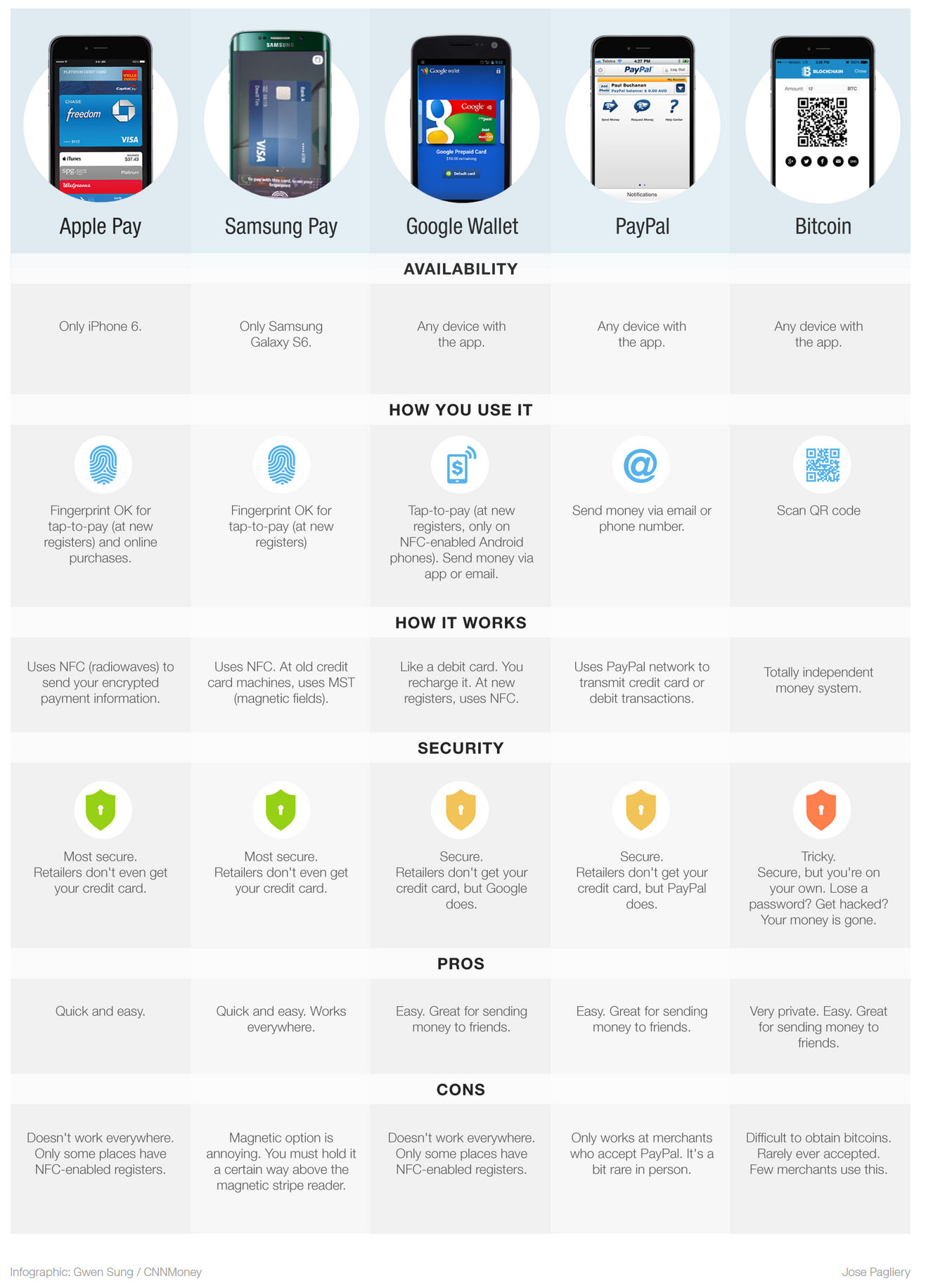 This comparison makes it pretty clear that Bitcoin is not ready as a personal mobile payment system. That’s not to say that there isn’t a place for the underlying technology in global payment processing. The most interesting example of this is Strike, a product in the international fintech arena. It is a ‘global’ money transmitter which uses bank connections in local currencies, but a private version of the Lightning network with settlement on the Bitcoin main chain. In practice users connect the app to their bank and can send money to the bank connected Strike app of another user instantly, and without a fee. This is a far better product than those previously available. In principle it’s open API allows many more applications to be integrated into the Strike back end. Twitter already uses this for international tipping (and remittance). It seems that this is a perfect contender for supporting transactions in open metaverse applications, and that may be true, but Strike is currently only available in three countries (USA, El Salvador, Argentina).
Paypal, xoom, Strike, servicing smaller payments, cashapp, venmo, revulot, Paypal especially is noteworthy for their recent Orwellian gaffe suggesting in their terms and conditions that they would be able to fine users $2500 for “disseminating informational”. They quickly walked this back but this kind of private fintech action is highly suggestive of a need for uncensorable money such as Bitcoin.
Apple has recently introduced a high-yield Savings account with an impressive 4.15 % APY, far surpassing the national average of 0.35 % APY. This development represents another milestone for the tech giant as it progresses towards potentially becoming the world’s largest bank. The Apple Savings account, established through a collaboration with Goldman Sachs, offers numerous benefits, including an interest rate more than ten times the national average, zero fees, no minimum deposit or balance requirements, and an efficient, user-friendly interface. Additionally, it provides FDIC insurance for balances up to $250,000. Although the 4.15 % APY is lower than returns from money market funds and 1 % below the 3-Month Treasury Bill Yield of 5.2 %, most people may not be aware of these alternatives. The key factors driving demand for Apple’s offering are convenience and the strong brand trust it enjoys. With products such as Apple Pay, Apple Cash, mPOS, Apple Card, Apple Pay Later, and now Apple Savings, the company is strategically constructing an Apple Finance empire poised to disrupt the traditional financial services landscape.
Stablecoins are ‘crypto like’ instruments which are ‘pegged’ at a 1:1 ratio with nationally issued Fiat currencies. In fact they usually correspond to units of privately issued debt underwritten by a variety of different assets. This is (depending on the issuing company’s model) a far more risky unit of money than the nominal currency that they represent, but they offer significant utility. They allow the user to self custody the cryptographic bearer instrument representing the money themselves, as with blockchain. This may afford the user less friction in that they can transmit the instrument through the newer financial rails which are emerging. Once again, this is likely a product most useful to emerging markets, those living under oppressive regimes, currencies suffering from high inflation, and countries who rely on the dollar as their currency, and within digitally native metaverse applications. These are [enormous] global uses though. The use in the west is prominently for ‘traders’ on exchanges at this time. /par The caveat of such products is that such ‘units’ of money can be frozen by the issuer, and they are subject to the third party risk of the issuer defaulting on the underlying instrument, instantly wiping out the value.
Klages-Mundt et al. wrote a paper in 2020, which explains the details of the different mechanisms and risks.
The following text paraphrases Spencer noon of on-chain analytics company “OurNetwork”, who provides an useful summary of the paper. [There are two major classes of stablecoins:]
[Custodial: entrusted by off-chain collateral assets like fiat dollars that sit in a bank. Requires trust in third party.] [Non-custodial (aka decentralized): fully on-chain and backed by smart contracts & economics. No trusted parties.] [In custodial stablecoins, custodians hold a combination of assets (currencies, bonds, commodities, etc.) off-chain, allowing issuers (possibly the same entity) to offer digital tokens of an reserve asset. The top 2 custodial stablecoins today are USDT and USDC. There are 3 types of custodial stablecoins.]
[Reserve Fund: 100% reserve ratio. Each stablecoin is backed by a unit of the reserve asset held by the custodian. A useful example of this the ] USDF banking consortium[.] [Fractional Reserve Fund: The stablecoin is backed by a mix of both reserve assets and other capital assets.] [Central Bank Digital Currency (CBDC): A digital form of central bank money that is widely available to the general public. CBDCs are in their nascency as today only 9 countries/territories have launched them, many of them small.] [Custodial stablecoins have three major risks:]
[Counterparty Risk (fraud, theft, govt seizure, etc.)] [Censorship Risk (operations blocked by regulators, etc.)] [Economic Risk (off-chain assets go down in value)] [Each can result in the stablecoin value going to zero.] It’s worth taking a look at these tokens individually, to get a feel for the trade-offs, and figure out how they might be useful for us in our proposed metaverse applications. It’s important to know that these tokenised dollars and/or other currencies are issued on top of the public blockchains we have been detailing throughout. Which tokens are on what blockchains is constantly evolving, so it’s not really worth enumerating specifics. In a metaverse application it would be necessary to manage both the underlying public blockchain and the stablecoin issued on top of it, making the interaction with the global financial system perversely more not less complex. In the following list of a few of the major coins, the first hyperlink is the whitepaper if it’s available.
USDC is a dollar backed coin issued by a consortium of major players in the space, most notably Circle, and Coinbase. It’s has a better transparency record than tether but is still not backed 1:1 by actual dollars in reserve. It may or may not be a fractional reserve asset. It’s well positioned to take advantage of regulatory changes in the USA, and seems to be quietly lobbying to be the choice of a government endorsed digital dollar, at least a significant part of a central bank digital currency initiative. It’s too early to tell how this will work out, but it has substantial ‘legacy finance backing’. It is the only stablecoin to increase slightly in value (depegging upward) in the wake of the UST implosion. This ‘flight to quality’ shows the advantage of the work that CENTRE put into regulatory compliance. It runs on Ethereum, Algorand, Solana, Stellar, Tron, Hedera, Avalanche and Flow blockchains. At this time USDC may be under speculative attack by Chinese exchange Binance, in favour of their own offering BUSD, and is losing market share. Binance USD is the dollar equivalent token from global crypto exchange behemoth Binance. It’s released in partnership with Paxos, who have a strong record for compliance, and transparency. Paxos also offer USDP. Both these stablecoins claim to be 100% backed by dollars, or US treasuries. They are regulated under the more restrictive New York state financial services and have a monthly attestation report. MakerDAO Dai is an Ethereum based stablecoin and one of the older offerings. It’s been ‘governed’ by a DAO since 2014. ‘Excess collateral’, above the value of the dai-dollars to be minted, is voted upon before being committed to the systems’ cryptographic ‘vaults’ as a backing for the currency. These dai can then be used across the Ethereum network. Despite the problems with DAOs, and the problems with Ethereum, DAI is well liked by its community of users and has a healthy billion dollars of issuance. They may be dangerously exposed to the new crackdown in the USA, and there is internal talk of pro-actively abandoning DAI altogether. TrueUSD claims to be fully backed by US dollars, held in escrow. It runs on the Ethereum blockchain. They have attestation reports available on demand and claim fully insured deposits. It’s not quite that simple in that a portion of the backing is ‘cash equivalents’. Gemini GUSD claim reserves are “held and maintained at State Street Bank and Trust Company and within a money market fund managed by Goldman Sachs Asset Management, invested only in U.S. Treasury obligations.” which seems pretty clear. TerraUSD (UST) [was] a newer and more experimental stablecoin, and one of a set of currency representations within the network. It worked in concert with the LUNA token on the Cosmos blockchain in order to keep it’s dollar stability. It was not backed in the same way as the other tokens, instead relying on an arbitrage mechanism using LUNA. In essence the protocol paid users to destroy LUNA and mint UST when the price was above one dollar, and vice versa. This theoretically maintained the dollar peg. There was much concern that this model of ‘algorithmic stable coin’ is unstable [113]. The developers of the Terra tried to address this concern by buying enormous amounts of Bitcoin, which they quickly had to employ to address UST drifting downward from $1. This failed to address the ‘great depegging’, with LUNA crashing to essentially zero, destroying some $50B of capital. It will now likely act as a cautionary tale to other institutions considering Bitcoin as a ‘reserve asset’. An earlier version of this book highlighted the specific variation of the risk which quickly manifested. Tether is the largest of the stablecoins, with some $70B in circulation, and the third largest ‘crypto’. This has been a meteoric rise, attracting the ire and scrutiny of regulators and investigators. There was considerable doubt that Tether had sufficient assets backing their synthetic dollars, but the market seems not to mind. Recently however they have transitioned to being backed by US treasury bills, a perfect asset for this use case. It’s resilience against ‘bank runs’ was tested in May 2022 when $9B was redeemed directly for dollars in a few days following the UST crash (more on this later). They are shortly to launch a GBP version for the UK. It’s an important technology for this metaverse conversation because of intersections with Bitcoin through the Lightning network. Tether might actually provide everything needed. It’s only as safe as the trust invested in the central issuer though, and the leadership and history of the company are questionable. It’s notable and somewhat ironic that it’s perhaps better and more transparently backed than most banks, and probably all novel fiat fintech products. We can employ the asset through the Taro technology described earlier but we would rather use something with higher regulatory assurances.
.
This comparison makes it pretty clear that Bitcoin is not ready as a personal mobile payment system. That’s not to say that there isn’t a place for the underlying technology in global payment processing. The most interesting example of this is Strike, a product in the international fintech arena. It is a ‘global’ money transmitter which uses bank connections in local currencies, but a private version of the Lightning network with settlement on the Bitcoin main chain. In practice users connect the app to their bank and can send money to the bank connected Strike app of another user instantly, and without a fee. This is a far better product than those previously available. In principle it’s open API allows many more applications to be integrated into the Strike back end. Twitter already uses this for international tipping (and remittance). It seems that this is a perfect contender for supporting transactions in open metaverse applications, and that may be true, but Strike is currently only available in three countries (USA, El Salvador, Argentina).
Paypal, xoom, Strike, servicing smaller payments, cashapp, venmo, revulot, Paypal especially is noteworthy for their recent Orwellian gaffe suggesting in their terms and conditions that they would be able to fine users $2500 for “disseminating informational”. They quickly walked this back but this kind of private fintech action is highly suggestive of a need for uncensorable money such as Bitcoin.
Apple has recently introduced a high-yield Savings account with an impressive 4.15 % APY, far surpassing the national average of 0.35 % APY. This development represents another milestone for the tech giant as it progresses towards potentially becoming the world’s largest bank. The Apple Savings account, established through a collaboration with Goldman Sachs, offers numerous benefits, including an interest rate more than ten times the national average, zero fees, no minimum deposit or balance requirements, and an efficient, user-friendly interface. Additionally, it provides FDIC insurance for balances up to $250,000. Although the 4.15 % APY is lower than returns from money market funds and 1 % below the 3-Month Treasury Bill Yield of 5.2 %, most people may not be aware of these alternatives. The key factors driving demand for Apple’s offering are convenience and the strong brand trust it enjoys. With products such as Apple Pay, Apple Cash, mPOS, Apple Card, Apple Pay Later, and now Apple Savings, the company is strategically constructing an Apple Finance empire poised to disrupt the traditional financial services landscape.
Stablecoins are ‘crypto like’ instruments which are ‘pegged’ at a 1:1 ratio with nationally issued Fiat currencies. In fact they usually correspond to units of privately issued debt underwritten by a variety of different assets. This is (depending on the issuing company’s model) a far more risky unit of money than the nominal currency that they represent, but they offer significant utility. They allow the user to self custody the cryptographic bearer instrument representing the money themselves, as with blockchain. This may afford the user less friction in that they can transmit the instrument through the newer financial rails which are emerging. Once again, this is likely a product most useful to emerging markets, those living under oppressive regimes, currencies suffering from high inflation, and countries who rely on the dollar as their currency, and within digitally native metaverse applications. These are [enormous] global uses though. The use in the west is prominently for ‘traders’ on exchanges at this time. /par The caveat of such products is that such ‘units’ of money can be frozen by the issuer, and they are subject to the third party risk of the issuer defaulting on the underlying instrument, instantly wiping out the value.
Klages-Mundt et al. wrote a paper in 2020, which explains the details of the different mechanisms and risks.
The following text paraphrases Spencer noon of on-chain analytics company “OurNetwork”, who provides an useful summary of the paper. [There are two major classes of stablecoins:]
[Custodial: entrusted by off-chain collateral assets like fiat dollars that sit in a bank. Requires trust in third party.] [Non-custodial (aka decentralized): fully on-chain and backed by smart contracts & economics. No trusted parties.] [In custodial stablecoins, custodians hold a combination of assets (currencies, bonds, commodities, etc.) off-chain, allowing issuers (possibly the same entity) to offer digital tokens of an reserve asset. The top 2 custodial stablecoins today are USDT and USDC. There are 3 types of custodial stablecoins.]
[Reserve Fund: 100% reserve ratio. Each stablecoin is backed by a unit of the reserve asset held by the custodian. A useful example of this the ] USDF banking consortium[.] [Fractional Reserve Fund: The stablecoin is backed by a mix of both reserve assets and other capital assets.] [Central Bank Digital Currency (CBDC): A digital form of central bank money that is widely available to the general public. CBDCs are in their nascency as today only 9 countries/territories have launched them, many of them small.] [Custodial stablecoins have three major risks:]
[Counterparty Risk (fraud, theft, govt seizure, etc.)] [Censorship Risk (operations blocked by regulators, etc.)] [Economic Risk (off-chain assets go down in value)] [Each can result in the stablecoin value going to zero.] It’s worth taking a look at these tokens individually, to get a feel for the trade-offs, and figure out how they might be useful for us in our proposed metaverse applications. It’s important to know that these tokenised dollars and/or other currencies are issued on top of the public blockchains we have been detailing throughout. Which tokens are on what blockchains is constantly evolving, so it’s not really worth enumerating specifics. In a metaverse application it would be necessary to manage both the underlying public blockchain and the stablecoin issued on top of it, making the interaction with the global financial system perversely more not less complex. In the following list of a few of the major coins, the first hyperlink is the whitepaper if it’s available.
USDC is a dollar backed coin issued by a consortium of major players in the space, most notably Circle, and Coinbase. It’s has a better transparency record than tether but is still not backed 1:1 by actual dollars in reserve. It may or may not be a fractional reserve asset. It’s well positioned to take advantage of regulatory changes in the USA, and seems to be quietly lobbying to be the choice of a government endorsed digital dollar, at least a significant part of a central bank digital currency initiative. It’s too early to tell how this will work out, but it has substantial ‘legacy finance backing’. It is the only stablecoin to increase slightly in value (depegging upward) in the wake of the UST implosion. This ‘flight to quality’ shows the advantage of the work that CENTRE put into regulatory compliance. It runs on Ethereum, Algorand, Solana, Stellar, Tron, Hedera, Avalanche and Flow blockchains. At this time USDC may be under speculative attack by Chinese exchange Binance, in favour of their own offering BUSD, and is losing market share. Binance USD is the dollar equivalent token from global crypto exchange behemoth Binance. It’s released in partnership with Paxos, who have a strong record for compliance, and transparency. Paxos also offer USDP. Both these stablecoins claim to be 100% backed by dollars, or US treasuries. They are regulated under the more restrictive New York state financial services and have a monthly attestation report. MakerDAO Dai is an Ethereum based stablecoin and one of the older offerings. It’s been ‘governed’ by a DAO since 2014. ‘Excess collateral’, above the value of the dai-dollars to be minted, is voted upon before being committed to the systems’ cryptographic ‘vaults’ as a backing for the currency. These dai can then be used across the Ethereum network. Despite the problems with DAOs, and the problems with Ethereum, DAI is well liked by its community of users and has a healthy billion dollars of issuance. They may be dangerously exposed to the new crackdown in the USA, and there is internal talk of pro-actively abandoning DAI altogether. TrueUSD claims to be fully backed by US dollars, held in escrow. It runs on the Ethereum blockchain. They have attestation reports available on demand and claim fully insured deposits. It’s not quite that simple in that a portion of the backing is ‘cash equivalents’. Gemini GUSD claim reserves are “held and maintained at State Street Bank and Trust Company and within a money market fund managed by Goldman Sachs Asset Management, invested only in U.S. Treasury obligations.” which seems pretty clear. TerraUSD (UST) [was] a newer and more experimental stablecoin, and one of a set of currency representations within the network. It worked in concert with the LUNA token on the Cosmos blockchain in order to keep it’s dollar stability. It was not backed in the same way as the other tokens, instead relying on an arbitrage mechanism using LUNA. In essence the protocol paid users to destroy LUNA and mint UST when the price was above one dollar, and vice versa. This theoretically maintained the dollar peg. There was much concern that this model of ‘algorithmic stable coin’ is unstable [113]. The developers of the Terra tried to address this concern by buying enormous amounts of Bitcoin, which they quickly had to employ to address UST drifting downward from $1. This failed to address the ‘great depegging’, with LUNA crashing to essentially zero, destroying some $50B of capital. It will now likely act as a cautionary tale to other institutions considering Bitcoin as a ‘reserve asset’. An earlier version of this book highlighted the specific variation of the risk which quickly manifested. Tether is the largest of the stablecoins, with some $70B in circulation, and the third largest ‘crypto’. This has been a meteoric rise, attracting the ire and scrutiny of regulators and investigators. There was considerable doubt that Tether had sufficient assets backing their synthetic dollars, but the market seems not to mind. Recently however they have transitioned to being backed by US treasury bills, a perfect asset for this use case. It’s resilience against ‘bank runs’ was tested in May 2022 when $9B was redeemed directly for dollars in a few days following the UST crash (more on this later). They are shortly to launch a GBP version for the UK. It’s an important technology for this metaverse conversation because of intersections with Bitcoin through the Lightning network. Tether might actually provide everything needed. It’s only as safe as the trust invested in the central issuer though, and the leadership and history of the company are questionable. It’s notable and somewhat ironic that it’s perhaps better and more transparently backed than most banks, and probably all novel fiat fintech products. We can employ the asset through the Taro technology described earlier but we would rather use something with higher regulatory assurances.
.
The evolving US position
In most regards the legislative front line is happening in the USA. Treasury Secretary Yellen responded to the collapse of Terra/UST saying that: [“A comprehensive regulatory framework for US dollar stablecoins is needed”] . She also said that the stablecoin market is too small to pose systemic risk at this time. This is clearly an evolving situation, but the incredible consumer exposure to these risky products is likely to elicit a swift and significant response, and the timing seems right for intervention. The markets suggest that USDC will be the eventual winner. The highly regulated New York state financial framework (Paxos, Gemini) Piggyback off of a (Nevada) state-chartered trust [TrueUSD, HUSD] Get dozens of money transmitter licenses [USDC] Proposed legislation specific to the concept of stablecoins has been advanced by Sen Toomey. There are many provisions in the bill, mostly pertaining to convertibility and the ever present problem of attestation of the ‘backing’ of these products. Mention has already been made of the major bill advanced by Sen. Lummis and Gillibrand. This bill also includes significant provision around stablecoins. Lummis said [“Stablecoins will have to be either FDIC insured or more than 100% backed by hard assets.”] . This is good news for this section of the digital asssets space. Crucially there is also more clarity on privacy. This is a huge threat from digital money systems, and the USA is likely to lead. Remember though that none of this is yet law. Valkenburg, the lead researcher of a US think tank in digital assets says the following: [“Stablecoin TRUST Act, is a discussion draft mostly about stablecoins, but it also has important privacy protections for crypto users broadly: it puts real limits on warrantless surveillance by narrowing what info can be collected from third parties. Last summer we fought a provision in the infrastructure bill that damaged the privacy of crypto users by expanding the broker definition (who needs to report information about transactions to the IRS) & crypto 6050I reporting (reports on business transactions over $10,000). The winter before we fought and successfully delayed a rushed proposal from the outgoing Trump administration to mandate that exchanges collect information about persons who are not their customers, who hold crypto at addresses in wallets they control directly. the Stablecoin TRUST Act would stop these encroachments, constrain the treasury from collecting any nonpublic information unless they get a search warrant or collect only information voluntarily provided to an exchange by a customer and for a legitimate business purpose. If “voluntarily provided for a legitimate business purpose” sounds familiar to you, that’s b/c it’s the constitutional standard articulated by the Court in Carpenter describing LIMITED circumstances where warrantless searches of customer data are ok.It’s the standard we’ve advocated must also limit warrantless data collection at crypto exchanges. If exchanges must collect information about non-customers, that information is, by definition, not voluntarily provided for a legitimate business purpose.“] The ongoing battle for control over emerging stablecoins by the CFTC and the SEC seems to be pushing the American government into legislation. They have published a draft bill and there have been some congressional hearings over the matter. At this time the bill is nascent, and there are as yet no firm decisions, though as seems typical in the USA there are hardening opinions along political lines.
Paypal
- The mainstream stablecoin Paypal accomplish what Libra did not, and have launched a dollar stablecoin into the aggressive regulatory landscape in the USA. PayPal is launching a new ERC-20 stablecoin called PayPal USD (PYUSD) pegged 1:1 to the US dollar and issued by Paxos It will be compatible with the Ethereum ecosystem and can be transferred between PayPal and Ethereum wallets The stablecoin will support P2P payments, PayPal checkout integration, and convertibility to other cryptocurrencies PayPal’s massive reach could drive significant crypto adoption if users take up the stablecoin Regulatory comfort with PayPal’s stablecoin shows preference for tradfi over non-compliant crypto firms. This embrace by lawmakers signals a shift to encourage crypto innovation from compliant US firms, not “shady” crypto natives Likely pressures Congress to finalize clear stablecoin regulation to enable innovation Fits growing trend of tradfi firms like BlackRock entering crypto as regulation tightens
The evolving European and UK position
Societe Generale is a leading European financial services group, based in France. Founded in 1864, it provides a wide range of services, including retail banking, corporate and investment banking, asset management, insurance, and financial solutions for both individual and institutional clients. The bank operates globally, with a strong presence in Europe, Africa, and the Middle East, as well as a growing presence in the Americas and Asia-Pacific regions. Societe Generale is recognized as one of the largest banks in Europe. They have announced a Euro based stablecoin initiative on the Ethereum blockchain, which has been met with howls of derision from the crypto and Bitcoin communities, since every transaction needs to be manually approved by the banking groups. In addition there is code in the contracts allowing them (or any party with access) to remotely ‘burn’ or revoke the money from a wallet. This is “decentralisation theatre”. The stablecoin is available only for institutional clients only, ‘aiming to bridge the gap between traditional capital markets and the digital assets ecosystem’. It is likely that this project is too clunky and experimental to ever see adoption.
The U.K. Financial Conduct Authority’s chief executive, Nikhil Rathi, outlined the FCA’s regulatory goals at the Peterson Institute for International Economics: [“The U.S. and U.K. will deepen ties on crypto-asset regulation and market developments --- including in relation to stablecoins and the exploration of central bank digital currencies.“] The timing seems right to explore the use of stablecoins in metaverse applications up the list of choices.
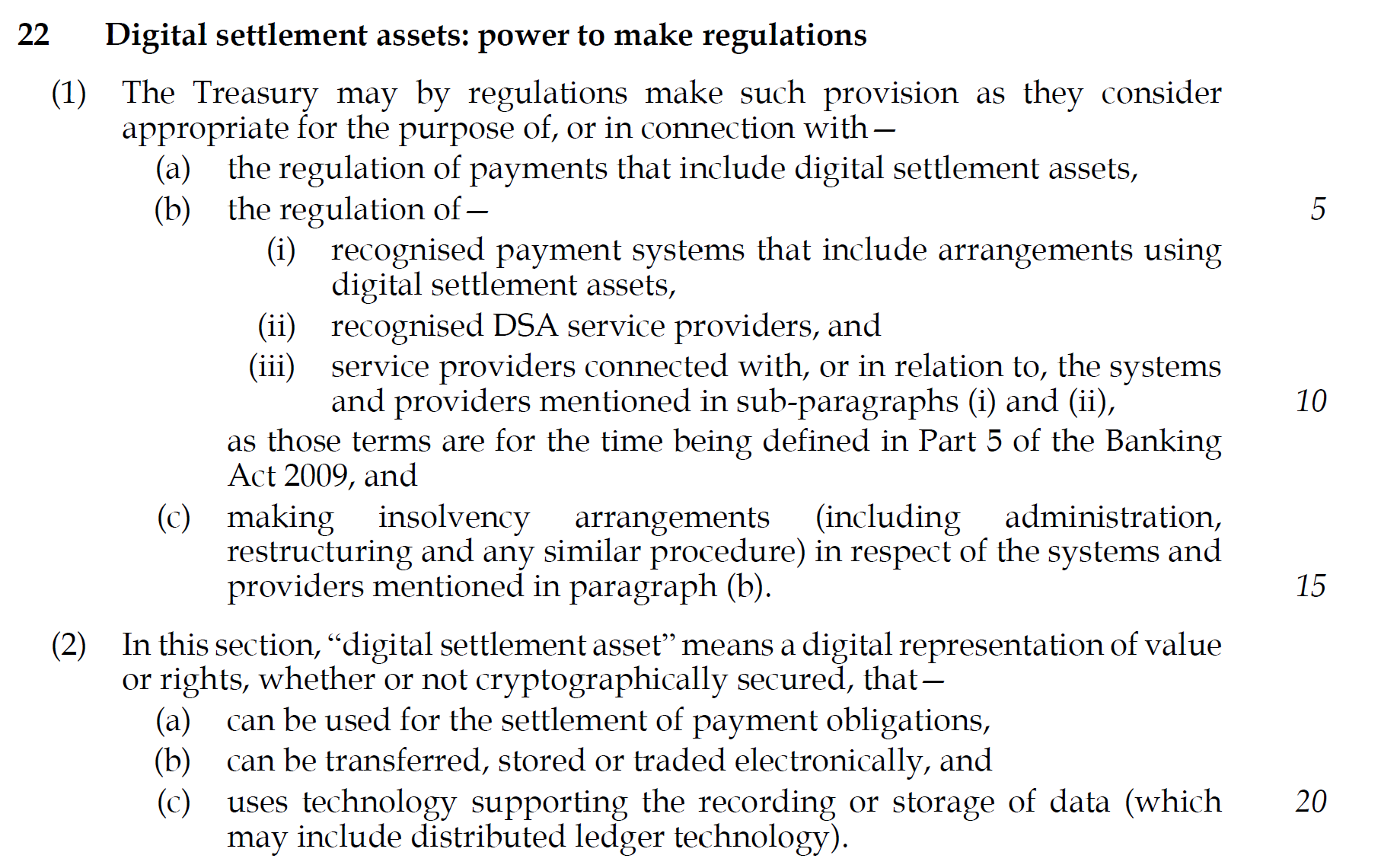
Stables in metaverse applications
It makes a [lot] of sense to consider stablecoin transfer as the money in metaverses. USDC is furthest along this possible adoption curve. Their partnership with global payment provider Stripe has enabled global dollar transfer within Twitter for users of their ‘Connect’ platform. This leverages the Polygon chain (mentioned in the blockchain chapter). Many digital wallets can be connected from the user end, with Metamask potentially being the easiest to integrate. This has also been mentioned in the book. The downside of this for our open platform is that none of these elements are particularly open, or distributed, and the users of the platform will still need to use an exchange to get the USDC to spend. This approach makes it easier for the vendors and product providers in the metaverse applications to accept USDC, but everything else is actually harder.
If 2022 was the year of the stablecoin then 2023 is likely to be the year of the central bank digital currency (CBDC). CBDCs would likely not exist without the 2019 catalyst of Facebook Libre crypto currency project, which is now cancelled and defunct, pressure exerted on central banks by the concept of Bitcoin, and the stablecoins which emerged from the technology.
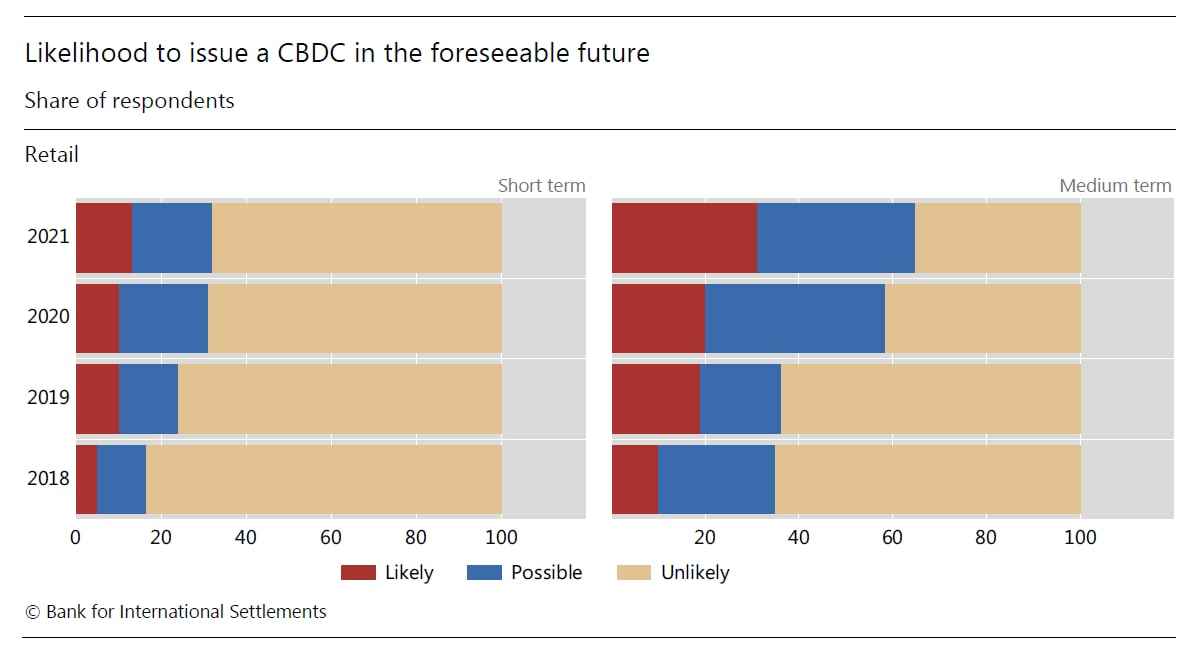
It now seems plausible that the world is moving toward a plurality of national and private digital currencies. Figure 4.3 from the Bank for International Settlement, shows the growing acceptance within central banks. Their 2022 annual economic report dedicates a 42 page chapter to the subject. Hyun Song Shin, head of research at BIS said [“Our broad conclusion is captured in the motto, ‘Anything that crypto can do, CBDCs can do better.“] Bank of America analysts Shah and Moss think that CBDC’s are ‘inevitable’ by 2030, and believe that in the meantime stablecoins will fill what they perceive to be this market gap.
This text from the thinktank VoxEU highlights the pressure on not to be ‘left behind’: [“Given the rapid pace of innovations in payments technology and the proliferation of virtual currencies such as bitcoin and ethereum, it might not be prudent for central banks to be passive in their approach to CBDC. If the central bank does not produce any form of digital currency, there is a risk that it loses monetary control, with greater potential for severe economic downturns. With this in mind, central banks are moving expeditiously when they consider the adoption of CBDC.“] The Atlantic Council have a website which tracks global adoption.
 CBDCs are wholly digital representations of national currencies, and as such are centralised database entries, endorsed and potentially issued by national governments. The USA’s whitepaper shows the approach. This thinking seems to have emerged in part from the ‘Digital Dollar Project’, an Accenture funded think tank founded by ex CFTC chairman Giancarlo [114]. Curiously only The Bahamas seem to have a successful implementation, but it is a rapidly evolving space, and many nations are now scrambling to catch up. A post on the LinkedIn page of the Bank of International Settlements highlights a research project between 20 Asian banks which settles tens of millions of dollars using CBDC tooling.
The following text is taken from the March 2021 Biden government “executive order” on digital assets, and defines the current global legislative position well.\ [“Sec. 4. Policy and Actions Related to United States Central Bank Digital Currencies. (a) The policy of my Administration on a United States CBDC is as follows:\ (i) Sovereign money is at the core of a well-functioning financial system, macroeconomic stabilization policies, and economic growth. My Administration places the highest urgency on research and development efforts into the potential design and deployment options of a United States CBDC. These efforts should include assessments of possible benefits and risks for consumers, investors, and businesses; financial stability and systemic risk; payment systems; national security; the ability to exercise human rights; financial inclusion and equity; and the actions required to launch a United States CBDC if doing so is deemed to be in the national interest.\ (ii) My Administration sees merit in showcasing United States leadership and participation in international fora related to CBDCs and in multi[-] country conversations and pilot projects involving CBDCs. Any future dollar payment system should be designed in a way that is consistent with United States priorities (as outlined in section 4(a)(i) of this order) and democratic values, including privacy protections, and that ensures the global financial system has appropriate transparency, connectivity, and platform and architecture interoperability or transferability, as appropriate.\ (iii) A United States CBDC may have the potential to support efficient and low-cost transactions, particularly for cross[-] border funds transfers and payments, and to foster greater access to the financial system, with fewer of the risks posed by private sector-administered digital assets. A United States CBDC that is interoperable with CBDCs issued by other monetary authorities could facilitate faster and lower-cost cross-border payments and potentially boost economic growth, support the continued centrality of the United States within the international financial system, and help to protect the unique role that the dollar plays in global finance. There are also, however, potential risks and downsides to consider. We should prioritize timely assessments of potential benefits and risks under various designs to ensure that the United States remains a leader in the international financial system.“] In traditional nation state currencies the central banks control the amount of currency in circulation by issuing debt to private banks, which is then loaned out to individuals [115]. The debt is ‘destroyed’ on the balance sheet to remove currency through the reverse mechanism. They also facilitate government debt [116], and work (theoretically) outside of political control to adjust interest rates, in order to manage growth and flows of money.
It is somewhat surprising that Powell, chair of the US Federal Reserve has recently said [“Rapid changes are taking place in the global monetary system that may affect the international role of the dollar. A US central bank digital currency is being examined to help the US dollar’s international standing.”] . This is a rapid evolution of the narrative, with implications. It seems unlikely that the world would sacrifice the traditional banking system in favour of centrally controlled money, but many things which cannot be done with traditional nation state money systems are possible with CBDCs, because they remove the middleman of private banking between the end user and the policy makers.
Negative interest rates are possible, such that all of the money can lose purchasing power over time, and at a rate dictated by policy. This “removal of the lower bound” has been discussed by economists over the last couple of decades as interest rate mechanisms have waned in efficacy. It is not possible in the current system, and instead money must be added through quantitative easing, which disproportionately benefits some though Cantillon effects [117, 118]. Ubiquitous basic income is possible in that money can be issued directly from government to all approved citizens, transferring spending power directly from the government to the people. This also implies efficiency savings for social support mechanisms. Asset freezing and confiscation are trivial if CBDCs can replace paper cash money completely, as a bearer asset. Criminals and global ‘bad actors’ could have their assets temporarily or permanently removed, centrally, by suspending the transferability of the digital tokens. Targeted bailouts for vital institutions and industries are possible directly from central government policy makers. Currently private banks must be incentivised to make cheap loans available to sectors which require targeted assistance. Financial surveillance of every user is possible. In this way a ‘panopticon of money’ can be enacted, and spending rulesets can be applied. For instance, social support money might only be spendable on food, and child support only on goods and services to support childcare. This is a very dystopian set of ideas. Eswar Prasad says “In authoritarian societies, central bank money in digital form could become an additional instrument of government control over citizens rather than just a convenient, safe, and stable medium of exchange[119].” This is possibly already happening in China through integration of outstanding debt data with the social credit system. It’s a virtually cost free medium of exchange, since there is no physical instrument which must be shipped, guarded, counted, assayed, and securely destroyed. The counterfeiting risk is significantly reduced because of secure cryptographic underpinnings rather than paper or plastic anti counterfeiting technologies. Global reach and control is instantly possible for the issuer. This is a big problem especially for a reserve currency such as the dollar. Two thirds of $100 bills are thought to reside outside of the USA. System level quantitative easing and credit subsidies are made far simpler and less wasteful when centrally dictated. Transfer of liability and risk to the holder globally reduces the management costs for global deposits of a currency. It may be possible to automate the stability of a currency through continuous adjustment of the ‘peg’ through algorithms or AI.
The UK had been signalled that it is not interested in developing a CBDC stating that it seemed to be a solution in search of a problem, with the Lords economic affairs committee saying:[“The introduction of a UK CBDC would have far-reaching consequences for households, businesses, and the monetary system for decades to come and may pose significant risks depending on how it is designed. These risks include state surveillance of people’s spending choices, financial instability as people convert bank deposits to CBDC during periods of economic stress, an increase in central bank power without sufficient scrutiny, and the creation of a centralised point of failure that would be a target for hostile nation state or criminal actors.“] Since those initial statements however it seems that the previously mentioned “fear of missing out” has forced legislators hand. The UK Treasury and the Bank of England are now exploring the possibility of launching a retail central bank digital currency (which they desperately hope will not end up called ‘Britcoin’), judging that “it is likely a digital pound will be needed in the future”. They have released a consultation paper inviting public comment. The consultation is aimed at informing the decision on whether to build the infrastructure for a digital pound, with a pilot test not expected before 2025.
One of the key points raised in the proposal is the potential to cap citizens’ CBDC holdings, with a range suggested between £10,000 to £20,000, to strike a balance between managing risks and supporting the usability of the digital pound. This limit would allow most UK wage earners to receive their salary in the form of a CBDC but would still allow for competition with commercial banks. The digital pound would not offer interest, enabling banks to offer competitive deposit accounts.
They are once again clear about the risks, highlighting that banks currently use deposits as a cheap source of funding for loans, and without that flow, they may become more reliant on expensive wholesale markets, driving up borrowing costs for users. In a severe scenario, a bank run could undermine the capital base for the commercial banking system.
The Bank of England has stated that it will not implement central bank initiated programmable functions, but instead provide the necessary infrastructure for the private sector to implement such features with user consent. The digital pound is intended to have at least the same level of privacy as a bank account and users would be able to make choices about data use. This is scant comfort, as such features are intrinsic to the technology, and we have seen time and again that if legislative and economic bodies are given a hammer, they will eventually find a nail to hit. Carlo, the director of ‘The Big Brother watch’ pointed to 2021 comments from John cunliff of the bank of England when he said “There’s a whole range of things that programmable money could do like giving the children pocket money but programming the money so it couldn’t be used for sweets”. Again, this raises the potential for government stimulus that has to be spent within a certain time or it disappears. As an interesting side note here it’s thought that up to 14% of American stimulus cheques went to buying crypto, most notably in less well off families [120]. It’s easy to imagine that a CBDC would be barred from such a thing.
The main motivation for issuing a CBDC is the assumption that there is demand for a safe and stable way to use money online. A digital pound, issued and backed by the Bank of England, could be a trusted, accessible, and easy-to-use form of payment. The infrastructure would allow firms to design innovative and user-friendly services. The civil service is hiring a “Head of CBDC” as seen in Figure 4.4.
CBDCs are wholly digital representations of national currencies, and as such are centralised database entries, endorsed and potentially issued by national governments. The USA’s whitepaper shows the approach. This thinking seems to have emerged in part from the ‘Digital Dollar Project’, an Accenture funded think tank founded by ex CFTC chairman Giancarlo [114]. Curiously only The Bahamas seem to have a successful implementation, but it is a rapidly evolving space, and many nations are now scrambling to catch up. A post on the LinkedIn page of the Bank of International Settlements highlights a research project between 20 Asian banks which settles tens of millions of dollars using CBDC tooling.
The following text is taken from the March 2021 Biden government “executive order” on digital assets, and defines the current global legislative position well.\ [“Sec. 4. Policy and Actions Related to United States Central Bank Digital Currencies. (a) The policy of my Administration on a United States CBDC is as follows:\ (i) Sovereign money is at the core of a well-functioning financial system, macroeconomic stabilization policies, and economic growth. My Administration places the highest urgency on research and development efforts into the potential design and deployment options of a United States CBDC. These efforts should include assessments of possible benefits and risks for consumers, investors, and businesses; financial stability and systemic risk; payment systems; national security; the ability to exercise human rights; financial inclusion and equity; and the actions required to launch a United States CBDC if doing so is deemed to be in the national interest.\ (ii) My Administration sees merit in showcasing United States leadership and participation in international fora related to CBDCs and in multi[-] country conversations and pilot projects involving CBDCs. Any future dollar payment system should be designed in a way that is consistent with United States priorities (as outlined in section 4(a)(i) of this order) and democratic values, including privacy protections, and that ensures the global financial system has appropriate transparency, connectivity, and platform and architecture interoperability or transferability, as appropriate.\ (iii) A United States CBDC may have the potential to support efficient and low-cost transactions, particularly for cross[-] border funds transfers and payments, and to foster greater access to the financial system, with fewer of the risks posed by private sector-administered digital assets. A United States CBDC that is interoperable with CBDCs issued by other monetary authorities could facilitate faster and lower-cost cross-border payments and potentially boost economic growth, support the continued centrality of the United States within the international financial system, and help to protect the unique role that the dollar plays in global finance. There are also, however, potential risks and downsides to consider. We should prioritize timely assessments of potential benefits and risks under various designs to ensure that the United States remains a leader in the international financial system.“] In traditional nation state currencies the central banks control the amount of currency in circulation by issuing debt to private banks, which is then loaned out to individuals [115]. The debt is ‘destroyed’ on the balance sheet to remove currency through the reverse mechanism. They also facilitate government debt [116], and work (theoretically) outside of political control to adjust interest rates, in order to manage growth and flows of money.
It is somewhat surprising that Powell, chair of the US Federal Reserve has recently said [“Rapid changes are taking place in the global monetary system that may affect the international role of the dollar. A US central bank digital currency is being examined to help the US dollar’s international standing.”] . This is a rapid evolution of the narrative, with implications. It seems unlikely that the world would sacrifice the traditional banking system in favour of centrally controlled money, but many things which cannot be done with traditional nation state money systems are possible with CBDCs, because they remove the middleman of private banking between the end user and the policy makers.
Negative interest rates are possible, such that all of the money can lose purchasing power over time, and at a rate dictated by policy. This “removal of the lower bound” has been discussed by economists over the last couple of decades as interest rate mechanisms have waned in efficacy. It is not possible in the current system, and instead money must be added through quantitative easing, which disproportionately benefits some though Cantillon effects [117, 118]. Ubiquitous basic income is possible in that money can be issued directly from government to all approved citizens, transferring spending power directly from the government to the people. This also implies efficiency savings for social support mechanisms. Asset freezing and confiscation are trivial if CBDCs can replace paper cash money completely, as a bearer asset. Criminals and global ‘bad actors’ could have their assets temporarily or permanently removed, centrally, by suspending the transferability of the digital tokens. Targeted bailouts for vital institutions and industries are possible directly from central government policy makers. Currently private banks must be incentivised to make cheap loans available to sectors which require targeted assistance. Financial surveillance of every user is possible. In this way a ‘panopticon of money’ can be enacted, and spending rulesets can be applied. For instance, social support money might only be spendable on food, and child support only on goods and services to support childcare. This is a very dystopian set of ideas. Eswar Prasad says “In authoritarian societies, central bank money in digital form could become an additional instrument of government control over citizens rather than just a convenient, safe, and stable medium of exchange[119].” This is possibly already happening in China through integration of outstanding debt data with the social credit system. It’s a virtually cost free medium of exchange, since there is no physical instrument which must be shipped, guarded, counted, assayed, and securely destroyed. The counterfeiting risk is significantly reduced because of secure cryptographic underpinnings rather than paper or plastic anti counterfeiting technologies. Global reach and control is instantly possible for the issuer. This is a big problem especially for a reserve currency such as the dollar. Two thirds of $100 bills are thought to reside outside of the USA. System level quantitative easing and credit subsidies are made far simpler and less wasteful when centrally dictated. Transfer of liability and risk to the holder globally reduces the management costs for global deposits of a currency. It may be possible to automate the stability of a currency through continuous adjustment of the ‘peg’ through algorithms or AI.
The UK had been signalled that it is not interested in developing a CBDC stating that it seemed to be a solution in search of a problem, with the Lords economic affairs committee saying:[“The introduction of a UK CBDC would have far-reaching consequences for households, businesses, and the monetary system for decades to come and may pose significant risks depending on how it is designed. These risks include state surveillance of people’s spending choices, financial instability as people convert bank deposits to CBDC during periods of economic stress, an increase in central bank power without sufficient scrutiny, and the creation of a centralised point of failure that would be a target for hostile nation state or criminal actors.“] Since those initial statements however it seems that the previously mentioned “fear of missing out” has forced legislators hand. The UK Treasury and the Bank of England are now exploring the possibility of launching a retail central bank digital currency (which they desperately hope will not end up called ‘Britcoin’), judging that “it is likely a digital pound will be needed in the future”. They have released a consultation paper inviting public comment. The consultation is aimed at informing the decision on whether to build the infrastructure for a digital pound, with a pilot test not expected before 2025.
One of the key points raised in the proposal is the potential to cap citizens’ CBDC holdings, with a range suggested between £10,000 to £20,000, to strike a balance between managing risks and supporting the usability of the digital pound. This limit would allow most UK wage earners to receive their salary in the form of a CBDC but would still allow for competition with commercial banks. The digital pound would not offer interest, enabling banks to offer competitive deposit accounts.
They are once again clear about the risks, highlighting that banks currently use deposits as a cheap source of funding for loans, and without that flow, they may become more reliant on expensive wholesale markets, driving up borrowing costs for users. In a severe scenario, a bank run could undermine the capital base for the commercial banking system.
The Bank of England has stated that it will not implement central bank initiated programmable functions, but instead provide the necessary infrastructure for the private sector to implement such features with user consent. The digital pound is intended to have at least the same level of privacy as a bank account and users would be able to make choices about data use. This is scant comfort, as such features are intrinsic to the technology, and we have seen time and again that if legislative and economic bodies are given a hammer, they will eventually find a nail to hit. Carlo, the director of ‘The Big Brother watch’ pointed to 2021 comments from John cunliff of the bank of England when he said “There’s a whole range of things that programmable money could do like giving the children pocket money but programming the money so it couldn’t be used for sweets”. Again, this raises the potential for government stimulus that has to be spent within a certain time or it disappears. As an interesting side note here it’s thought that up to 14% of American stimulus cheques went to buying crypto, most notably in less well off families [120]. It’s easy to imagine that a CBDC would be barred from such a thing.
The main motivation for issuing a CBDC is the assumption that there is demand for a safe and stable way to use money online. A digital pound, issued and backed by the Bank of England, could be a trusted, accessible, and easy-to-use form of payment. The infrastructure would allow firms to design innovative and user-friendly services. The civil service is hiring a “Head of CBDC” as seen in Figure 4.4.
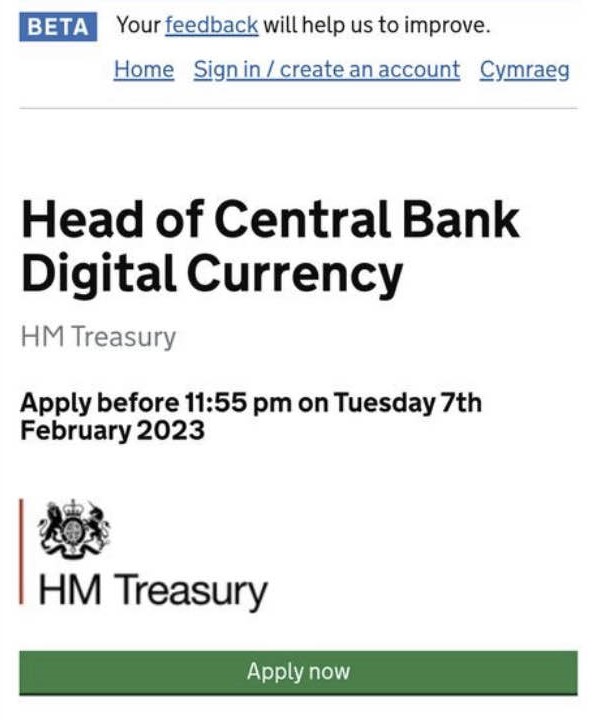 Meanwhile in Europe, ECB President Christine Legarde said: [“On your question concerning CBDC, you know my views on CBDC and you know that I have pushed that project. Fabio Panetta is working hard on that together with members in the entire Eurosystem with the high-level taskforce that is working really hard on moving forward. But in a way, I am really pleased that attention is now focussed on the role that cryptos can play and the role that Central Bank Digital Currency can have when they are implemented. We have a schedule, as you know. The Governing Council decided back in October ‘21 to launch a two-year investigation phase, and it is at the end of that investigation phase that the decision will definitely be made to launch the CBDCs and to make it a reality. We can’t go wrong with that project. I am confident that we will move ahead, but that’s going to be a decision of the Governing Council. I think it’s an imperative to respond to what the Europeans expect, and I think we have to be a little bit ahead of the curve if we can on that front. If we can accelerate the work, I hope we can accelerate the work. I will certainly support that and I was delighted to see that in the United States there was an executive order by President Biden to actually expect similar effort and focus and progress on CBDC, cryptos. I think that it will take all the goodwill of those who want to support sovereignty, who want to make sure that monetary policy can be transmitted properly using our currency, will endeavour.“] She has expanded on these points saying in a video interview that the digital euro will be decided in October 2023. If passed, the current paradigm of cash spending and transfers will become even more restrictive. Lagarde justified the move by saying that she did not want the EU to be ‘dependent on the currency of an unfriendly country’ or a friendly currency activated by a private corporate entity’. She identified Meta, Google, and Amazon.
India has expressed far more interest in the technology, and of course their addressable market is huge! They have published a ‘concept note’ in which they assert that a digital Rupee would be faster, cheaper, and easier to maintain. The key difference in India’s situation is the large areas of the rural population where mobile internet is more patchy. In such situations a cash equivalent stablecoin token with cash finality which can be transferred between mobile phone wallets [without] an internet connection is a huge boon. It seems very likely that India is moving to react to the innovation threat posed by cryptocurrencies to their own cash infrastructure. They are piloting the technology already. Similarly there seems to be a strong, and predictably illiberal push for transition to digital money in Nigeria. Again this is an enormous number of people, and it is hard not to be suspicious of future abuse of the system by governments.
In the USA this text from Congressman Tom Emmer shows how complex and interesting this debate is becoming.[“Today, I introduced a bill prohibiting the Fed from issuing a central bank digital currency directly to individuals. Here’s why it matters: As other countries, like China, develop CBDCs that fundamentally omit the benefits and protections of cash, it is more important than ever to ensure the United States’ digital currency policy protects financial privacy, maintains the dollar’s dominance, and cultivates innovation.\ CBDCs that fail to adhere to these three basic principles could enable an entity like the Federal Reserve to mobilize itself into a retail bank, collect personally identifiable information on users, and track their transactions indefinitely.\ Not only does this CBDC model raise “single point of failure” issues, leaving Americans’ financial information vulnerable to attack, but it could be used as a surveillance tool that Americans should never be forced to tolerate from their own government.\ Requiring users to open an account at the Fed to access a United States CBDC would put the Fed on an insidious path akin to China’s digital authoritarianism.\ Any CBDC implemented by the Fed must be open, permissionless, and private. This means that any digital dollar must be accessible to all, transact on a blockchain that is transparent to all, and maintain the privacy elements of cash.\ In order to maintain the dollar’s status as the world’s reserve currency in a digital age, it is important that the United States lead with a posture that prioritizes innovation and does not aim to compete with the private sector.\ Simply put, we must prioritize blockchain technology with American characteristics, rather than mimic China’s digital authoritarianism out of fear.“] Most analysts now seem to think that there is little appetite to replace established ‘Western’ cash with CBDCs. Most significantly such products would need the support of retail banks, and it is not in their interest to service such a product. Their business model relies on using retail deposits for providing loans, and it is these deposits, not cash itself that would be the most addressable market for a CBDC. Banks don’t want people to self custody money. In addition it exposes the whole banking system to a higher risk of bank runs. Such a self custody, interest bearing, central government backed asset would have significantly less counterparty risk than even bank deposits, and at times of high systemic stress it seems likely that money would flow to where it’s thought safest, exposing the retail banks to runs. Fabio Panetta of the ECB said: [“If we give access to a means of payment, which is relatively limited, there are no transaction costs because you only need to have a smartphone. There will be risks that people could use this possibility to move, for example, their deposits of other banks or their money out of financial intermediates.“] - All of the proposed solutions to these problems such as caps and negative interest penalties seem poorly thought through. Held and Smolenski present a detailed and rigorous negative critique of the dystopian ramifications of the technology. In their conclusion they point out that: [“Central bank digital currencies (CBDCs) represent an extension of state control over economic life. CBDCs provide governments with direct access to every transaction in that currency conducted by any individual anywhere in the world. As governments worldwide routinely share data with one another, individual transaction data will quickly become known to any government in a datasharing arrangement. Given the frequency with which government databases are compromised, this arrangement virtually ensures that anyone’s transaction data will eventually become available for global perusal.“]
Beyond even national CBDCs it is now possible to find discussion around weaving these together at a supranational level. Indeed it seems that competition is starting to emerge. The Bank for International Settlements (BIS) and the International Monetary Fund (IMF) have both presented plans to deploy global ledgers to support programmable Central Bank Digital Currencies.
Meanwhile in Europe, ECB President Christine Legarde said: [“On your question concerning CBDC, you know my views on CBDC and you know that I have pushed that project. Fabio Panetta is working hard on that together with members in the entire Eurosystem with the high-level taskforce that is working really hard on moving forward. But in a way, I am really pleased that attention is now focussed on the role that cryptos can play and the role that Central Bank Digital Currency can have when they are implemented. We have a schedule, as you know. The Governing Council decided back in October ‘21 to launch a two-year investigation phase, and it is at the end of that investigation phase that the decision will definitely be made to launch the CBDCs and to make it a reality. We can’t go wrong with that project. I am confident that we will move ahead, but that’s going to be a decision of the Governing Council. I think it’s an imperative to respond to what the Europeans expect, and I think we have to be a little bit ahead of the curve if we can on that front. If we can accelerate the work, I hope we can accelerate the work. I will certainly support that and I was delighted to see that in the United States there was an executive order by President Biden to actually expect similar effort and focus and progress on CBDC, cryptos. I think that it will take all the goodwill of those who want to support sovereignty, who want to make sure that monetary policy can be transmitted properly using our currency, will endeavour.“] She has expanded on these points saying in a video interview that the digital euro will be decided in October 2023. If passed, the current paradigm of cash spending and transfers will become even more restrictive. Lagarde justified the move by saying that she did not want the EU to be ‘dependent on the currency of an unfriendly country’ or a friendly currency activated by a private corporate entity’. She identified Meta, Google, and Amazon.
India has expressed far more interest in the technology, and of course their addressable market is huge! They have published a ‘concept note’ in which they assert that a digital Rupee would be faster, cheaper, and easier to maintain. The key difference in India’s situation is the large areas of the rural population where mobile internet is more patchy. In such situations a cash equivalent stablecoin token with cash finality which can be transferred between mobile phone wallets [without] an internet connection is a huge boon. It seems very likely that India is moving to react to the innovation threat posed by cryptocurrencies to their own cash infrastructure. They are piloting the technology already. Similarly there seems to be a strong, and predictably illiberal push for transition to digital money in Nigeria. Again this is an enormous number of people, and it is hard not to be suspicious of future abuse of the system by governments.
In the USA this text from Congressman Tom Emmer shows how complex and interesting this debate is becoming.[“Today, I introduced a bill prohibiting the Fed from issuing a central bank digital currency directly to individuals. Here’s why it matters: As other countries, like China, develop CBDCs that fundamentally omit the benefits and protections of cash, it is more important than ever to ensure the United States’ digital currency policy protects financial privacy, maintains the dollar’s dominance, and cultivates innovation.\ CBDCs that fail to adhere to these three basic principles could enable an entity like the Federal Reserve to mobilize itself into a retail bank, collect personally identifiable information on users, and track their transactions indefinitely.\ Not only does this CBDC model raise “single point of failure” issues, leaving Americans’ financial information vulnerable to attack, but it could be used as a surveillance tool that Americans should never be forced to tolerate from their own government.\ Requiring users to open an account at the Fed to access a United States CBDC would put the Fed on an insidious path akin to China’s digital authoritarianism.\ Any CBDC implemented by the Fed must be open, permissionless, and private. This means that any digital dollar must be accessible to all, transact on a blockchain that is transparent to all, and maintain the privacy elements of cash.\ In order to maintain the dollar’s status as the world’s reserve currency in a digital age, it is important that the United States lead with a posture that prioritizes innovation and does not aim to compete with the private sector.\ Simply put, we must prioritize blockchain technology with American characteristics, rather than mimic China’s digital authoritarianism out of fear.“] Most analysts now seem to think that there is little appetite to replace established ‘Western’ cash with CBDCs. Most significantly such products would need the support of retail banks, and it is not in their interest to service such a product. Their business model relies on using retail deposits for providing loans, and it is these deposits, not cash itself that would be the most addressable market for a CBDC. Banks don’t want people to self custody money. In addition it exposes the whole banking system to a higher risk of bank runs. Such a self custody, interest bearing, central government backed asset would have significantly less counterparty risk than even bank deposits, and at times of high systemic stress it seems likely that money would flow to where it’s thought safest, exposing the retail banks to runs. Fabio Panetta of the ECB said: [“If we give access to a means of payment, which is relatively limited, there are no transaction costs because you only need to have a smartphone. There will be risks that people could use this possibility to move, for example, their deposits of other banks or their money out of financial intermediates.“] - All of the proposed solutions to these problems such as caps and negative interest penalties seem poorly thought through. Held and Smolenski present a detailed and rigorous negative critique of the dystopian ramifications of the technology. In their conclusion they point out that: [“Central bank digital currencies (CBDCs) represent an extension of state control over economic life. CBDCs provide governments with direct access to every transaction in that currency conducted by any individual anywhere in the world. As governments worldwide routinely share data with one another, individual transaction data will quickly become known to any government in a datasharing arrangement. Given the frequency with which government databases are compromised, this arrangement virtually ensures that anyone’s transaction data will eventually become available for global perusal.“]
Beyond even national CBDCs it is now possible to find discussion around weaving these together at a supranational level. Indeed it seems that competition is starting to emerge. The Bank for International Settlements (BIS) and the International Monetary Fund (IMF) have both presented plans to deploy global ledgers to support programmable Central Bank Digital Currencies.
BIS proposal
The BIS proposed the concept of a Unified Electronic Ledger, which would combine Central Bank Digital Currencies, tokenized money, and assets on a single platform. This ledger would enable smart contract functionality similar to Ethereum on a global scale. The BIS emphasized the benefits of integrating different types of money and assets on a unified ledger, such as reducing delays, uncertainties, and trade financing costs. They also highlighted the importance of policy harmonization across jurisdictions for the success of such a system.
The IMF’s Proposal
The IMF proposed a global CBDC platform that would facilitate cross-border CBDC settlement. The stated aim is to enhance interoperability, efficiency, and safety in cross-border payments, while allowing individual nations to maintain capital controls and limits on the flow of funds. The IMF envision a permissioned (closed, but distributed) ledger, perhaps controlled by a platform operator (in the manner of SWIFT), to ensure unique ownership descriptions and prevent double spending. They emphasized the need for maintaining capital controls during national financial crises.
The Bank of England’s Experiment
The Bank of England, in collaboration with the BIS Innovation Hub, conducted a field test of CBDC technology known as Project Rosalind. The test explored various CBDC use cases, including offline payments, retail transactions, and micropayments. The test focused on a centralized ledger hosted by the Bank of England and involved the development of API functionalities for different scenarios. The BIS considered these experiments informative for the ongoing discussions on CBDCs. The introduction of CBDCs could have a significant impact on both individuals and the existing private financial sector. For individuals, the risks of CBDCs include: Privacy concerns: CBDCs could potentially be used to track and monitor individuals’ financial transactions, raising concerns about privacy and government surveillance. Lack of anonymity: Unlike cash, CBDCs could be easily traced and linked to individuals, which may compromise their financial privacy and security. Cybersecurity risks: CBDCs could be vulnerable to cyberattacks, which could lead to the loss of funds and personal information. For the existing private financial sector, the risks of CBDCs include: Competition: CBDCs could potentially compete with private sector financial institutions, which could lead to a decline in the use of traditional financial services. Disruption: CBDCs could disrupt existing financial systems and business models, which could lead to a decline in profits and revenue for private sector financial institutions. Regulation: The introduction of CBDCs could lead to increased regulation of the private financial sector, which could increase compliance costs and reduce profitability. CBDCs could have implications on monetary policy, financial stability, and international relations. For example, it could change the way central banks conduct monetary policy, and it could also impact the global financial system and the role of the US dollar as a global reserve currency. CBDCs could also bring about significant changes in the global payment system, which could have major implications for the financial industry, and for the private sector as well as for the central banks. A single global ledger, especially one controlled by large international bodies like the BIS and IMF, could potentially lead to an unhealthy centralization of power. This could exacerbate existing imbalances in global financial control and further marginalize countries with less political and economic power. A centralized ledger system would necessitate a high degree of technological dependence, which could leave countries vulnerable in the event of technological failure or cyber attacks. A global ledger system would require a high level of standardization. This could limit the ability of individual nations to adapt their financial systems to local conditions and needs, potentially leading to a “one-size-fits-all” approach that might not be appropriate for all contexts. There are concerns that the shift to digital currencies could leave behind those without access to necessarytechnology, contributing to financial exclusion rather than mitigating it. In conclusion, the risks associated with CBDCs are significant and multi-faceted. It is (hopefully) more likely that a blend of stablecoins, private bank issued digital currency (with a yield incentive) and perhaps some limited CBDC, alongside the new contender Bitcoin, will present a new landscape of user choice. Different models of trust, insurance, yields, acceptability, and potentially privacy, will emerge. Clearly a global, stable, wholly digital bearer asset in a native currency would ostensibly be the ideal integration for money in a metaverse application, but the whole concept seems deeply ‘wrong’, and it is likely that a transition to such a technology would be complex and painful. Either way, it is certainly not ready for consideration now. It’s important that central banks and governments carefully consider these risks before introducing CBDCs, but it’s not clear this is happening. It is conceivable that by working closely with the private sector policy makers could minimize any negative impacts, ensuring that any new regulations are designed in a way that protects the rights and privacy of individuals, while also promoting financial stability and economic growth. Gerard, an incredibly staunch critic of [all] things crypto points to woeful adoption and manifest corruption in the attempts so far. We are not particularly hopeful either.
The Role of Tokenisation
Tokenisation represents a paradigm shift from traditional cryptocurrencies. The concept was introduced and popularised by the wider cypto movement, and it’s somewhat absurd claims around ‘tokenising everything’. After this fab died down post the ‘initial coin offering’ craze of 2018 attention shifted elsewhere. Curiously however the ‘Office of the Comptroller of the Currency’ and the BIS have been focusing on resolving settlement issues within financial systems. It deviates from the blockchain dependency, (correctly) and simply offers a more streamlined approach to financial transactions. This innovation will notably be explored in the OCC’s tokenisation symposium held on February 8th 2024, with an aspiration of integrating different types of money and assets on a unified platform. The symposium, a public event featuring keynotes from prominent figures in the financial world, will highlight the burgeoning interest in tokenisation (OCC Tokenization Symposium Details).
Implications and Potential Risks
While tokenisation presents significant potential for improving transaction efficiency and reducing risk, it is not without its challenges. A key concern is the impact on the traditional financial sector and the regulatory complexities it introduces. The integration of diverse forms of digital assets on a unified platform necessitates robust regulatory frameworks to ensure stability and prevent misuse. In truth this, like the global push toward central bank digital currency, seems inspired by but asymptotic to the concept of cryptocurrencies. They are important technologies to consider as digital society tooling evolved, but they remain curiously far behind the retail technologies which spawned them. As the banking sector evolves with technological advancements, the role of tokenisation and its interaction with existing financial systems become increasingly crucial. The potential for a more efficient, secure, and integrated global financial system is evident, yet the path to achieving this is laden with regulatory, technical, and ethical challenges. The success of tokenisation initiatives will largely depend on the collaborative efforts of regulatory bodies, financial institutions, and technology experts to navigate these challenges effectively. Nwosu, cofounder of Coinfloor exchange in the UK, and cofounder of the aforementioned Fedimint and says that a digital money needs the following four characteristics: that it be technically mature. it should have strong community support and network effect. We have seen that this is more simply a feature of money itself. that there should be regulatory clarity around the asset, a feature which even Bitcoin currently struggles with. it should demonstrate a core use case of ‘store of value’ which sounds simple enough, but again is contestable because of the volatility of Bitcoin. Since this book seeks to examine transfer of value within a purely digital environment it is necessary to ask the question of whether Bitcoin is money. This short ‘story’, purportedly written by Nakamoto, is a fabulous look at the money values of the technology, irrespective if it’s provenance. In it is the following text: [“Here, for once, was this idea that you could generate your own form of money. That’s the primary and sole reason, is because it was related to this thing called money. It wasn’t about the proficiency of the code or the novelty, it was because it had to do with money. It centered around money. That is something people cared about. After all, plenty of projects on Sourceforge at the time were just as well coded, well maintained, if not better, by teams, and even if someone else had created the blockchain before me, had it been used for something else beyond currency, it probably would not have had much of an outcome.] Again, irrespective of the author here, this point seems to ring true. The memetic power of Bitcoin is in it’s proximity to ‘money’, and the potential of the separation of money from the state. It is beyond argument that the Bitcoin network is a rugged message passing protocol which achieves a high degree of consensus about the entries on it’s distributed database. Ascribing monetary value to those database entries is a social consensus problem, and this itself is a contested topic. The most useful ‘hot take’ here is that Bitcoin behaves most like a ‘property’, while it’s network behaves far more like a monetary network which is created and supported by the value of the Bitcoin tokens. Jack Mallers, of Strike presentation to the IMF identified the following challenges which he claims are solved by the bitcoin monetary network. Limited transparency and dependability He further identifies the attributes of the ideal global money. Mallers has recently announced USA focused partnerships which leverage his Strike product to enable spending Bitcoin, through Lightning, as Dollars in much of the point of sale infrastructure in the USA. This is a huge advance as it immediately enables the vendors both online and at physical locations to either save 3% costs for card processors, or else pass this on as a discount. Crucially for ‘Bitcoin as a money’ it also allows the vendors to receive the payment [as] Bitcoin, not Dollars. A possible further and highly significant feature is that it might now be possible to divest of Bitcoin in the USA, buying goods, without a capital gains tax implication. Mallers claims to have legislative backing for this product, but the devil will likely be in the detail. The likely mechanism for this product is that the EPOS partner sends a Lighting request to Strike, which liquidates some of their Bitcoin holding to a dollar denominated stablecoin, but in a tax free jurisdiction such as El Salvador. This stablecoin will then be sent to the EPOS handing partner such as NCR. Stablecoin to Dollar transactions in the USA are much murkier and likely don’t cost anything for these companies. This agent will then authorise the Dollar denominated sale to the American digital till. Crucially nobody has a US capital gains tax exposure in this chain, and all of the settlements were near free, and instantaneous, with ‘cash finality’ for everyone except the EPOS company. They are likely actually exposed to a small risk here because uptake will be very low level. The novelty opportunity will likely cover any potential exposure to stablecoin collapse. This is a radical upgrade on the normal flow of divesting Bitcoin for American users. Using this open product to spend Bitcoin as Bitcoin to vendors might be available through Shopify globally. Again, it’s too new to be sure. Promisingly a Deloitte study has found that 93% of businesses accepting Bitcoin have seen revenue and brand perception improve, and 75% of USA sales execs plan to accept digital assets at some point in the next 2 years. This ambition in the US markets is likely to benefit from the proposed $200 tax exempt law for purchasing goods and services with Bitcoin. Of these recent developments in Lightning Lyn Alden says: [Some people naturally dismiss [strike] because they don’t want to spend their BTC; they want to save it. However, the more places that accepted BTC at point of sale (on-chain or Lightning or otherwise), the more permissionless the whole network is. This is because, if all you can do with BTC is convert it back into fiat on a major exchange, then it’s easy to isolate it, effectively blacklist addresses, etc. But if you can directly spend it on goods and services across companies and jurisdictions, it’s harder to isolate. There are now plenty of vendors that make this easy for merchants to implement, and the merchant can still receive dollars if they want (rather than BTC), or can decide their % split. Since it’s an open network, anyone can build on it, globally. And then when you add fiat-to-BTC-to-fiat payments over Lightning, it gets even more interesting because it doesn’t necessarily need to be a taxable event. Lightning wallets with a BTC balance and a USD/stablecoin balance. Lower fees than Visa and others.]
African adoption
Africa has one of the most fragmented banking, payment, and currency systems in the world, which makes simple financial tasks like paying a bill, sending money, or accepting money extremely difficult. Over half of Africa does not have access to a bank account, so people hold and save everything in cash, which is often stolen and loses value due to inflation. It is also difficult to get money in and out of many African countries because only about 40% of people have active internet access, and must rely on financial institutions. Bitcoin is being used in Africa as an alternative form of money that resolves these issues. It is being taught in education centers in underdeveloped areas, giving children the opportunity to learn about and use Bitcoin as a way to access financial services that have been unavailable to them for generations. However, the rest of the country may have difficulty implementing the use of Bitcoin due to issues such as a lack of electricity and internet access, as well as government policies that centralize power.
Bitcoin based FIAT
More interestingly for metaverse applications Mallers has opened this section of the company to interact with the public Lightning network, allowing people with a self hosted wallet or node to pay directly for goods across America, settling immediately in Dollars, using their Bitcoin, at zero cost. [This opens the possibility to buy from US based (Dollar denominated) metaverse stores, using the capabilities of the stack assembled at the end of the book] . The implications globally are unclear at this time.
Stablesats is another approach which uses exclusively lightning bitcoin but makes the value stable against the US dollar using an algorithm. This is a very interesting option and will be explored in detail at some point.
The following paraphrases Eric Yakes, author of ‘The 7th Property’. Again, this is an Austrian economics perspective, and like much economic theory the underlying premise is contested[122]: [“Paper became money because it was superior to gold in terms of divisibility and portability BUT it lacked scarcity. People reasoned that we could benefit from the greater divisibility/portability of paper money as long as it was redeemable in a form of money that was scarce. This is when money needed to be “backed” by something.\ Since we changed money to paper money that wasn’t scarce, it needed to be backed by something that was. Since the repeal of the gold standard, politicians have retarded the meaning of the word because our money is no longer backed by something scarce.\ So, what is bitcoin backed by? Nothing.\ Sound money, like gold, isn’t “backed”. Only money that lacks inherent monetary properties must be backed by another money that maintains those properties. The idea that our base layer money needs to be backed by something is thinking from the era of paper money. Bitcoin does not require backing, it has inherent monetary properties superior to any other form of money that has ever existed.“] The 2022 ARK Big Ideas report again provides some useful market insight. They posit that demand for the money features of Bitcoin could drive the price of the capped supply tokens to around 1M pounds per Bitcoin as in Figure 4.5. Take this with the usual pinch of salt, as Ark have been performing notably badly lately with their predictions.
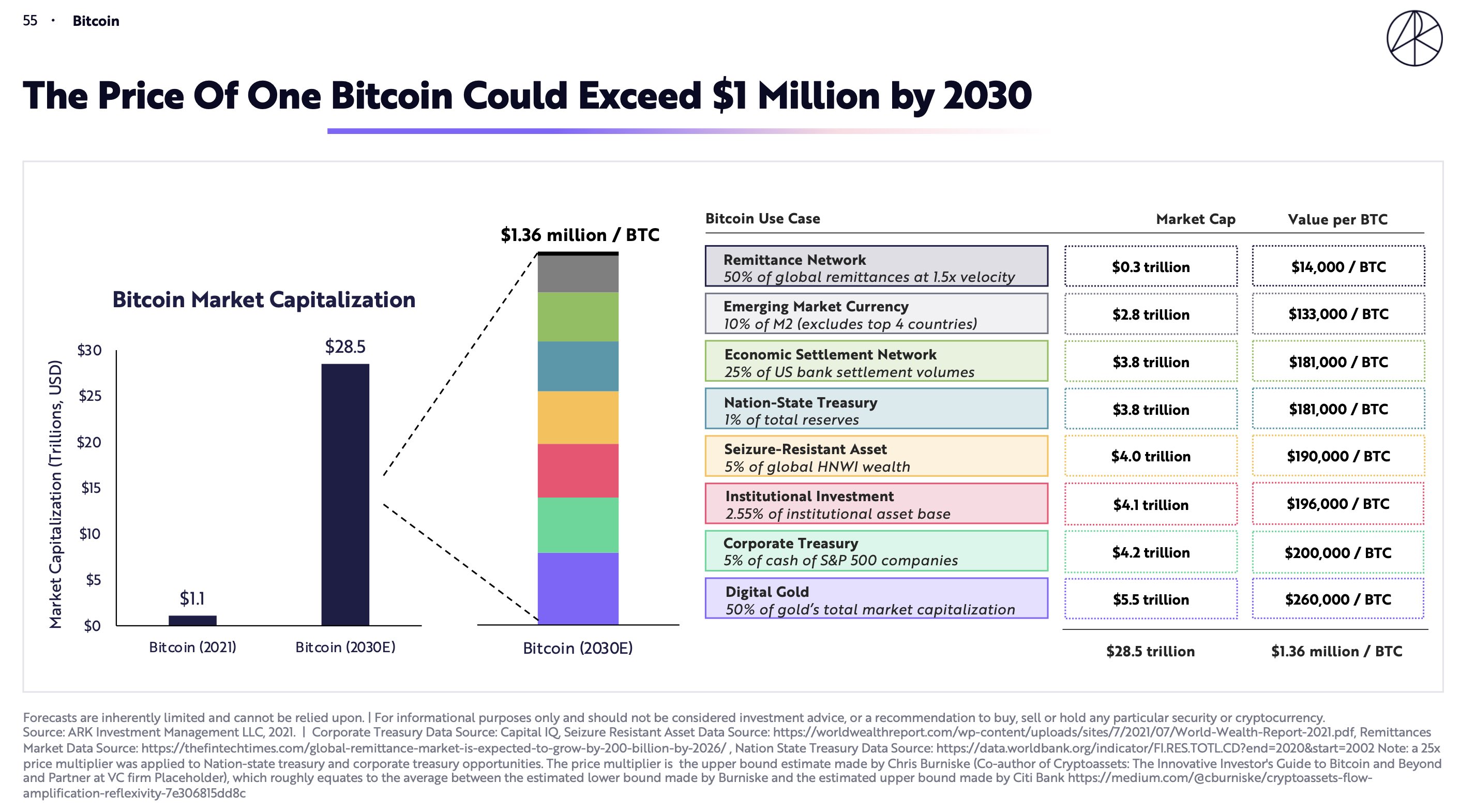 Perhaps more than any of these takes, it is worth considering the current public perception of the technology as a money and store of value. This twitter thread from professional sportsman Saquon Barkley, to his half million followers on the platform, captures the mood. He is one of a handful of athletes now being paid directly in Bitcoin.
[“I want my career earnings to last generations. The average NFL career is 3 years and inflation is real. Saving and preserving money over time is hard, no matter who you are. In today’s world: How do we save? This is why I believe in bitcoin. Almost all professional athletes make the majority of their career earnings in their 20s. With a lack of education, inaccessible tools, and inflation, a sad yet common reality is many enter bankruptcy later on. We can do better. We need to improve financial literacy. Bitcoin is a proven, safe, global, and open system that allows anyone to save money. It is the most accessible asset we’ve ever seen.“] This ubiquity of access is what probably most distinguishes Bitcoin. Previously it could be argued that only the most wealthy could access the ‘means’ to store their labour without loss of value over time (through inflation). To be clear, inflation is an important part of the money system, somewhat within the control of the central banks, and approximate to taxation. It applies equally to all holders of the money supply. Asserting that money should be replaced by a ‘hard asset’ such as Bitcoin, in the place of the more controllable utility of money, is likely both a fantasy, and wrong minded. This conflation of money and property is a confusion caused by Bitcoin’s proximity to money, and it’s ‘money like’ network, and is extremely commonplace.
These narrative takes are all rooted in the popular idea that Bitcoin is a ‘hedge against inflation’; an increasingly fragile take, as the price plummets with global markets. The Bitcoin community seems somewhat confused about the nature of money, which is predictable because we can see in these sections that money is pretty confusing. Money is the fluid, elastic [123], and thin ‘working credit’ layer on top of historical human production, which provides transaction convenience, and tools for credit. Value is effectively swapped in and out of this layer through the actions of central banks, controlling inflation into acceptable margins. Simplistically this is done through manipulation of interest rates (the easiness of credit), quantitative easing (buying of assets) and quantitative tightening (selling of assets). To give a quick high level view of central bank activity we can use the PESTLE framework:
Political:
Perhaps more than any of these takes, it is worth considering the current public perception of the technology as a money and store of value. This twitter thread from professional sportsman Saquon Barkley, to his half million followers on the platform, captures the mood. He is one of a handful of athletes now being paid directly in Bitcoin.
[“I want my career earnings to last generations. The average NFL career is 3 years and inflation is real. Saving and preserving money over time is hard, no matter who you are. In today’s world: How do we save? This is why I believe in bitcoin. Almost all professional athletes make the majority of their career earnings in their 20s. With a lack of education, inaccessible tools, and inflation, a sad yet common reality is many enter bankruptcy later on. We can do better. We need to improve financial literacy. Bitcoin is a proven, safe, global, and open system that allows anyone to save money. It is the most accessible asset we’ve ever seen.“] This ubiquity of access is what probably most distinguishes Bitcoin. Previously it could be argued that only the most wealthy could access the ‘means’ to store their labour without loss of value over time (through inflation). To be clear, inflation is an important part of the money system, somewhat within the control of the central banks, and approximate to taxation. It applies equally to all holders of the money supply. Asserting that money should be replaced by a ‘hard asset’ such as Bitcoin, in the place of the more controllable utility of money, is likely both a fantasy, and wrong minded. This conflation of money and property is a confusion caused by Bitcoin’s proximity to money, and it’s ‘money like’ network, and is extremely commonplace.
These narrative takes are all rooted in the popular idea that Bitcoin is a ‘hedge against inflation’; an increasingly fragile take, as the price plummets with global markets. The Bitcoin community seems somewhat confused about the nature of money, which is predictable because we can see in these sections that money is pretty confusing. Money is the fluid, elastic [123], and thin ‘working credit’ layer on top of historical human production, which provides transaction convenience, and tools for credit. Value is effectively swapped in and out of this layer through the actions of central banks, controlling inflation into acceptable margins. Simplistically this is done through manipulation of interest rates (the easiness of credit), quantitative easing (buying of assets) and quantitative tightening (selling of assets). To give a quick high level view of central bank activity we can use the PESTLE framework:
Political:
- [[—] ] Government policies and regulations can impact central banks by influencing monetary policies. - [[—] ] Political stability and government credibility can impact the confidence in central banks and currency. Economic:
- [[—] ] Economic growth and inflation rates influence central bank decisions on monetary policy. - [[—] ] The level of debt and balance of payments can impact a central bank’s ability to control monetary policy. Sociocultural:
- [[—] ] Consumer behavior and demographics can influence demand for money and credit. - [[—] ] Attitudes towards saving and borrowing can impact the economy and central bank decisions. Technological:
- [[—] ] Technological advancements can change the way money is distributed and managed, such as the increasing use of digital currencies. - [[—] ] Technology can also influence the accuracy of economic data, affecting the decisions of central banks. Legal:
- [[—] ] Central banks are subject to laws and regulations, such as those related to banking and finance. - [[—] ] Changes in laws and regulations can impact central bank policies and operations. Environmental:
- [[—] ] Environmental factors, such as natural disasters, can affect the economy and central bank decisions. - [[—] ] The focus on sustainability and reducing carbon emissions can impact the decisions of central banks. Fiat money is primarily [not] a long term store of value, as Austrian economists perhaps believe it should be. This function is left to assets. The Austrian thesis of ‘hard money’ (which cannot be ‘debased’ by government action) seems somewhat naive when one considers that if credit exists anywhere in the world (ie, the creation of paper money through loans) then this would be used to buy up a hard money asset in the long run, causing a scarcity crisis. This is what happened to gold in the middle of the last century. Fundamentally, Bitcoin isn’t money (in the traditional sense) because it’s not an IOU, which money certainly is. It’s a bearer instrument, novel asset class, with money like properties, as identified above. As said again and again it functions most like a ‘property’ which can be invested in by anyone, with all the attendant risks of that property class to the holder. Lyn Alden says it sits somewhere between a saving tool, and an investment, acting as “programmable commodity money”. Andrew M. Bailey says [“in an ideal world where governments honour the rights of citizens, they don’t spy, they don’t prohibit transactions, they manage a sound money supply, and they make sound decisions, the value of bitcoin is very low; we’re just not in an ideal world”] Another potentially important differentiating affordance is censorship resistance. There’s really nothing else like it for that one feature. With that said Bitcoin is only a viable ‘money like thing’ when viewed in the layers described in this book, and elsewhere[124]. The base chain layer is an apex secure store of value. Whatever layer 2 ultimately emerges is the transactional layer which could replace day to day cash money, while the hypothetical layer 3 might be useful for complex financial mechanisms and contracts operating automatically, and also provides the opportunity for using the security model of the chain to support other digital assets, including government currencies through stablecoins. All these things have a natural home in borderless social spaces. Special thanks to economist Tim Millar for help with this section.
Geopolitics
It can be seen that following the invasion of Ukraine by Russia, that sanctions of various kinds were applied to the Russian economy. One of these was the previously dicussed Swift international settlement network. Another whole catagory was the removal of support by private businesses domiciled outside of Russia and Ukraine, and pertinent here is that VISA, Mastercard, Paypal, and Western Union all removed support for their product rails. This means that while some cards and services still work, and will likely work again through Chinese proxies in the coming months, considerable disruption will be felt by Russian companies and individuals. This is not to say that this disruption is necessarily wrong, but it is clear now that all of these global financial transfer products and services are contingent on political factors. The same might be true of CBDC products if they gain traction globally. There is certainly no reason why all money within a physically delineated border could not be blocked or cancelled. This is not as true for Bitcoin at this time. However, with enough political will it is technically plausible to incentivise miners with additional payments to exclude transactions from geolocated wallets. This would be mitigated by Tor, and in a global anonymous network it is very likely that a miner could be found at a higher price for inclusion in the next block. We have already seen much negative political positioning related to the energy concerns in an earlier chapter. There are similar noises coming from policy makers with regard to the money utility of the technology. The United Nations have made the following recommendations: [“Developing countries may have less room to manoeuvre, yet the regulation of cryptocurrencies is possible. The following policies, among others, have the potential to curb the further spread of the risks of cryptocurrencies and stablecoins:] [Ensuring comprehensive financial regulation, through the following actions:]
- [[—] ] [Require the mandatory registration of crypto-exchanges and digital wallets and make the use of cryptocurrencies less attractive, for example by charging entry fees for crypto-exchanges and digital wallets and/or imposing financial transaction taxes on cryptocurrency trading;] - [[—] ] [Ban regulated financial institutions from holding stablecoins and cryptocurrencies or offering related products to clients;] - [[—] ] [Regulate decentralized finance (such finance may, in fact, not be fully decentralized, given its central management and ownership, which form an entry point for regulation);] [Restricting or prohibiting the advertisement of crypto-exchanges and digital wallets in public spaces and on social media. This new type of virtual, and often disguised, advertisement requires policymakers to expand the scope of regulation beyond traditional media. This is an urgent need in terms of consumer protection in countries with low levels of financial literacy, as even limited exposure to cryptocurrencies may lead to significant losses;] [Creating a public payment system to serve as a public good, such as a central bank digital currency. In the light of the regulatory and technological complexity of central bank digital currencies and the urgent need to provide safe, reliable and affordable payment systems, authorities could also examine other possibilities, including fast retail payment systems.] This is tough talk. We have seen that the IMF is willing to make their loans contingent on such regulation, and are increasingly talking about banning the technology. This global response to the technology is a significant headwind, but like the internet itself, it’s very hard to actually stop these products being used.
Capture by traditional finance
As the popularity of Bitcoin continues to grow, traditional financial market incumbents have begun to take notice. In an effort to assert their dominance and protect their interests, these incumbents have turned to regulation and acquisition as means of capturing the growing markets. This is most clear in the ‘alt coin’ space where traditional banks have leveraged their knowledge and marketing to transfer money from retail investors into their own venture capital operations. This is not to say that Bitcoin is immune from these harms. One way that traditional financial market incumbents have sought to capture the bitcoin market is through the use of regulatory frameworks. By working with government agencies (as described in previous chapters), to develop and implement regulations governing the use and trade of cryptocurrencies, these incumbents are able to limit competition and control the flow of capital into and out of the markets. They are also able to “print paper bitcoin”, running a fractional reserve operation, as happened in the FTX/Alameda fiasco. We have already described how, in the United States, the Securities and Exchange Commission (SEC) has implemented regulations governing the issuance and trading of bitcoin-based securities. These regulations, which require issuers of bitcoin-based securities to register with the SEC and comply with a variety of reporting and disclosure requirements, have effectively made it difficult for small and independent players to enter the market. Another way that traditional financial market incumbents have sought to capture the bitcoin market is through the use of partnerships and acquisitions. As the newer companies stumble and fail as a result of poor risk management and over-leverage it seems that Wall Street incumbents like Goldman Sax are taking advantage of the opportunity at structural scale. By acquiring existing crypto companies, these incumbents are able to gain access to the technology, expertise, and customer base of these companies, giving them a significant advantage over their competitors. For example, in 2017, the Chicago Mercantile Exchange (CME) partnered with the CBOE to launch bitcoin futures trading. This partnership allowed the CME and CBOE to tap into the growing market for bitcoin derivatives, while also providing a means for traditional financial market participants to gain exposure to bitcoin without having to hold the underlying asset. This is a crucial risk to the emerging technology as ownership of the underlying asset (self custody) was supposed to be the whole point of the technology. Ben Hunt of epsilon theory recently said: [“..if you don’t see that the crypto quote-unquote industry has become just as blindingly corrupt as the traditional Financial Services industry it was supposed to replace well you’re just not paying attention what made Bitcoin special is nearly lost and what remains is a false and constructed narrative that exists in service to Wall Street in Washington rather than in resistance; the Bitcoin narrative must be renewed and that will change everything”]
Liquidity Lottery
Because holders of BTC are disincentived to sell the asset (assuming future gains) it is likely vulnerable to something Kao called the ‘liquidity lottery’. This is a supply/demand mismatch which he thinks could spell the end of the asset class in time. Macro analyst group ‘Doomberg’ believe that this mispricing of the asset is the significant risk, and point out that if Bitcoin is approached within the framework of government controlled Fiat, then there is no ‘there there’. Bitcoin does not generate more fiat money within it’s ecosystem (as say an energy extraction company would), and as such is very suggestive of the features of a Ponzi. They have recently softened on this view, and are now clear to separate Bitcoin from the wider ‘crypto’ world, which they remain convinced are simply scams, wash trading magic beans without any productivity. The value is dependent on finding the ‘greater fool’ mentioned near the start of the book. Doomberg assert that the price of the asset has been inflated by manipulation in the unregulated stablecoin markets (specifically Tether), and in the event of a ‘run for the exits’ there would be a serious repricing. This seems entirely possible, and perhaps even likely, below an unknown threshold of confidence. They are now asserting that if the manipulation and mispricing could be ‘washed out’ of Bitcoin then it would present an investment opportunity, and they estimate that price at around $3000. We think that the combination of global speed of exchange of value, generative AI, and bots which leverage the network to create value within the ecosystem of the network, that this thesis does not stand true, but there is no way to know for sure at this time.
Manipulation of price or the network
Bitcoin is still young and illiquid enough to be highly manipulable. Imagine for instance if a major organisation or nation state wished to accumulate a significant amount of the asset, but would prefer a lower price. There is an unknown level of exposure to risk from centralised mining. If a few of the major mining pools were simultaneously infiltrated by a nation state actor then it might be possible to engineer a ‘deep re-org’ of a large transaction. This would be dealt with quickly and almost certainly be a transient attack, but the damage to the narrative might be substantial. The proposed solution to this known vulnerability is called ‘Stratum V2’ in which the transaction in the blocks would be organised by pool miners or their delegates, with an increase in efficiency as a driving incentive. A similar vulnerability exists in the centralisation at the level of internet service providers [84]. This or some other flaw might lead to a selling cascade. Nobody knows just how vulnerable to selling cascades Bitcoin might be against a really serious challenge by an empowered actor, but it’s already high volatility is suggestive of risk.
Rehypothecation
It’s vulnerable to rehypothecation (paper bitcoin managed by centralised entities running a fractional reserve). It seems that Figure 4.6 by Nassim Taleb is a cautionary tale [125].

Scale
Scalability is always going to be a problem for Bitcoin, for all the reasons discussed in the blockchain chapter. There is no “ready to go” solution (except perhaps federations) that could onboard the whole world at this time because of the limited number of available UTXOs. Finally, a lack of fungibility, and privacy by default in Bitcoin, trends towards blacklists and over time this could seriously compromise the use of the asset.
Centralisation of the money over time
In a medium term future it’s possible to imagine a smart enough autonomous AI or ML actor managing to accrue Bitcoin through fast and smart ‘decisions’. This could unreasonably centralise the asset, and it would be impossible to claw this situation back. These constructs would last for the lifetime of the chain unless constrained by timelock multisigs for instance. This section is the risks that Bitcoin poses to external money systems, but it’s worth pointing out that a risk to wider society is clearly [also] a risk to Bitcoin itself.
Inherent volatility
One of the better public analysts of the asset, sees the price eventually fluctuating somewhere between $700k and $300k. Figure 4.7. This is not how a money is supposed to work.
![Figure 4.7: Cycle theory revisited blog post [Image used with permission]](../assets/DaveTheWave.jpg) Neither though is it the endless “number go up” that speculators have been promised. The aims of the project have a cognitive dissonance right at the core. The volatility trends toward:
Neither though is it the endless “number go up” that speculators have been promised. The aims of the project have a cognitive dissonance right at the core. The volatility trends toward:
Unfair distribution
By design the distribution of Bitcoin is likely ‘fair’, in that everyone has been able to access and secure the asset long term without prejudice. Figure 4.8 from Twitter user @Geertjancap shows the distribution in 2021. Whether this is judged to be fair if the asset jumps to 10 times it’s current value, minting a new class of hyper rich holders, is another matter.
![Figure 4.8: Bitcoin distribution is skewed to s few early holders, but it likely [is] fair. [Image used with permission]](../assets/btcdistribution.jpg) This pressure to emulate the early winners leads to:
This pressure to emulate the early winners leads to:
Endless HODL
It’s possible that there’s a problem with people not wanting to sell the asset, because they are predisposed to a particular fervour promoted within the community. This can be seen in the glassnode data, where the black line in Figure 4.9 shows that the asset held for more than a year (illiquid) has increased over the years.
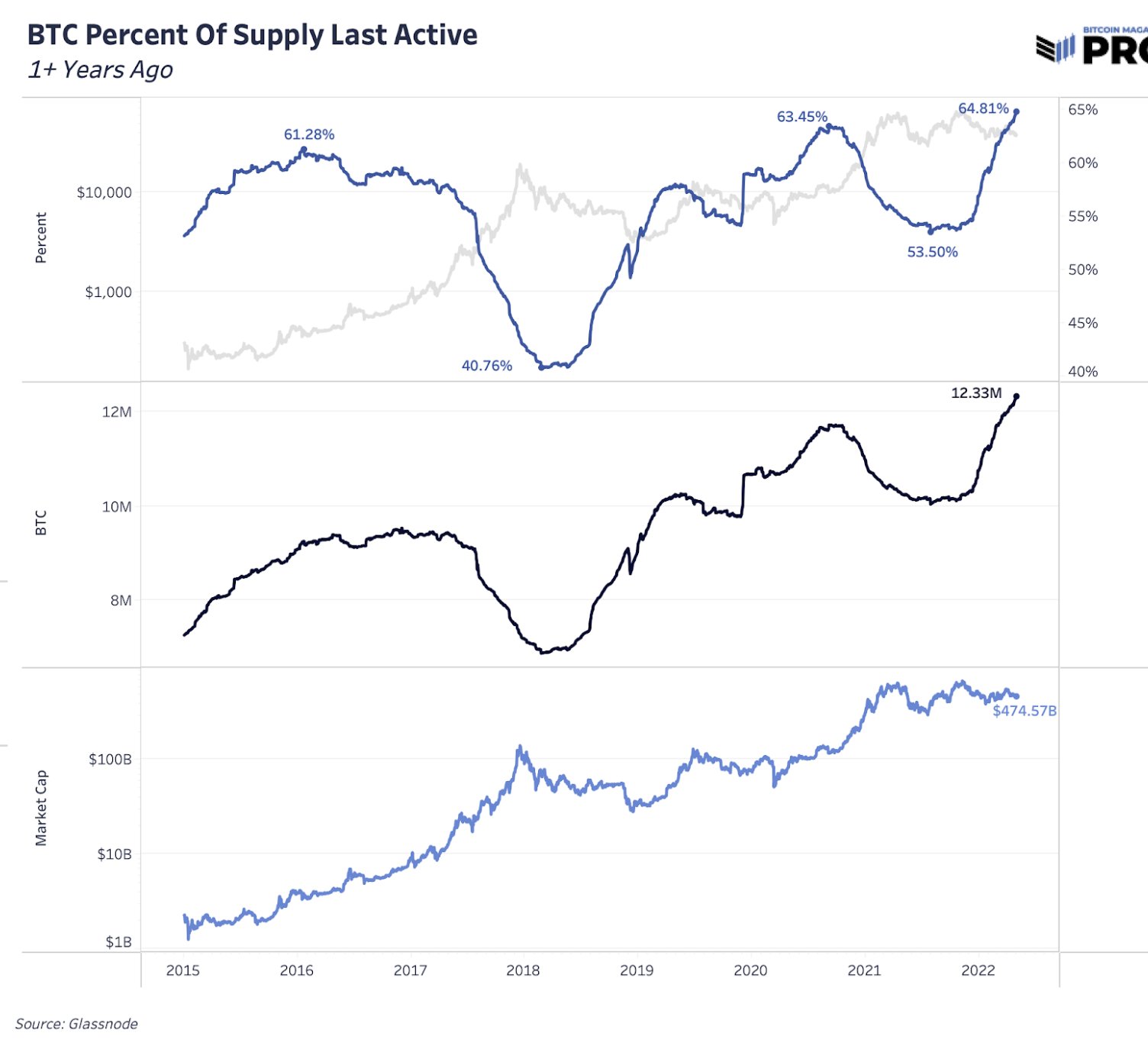 There’s real recalcitrance about using the asset as a money, which potentially negatively impacts the security model [67] and leads to:
Reduction of funding source / liquidity in legacy finance
In the current financial system remuneration for labour performed in the workforce is loaned into the money system, where it’s put to work providing liquidity for creation of more opportunity. This system actually works pretty well. The more of this deferred labour that’s taken out of the legacy system, the less work can be done with what remains. This isn’t to say that Bitcoin will cause a liquidity crisis, but there is possibly a cost if the current trend continues. This isn’t as bad as:
Bitcoin collapse system shock
In the event of an existential collapse of the Bitcoin network the erasure of so much capital would certainly have a contagion effect on the whole global financial system. It’s hard to imagine what such an event could be, this being the nature of “black swans”. One cited example is the unravelling of cryptography by quantum computing. Some conspiracy theorists in the past have even speculated that Bitcoin is itself a canary in the coal mine, engineered by the NSA to warn about emergent quantum computing somewhere in the world. It’s all pretty silly because without cryptography Bitcoin would be the least of humanities problems. The risk of ‘something’ does exist though. The same anti-fragile feature can’t be said about the technologies around Bitcoin, which gives us:
Stablecoin collapse system shock
This is much more likely. Stablecoins are under regulated, centralised, under collateralised, ponzo like structures, which could quite clearly fall apart at any point. The contagion effects of this are unclear as they’re not yet too significant. They’re a risk nontheless, and may be an indicator of:
Tech for techs sake yielding unexpected outcomes
The whole question of what Bitcoin addresses, whether it’s been properly thought about, what the end goals are, and what the risks are is significant. It’s a computer science and engineering solutions gone completely wild. It’s clearly got benefits and there’s clearly human appetite for this technology, but it’s probably running ahead of the knowledge base around it. This is most exemplified in:
No agreed measurable end goal
Bitcoin is a game theoretic juggernaut, where success of the network breeds more success for the network. The was obviously a great design choice for the computer scientists trying to solve the problem of a secure, and scalable, electronic cash, which couldn’t be confiscated. Ironically for a global consensus mechanism it seems that nobody wants to discuss what constitutes a successful end point to this, and especially not what ‘successful’ endpoints for the game theory which have calamitous negative repercussions for wider society look like [126]. This might have implications for:
National security / actual warfare
There’s some national security implications for Bitcoin which are discussed both in the fringes and the sector media. Essentially, the industrial mining complexes which are more commonplace now, are easily identifiable targets, and provide nations with both some leverage over the global network, and a considerable source of income. The IMF correctly identifies these facilities as a way for nation states to monetise their energy reserves without the need for foreign markets, opening the door to sanction avoidance. In the case of smaller and developing nation states who are perhaps subject to financial penalties on the global stage for whatever reason, these facilities start to look like legitimate targets for cyber and conventional warfare. Lowry explain the potential strategic importance of Bitcoin in Softwar [33], though to be clear his motives are unclear and his thesis is neither peer reviewed nor publicly accessible. This ‘weaponisation’ of a neutral technology is already manifest in:
Bitcoin as a culture war foil
Bitcoin’s online community skews very hard toward right wing libertarianism. This isn’t to say there are no other voices, but they are certainly outnumbered. This imbalance is almost certainly a product of the ESG concerns around the technology. There has been a notable increase in diversity of thought since the evolution of the energy narrative, but it persists. This leads to a paucity of voices in policy making circles, and in the USA a strong delineation between policy makers along party lines. This kind of thing tends to be self reinforcing, and it seems very possible that the global liberal left will swing mainly against the technology, while the neoliberal right will be attracted more to it. As tensions increase so it seems does the online rhetoric. Even scientists now seem to agree that Bitcoin investors are calculating psychopaths [127]. This leads to:
Self reinforcing monocultures
There are some powerful ‘pockets’ of fringe thinking within the vocal, online, Bitcoin communities. The most palatable of these are figures like Michael Saylor, Elon Musk and Jack Dorsey, but there’s whole subcultural intersections around antivax, anti-woke, anti cancel culture, and fad diets. These are the so-called “toxic maximalists”. There are a disproportionate number of adherents of the failed global “neocon” experiment [128], and not a few outright bigots. Lopp’s list linked above is an amusing roundup: Overt Christian moralizing “Have fun staying poor” retorts Rejection of seed oils and sunscreen Vaccine conspiracies, alt-health cure-alls Contrarianism for the sake of contrarianism Political populism and support of strongmen “Fiat” criticism of contemporary art and architecture As Lopp himself points out, it’s not that these things are necessarily wrong or bad, but more that adherence to the set became a purity test for the whole space. It might seem that this isn’t terribly important, but Bitcoin viewed though the lens of these of these communities looks pretty strange to the newcomer. The early adopters are just using their wealth to leave the battlefield behind using:
Jurisdictional / legislative arbitrage
The reach of Bitcoin and it’s ability to undercut the global money systems, delivering savings for those with a first mover advantage, and the current paucity of agreed legislation has set up an interesting and rare condition. Bitcoin encourages something called jurisdictional arbitrage; the race to take advantage of the variance in national approaches to the asset class. This section could perhaps be explored as a list of opportunities, but from the viewpoint of our SME business use case it’s far more likely that these destabilising ‘features’ are risks: [Difference in ‘crypto’ profit models] . Countries and jurisdictions can apply different charges for use of trading platforms and capital gains tax enjoys huge variance. Some countries are now competing to offer zero tax as a way to attract valuable tech mind share. [Income tax] is harder to monitor in a truly international context. This is variously pitched around the world. It’s hard to monitor this stuff and tax at source like with company employees wages, because it’s basically designed to be hard to monitor. This results in: [Passport perks] . Countries are already selling residence and company rights against Bitcoin marketing. There’s a lot of new ways to buy passports and citizenship based on ‘inclusion’ in this community now. It’s a terrible look. The early adopters can live international jetsetter lifestyles and ca benefit from: [Business subsidies] such as those appearing in Switzerland, Hondoras, El Salvador, Africa etc. This means a new divide is emerging since some countries are in instead applying: [KYC/AML] rules which make onboarding into this technology harder. Currently there’s a trend toward globally capturing information about people buying these assets, but it’s effectively tech warfare now with engineers, rapidly producing tools to circumvent slow and varied legislation. The best example of this remains El Salvador, where Bitcoin is legal tender, and has perhaps kickstarted: [Bond issuances] . El Salvador are having a faltering start to their promised bond issuance. It might be that all of this is a harbinger of the rise of: [The Network State] is a proposal by Srinivasan [129]. His is a transhumanist thesis which he describes: [“The fundamental concept behind the network state is to assemble a digital community and organize it to crowdfund physical territory. But that territory is not in one place --- it’s spread around the world, fully decentralized, hooked together by the internet for a common cause, much like Google’s offices or Bitcoin’s miners. And because every citizen has opted in, it’s a model for 100% democracy rather than the minimum threshold of consent modeled by 51% democracies.“]
Hyperbitcoinization
All of the above starts to look like Convergence on something the crypto community regularly describes to itself within it’s internal media. Hyperbitcoinization is a term coined in 2014 by Daniel Krawisz [130]. It is the hypothetical rise of Bitcoin to become the global reserve currency, and the demonetisation of all other store of value assets. This seems unlikely but is hinted at in a game theoretic analysis of both Bitcoin and current macro economics. Again, Bitcoin is a likely very poor replacement for money. The ability to monetise assets through banks, backed by law and contracts (the debt based system), is a highly refined human concept, while Bitcoin is a fusion of Austrian economics, and a computer science project. The hyperbitcoinization idea finds it’s ultimate expression in Svalholm’s “Everything Divided by 21 Million”, a hypothetical re-accounting of all human production into the Bitcoin ledger [131]. Nobody is sure what a regular deflationary cycle might do to global supply chains. Malherbe et al. point out the inherent unsuitability of a deflationary asset such as Bitcoin as the global reserve currency [132] and feel that perhaps other cryptocurrencies might be more suitable for adoption by governments. Interestingly this is the only paper to reference ‘Duality’ (the only thing purportedly written by Satoshi Nakamoto after they left the project). Writer and activist Cory Doctorow is not a fan of Bitcoin. He provides an excellent summary of what he sees as the basic societal mistake of the libertarian ideals around strong property rights and hard money. In a hyperbitcoinised world where debt law would be enforced by distributed code, it might be far harder to prevent the “fall of Rome” scenario he describes. It is notable that he is also strongly opposed to the current hype in AI and it’s possible this is just his stock in trade. Fulgur Ventures (a venture capital firm) provide a blog post series about the route this might take. It’s important to note that Budish suggested that the usefulness of Bitcoin (and blockchain) cannot exceed the cost to attack it. The is highly suggestive that hyperbitcoinisation is impossible [133]. It’s beyond the scope of this book to look at the implications of all this. DeFi is decentralised finance, and might only exist because of partial regulatory capture of Bitcoin. If peer-to-peer Bitcoin secured yield and loans etc were allowed then it seems unlikely that the less secure and more convoluted DeFi products would have found a footing. DeFi has been commonplace over the last couple years, growing from essentially zero to $100B over the last two or three. It enables trading of value, loans, and interest (yield) without onerous KYC. If Bitcoin’s ethos is to develop at a slow and well checked rate, and Ethereum’s ethos is to move fast and break things, then DeFi could best be described as throwing mud and hoping some sticks. A counter to this comes from Ross Stevens, head of NYDig who says [“The concept of decentralized finance is powerful, noble, and worthy of a lifetime of focused effort.”] . This may be true in principle, but certainly isn’t the case as things stand. According to a recent JPMorgan industry insider report, around 40% of the locked value on the Ethereum network is DeFi products. It is characterised by rapid innovation, huge yields for early adopters, incredibly high risk, and a culture of speculation which leads to products being discarded and/or forked into something else in the pursuit of returns. Ethereum also allows miners of the blockchain to cheat the system [134]. Much of the space is now using arcane gamification of traditional financial tools, combined with memes, to promote what are essentially pyramid schemes. Scams are very commonplace. Loss of funds though code errors are perhaps even more prevalent. The Bank for International Settlements have the stated aim of supporting central banks monetary and financial stability. Their 2021 report on DeFi noted the following key problems. ..a “decentralisation illusion” in DeFi due to the inescapable need for centralised governance and the tendency of blockchain consensus mechanisms to concentrate power. DeFi’s inherent governance structures are the natural entry points for public policy. DeFi’s vulnerabilities are severe because of high leverage, liquidity mismatches, built-in interconnectedness and the lack of shock-absorbing capacity. These are two excellent and likely true points. European Parliament Vice President Eva Kaili made this same point at the World Economic Forum, so clearly regulators are aware of the lack of meaningful distribution in DeFi. In addition access to DeFi is ‘usually’ through web.0 centralised portals (websites) which are just as vulnerable to legal takedown orders as any other centralised technology. Given who the major investment players seem to be in this ‘new’ financial landscape it seems very likely that regulatory capture is coming. The seemingly unironic trend towards CeDeFi (centralised decentralised finance) illustrates this. With this said, it is notable that in the wake of the FTX debacle and unwinding of counter party risk across the whole extended ecosystem, it is DeFi which seems to have fared best, suggesting there might be a viable product here in the end. Circle and DeFi infrastructure lab Uniswap have recently published a paper which asserts that use of the technology could de-risk foreign exchange markets [135]. It feels regrettably close to the endless broken promises of ‘blockchain for remittance’ which have circulated for a decade [136, 137]. They estimate that it may be possible to cut the costs of cross border remittances by 80% This is a big claim and time will tell. There are more recent DeFi on Bitcoin contenders, but these are vulnerable to the same attacks and problems in the main. There is likely no use for this technology for small and medium sized companies on the international stage, at least until the proposed Forex integrations appear. It is far more likely that reputation would be damaged. It’s possible to get loans (by extension business loans) out of such systems at relatively low risks. The best ‘distributed’ example of this is probably Lend, at HODLHODL, which is a peer-to-peer loan marketplace. Atomic Finance leverages discrete log contracts amongst other more edge uses of Bitcoin, to provide financial services without custody of the users’ Bitcoin. It is possible to make the argument that between hodlhodl loans, taro asset issuance, boltz exchange, and lightning escrow that all of the “classes” of DeFi smart contract can be serviced already by Bitcoin alone, but this tech is fringe at best. Many more custodial options exist for loans (CASA, Nexo, Ledn, Abra etc). These might not really fit the definition of DeFi at all. Many of these centralised DeFi companies (CeDeFi) have imploded in the wake of the Terra/Luna collapse since they were generating yield from one another and ultimately Terra. The maxim seems to be that if you don’t know how the system is monetised then you are likely the product. As mentioned, DeFi itself weathered the recent market turmoil comparatively well and it’s possible that as these products evolve they may be useful to companies who have Bitcoin and stablecoins on their balance sheet long term. Dan Held maintains an online spreadsheet which compares these products. [\chapterimage] orange6.jpg In his latest book, Runciman, professor of Politics at Cambridge University, traces contemporary anxieties about artificial intelligence back centuries to the origins of the modern state and corporation. There are interesting an striking parallels between the apparatus of state, and the emergent field of AI. In the 17th century, Thomas Hobbes described the ideal state as a kind of “automaton”
- a human-made machine that could provide stability and security beyond fickle, emotional human politics. Later, the invention of the limited liability corporation allowed artificial entities to take on previously unthinkable risks and debts. Runciman argues that states and corporations function essentially as “robots”
- artificial, human-made creations constructed to make decisions and take actions. Much like our worries about AI today, these entities were designed to take over certain tasks and responsibilities from human hands. States and corporations have acquired immense, sometimes unchecked power, persisting and protecting themselves as emergent features of their creation. They remain fundamentally inhuman; they do not think, feel, or have a conscience as individual humans do. Runciman suggests that the story of the modern world is the story of handing over decision-making and control to these robots, AI and systemic alike. Today, our prosperity, health, and safety depend deeply on these state and corporate machines. Yet Runciman warns they could also lead to catastrophe if we fail to maintain control. Their vast powers, from mass surveillance to nuclear weapons, remind us of their inhuman, robotic nature. Runciman argues we must focus not just on regulating new AI, but on democratizing and improving oversight over existing state and corporate “robots” we rely upon daily. More transparency, public input, and innovation in governance is needed to retain human agency. Though we created them, these powerful machines can take on a life of their own. This chapter attempts to speak to these issues, and the wider global need to reassert control over the human condition. We will start by looking at global economics, then talk briefly about the global approaches to AI which are emerging, before exploring AI in detail in it’s own chapter. Malone, an ex central banking analyst now working in crypto, links across the last two chapters of blockchain, and money, in a Twitter thread. He believes that policymakers should focus on the underlying problems in the financial system, rather than just focusing on crypto. He has a lot of appreciation for US policymakers worrying about risk in the financial system. Crypto gets attention because it’s an easy target, but Malone believes that the real problems are so much bigger. According to Malone, people want to hold USD money to store value and make payments. Most are familiar with cash and bank deposits, but there’s actually a spectrum of assets of varying quality that act like money, as we saw in the previous chapter. These include Euro dollars, repo, commercial paper, and more. This is what people are talking about when they reference the shadow banking system
- money moving around the financial system outside of traditional banks, primarily in non-banks. As an aside, the name ‘euro dollar’ predates the Euro currency, and has nothing to do with it. The origins of the eurodollar market can be attributed to the Cold War in the 1950s. At that time, the Soviet Union and its Eastern European allies began depositing their US dollar holdings in European banks, primarily in London, to avoid the risk of their assets being frozen by the US government. These dollar-denominated deposits held outside the United States became known as eurodollars. Malone notes that some amount of shadow banking activity is good because it allows the money supply to be more reactive and expand and contract with economic activity, which helps fuel economic growth. However, the regulatory and political apparatus and the underlying systems weren’t really designed for a system this large, opaque, and multi-dimensional. This was seen in 2008 and 2009, which was as much about shadow banking and financial plumbing as it was about subprime housing and complex derivatives. The same was seen in 2020 with COVID-19. In times of crisis, people want to be able to freely convert whatever they are holding into something safer on the spectrum. Sadly, sometimes market liquidity isn’t there, so the central banks and come to save the day, and this kicks the can down the road. The core issue is that people an institutions want to store capital in places they can’t access due to technical, institutional, or geopolitical reasons. Sovereigns hold US treasuries, hedge funds and HRTs use repo, and we have seen that the crypto and Bitcoin economies have stablecoins. Since 2008 and 2009, the Treasury Market has gotten significantly larger, more fragile, and more complex. Banks have even more restrictions on creating deposits, and the demand for safe assets keeps skyrocketing. On top of that, the geopolitical landscape has changed dramatically, with US sanctions and seizure of Russian USD assets. Malone notes that crypto is a response to these underlying problems. Although it is not perfect, it is getting better as people learn from past experiences and begin to build regulatory clarity. This issue of regulatory clarity leads us into this section of the book, which looks are implicit or explicit corruption of governance. As a uueful example; The New York Magazine article provided an in-depth interview with Gary Gensler, the head of the Securities and Exchange Commission, in which he shared his thoughts on the cryptocurrency industry. One of the key takeaways was his belief that all cryptocurrencies, except for Bitcoin, should be considered securities, as they involve relying on the work of others to give them value. Gensler is an ex banker, and an ambitious politician, with his eyes on bigger prizes. He openly courted the attention of the now disgraced top team at FTX which failed so spectacularly. His assertions have sparked controversy, as it raises questions about the feasibility of registering all tokens as securities, given the unique challenges posed by open-source protocols and the changing nature of blockchain technologies. Critics argue that Gensler’s stance could harm innovation and capital formation, as companies and entrepreneurs may struggle to comply with onerous regulations or abandon their projects altogether. The current system simply doesn’t fit this new self forming marketplace, and his implication seems to be that the legal end game here is the destruction of the invested capital, because of non compliance. This has led to frustration and concern among crypto advocates and investors, who worry about the impact of such policies on the industry’s growth and development. The discourse should be on the much more fundamental questions of the monetary system and fragility of past assumptions and their ability to predict what comes next. Even as these conversations happen, however, the Bitcoin and stable coin builders will keep building because they are not going to sit around and wait for solutions to be presented to them.